Guide
Work Boot Size Chart: One Foot Length, Eight Makers' Sizes
By The Boot Yard editors · Updated 2026-11-08 · How we research
We may earn a commission when you buy through links on this page.
Short answer
Measure your longer foot from heel to longest toe in the afternoon, then read that length against each maker's own chart, not your sneaker size. The same foot can land on different sizes: at US men's 10, Ariat lists a 10 5/8 in foot and CAT lists 11 in. Use the converter below to see every brand at once.
Before you open any work boot size chart, measure your foot: tape a sheet of paper to the floor against a wall, stand on it in the socks you work in with your heel touching the wall, mark the tip of your longest toe, and measure from the wall to the mark. Do both feet and keep the larger number. Timberland, KEEN, Reebok Work and Ariat all publish this same paper-and-wall method on their size pages, and Thorogood adds two details worth copying: press the toes down gently before you read, and if you land between sizes, use the bigger one.
Measure later in the day if you can. CCOHS, Canada's occupational safety agency, tells buyers to try on new safety footwear around midday, because feet swell over a shift. A morning measurement taken barefoot can come out short against the foot you'll actually have at hour ten.
With that one number in hand, the converter below shows the US size each maker's chart gives for it. Every value comes from the maker's own published chart, read on 9 November 2026 and linked in the sources at the bottom of this page. The table further down shows why this matters: the makers don't agree on how long a size 10 foot is.
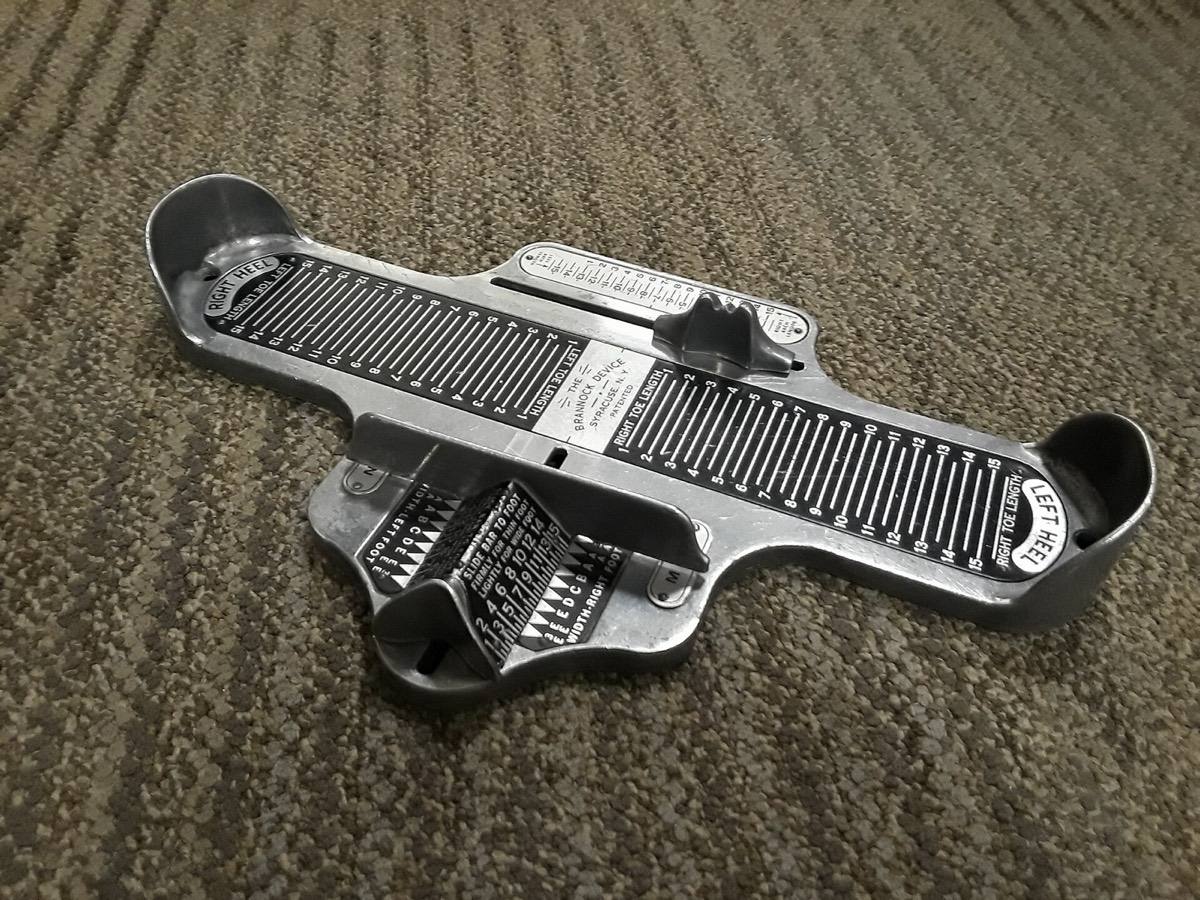
Pick the brand and size you wear now. We read your foot length from that maker's own chart, then find the closest size on every other maker's chart. Only makers that publish foot lengths are included.
Ariat men's US 10 = foot length 10 5/8 in / 27.1 cm on Ariat's chart.
| Brand | Closest US size | Their foot length | Chart |
|---|---|---|---|
| Carhartt | 10 | 10.6 in | source (2026-11-09) |
| CAT Footwear | 9 | 10 5/8 in · a full size or more from your size: makers may measure foot length differently, so read both charts before ordering | source (2026-11-09) |
| Irish Setter | 9 | 27 cm · a full size or more from your size: makers may measure foot length differently, so read both charts before ordering | source (2026-11-09) |
| KEEN Utility | 10 | 27 cm | source (2026-11-09) |
| Reebok Work | 9 | 10.6 in · a full size or more from your size: makers may measure foot length differently, so read both charts before ordering | source (2026-11-09) |
| Timberland PRO | 9 | 10.63 in · a full size or more from your size: makers may measure foot length differently, so read both charts before ordering | source (2026-11-09) |
| Wolverine | 9 | 10.63 in · a full size or more from your size: makers may measure foot length differently, so read both charts before ordering | source (2026-11-09) |
Charts map foot length to a size; they don't describe how a particular boot fits. Width letters and any fit notes are on each maker's page. Measure your foot late in the day in your work socks.
Specs are makers' published figures, linked on every card. Prices as of 2026-11-13; product prices and availability are subject to change. As an Amazon Associate we earn from qualifying purchases.
The same foot, eight different charts
Most people order work boots in their sneaker size and hope. Line up each brand's work boot size chart side by side and you can see why that's a gamble. For a US men's 9, 10 and 11, here's the length each maker prints. Where a maker publishes centimetres only, we show its centimetre figure rather than converting it, so you're reading the maker's number, not ours.
Look at the men's 10 column. Ariat and Carhartt put a size 10 foot at about 10.6 inches. CAT, Reebok Work, Timberland PRO and Wolverine put it at 11.0 inches. That gap of roughly three-eighths of an inch is close to a full size step on several of these charts. A foot that measures 10 5/8 inches is a 10 on Ariat's chart and a 9 on CAT's, where 10 5/8 inches is the listed length for a men's 9.
Reading the chart that way round, from your measured length to the size, is the whole trick. If your foot is 11 inches, Ariat lists that length at a men's 11, while CAT, Reebok Work, Timberland PRO and Wolverine list roughly that length at a men's 10. Neither is wrong. Each maker sizes its own lasts, and the chart is the only public statement of how.
A few caveats sit behind these columns. Wolverine and CAT head their length columns simply “Inches” and don't say whether that is foot length or the length of the last (the foot-shaped form the boot is built on), so treat them as each maker's reference length. Carhartt has no standalone footwear chart; its figures come from the Size & Fit panel on a boot product page and may not cover every Carhartt style. Ariat prints its women's sizes 7.5, 7.5 and 8.5 in its first three rows, so there is no women's 8 to quote. We copy charts as published rather than correcting them.
Both CAT and Wolverine label their unisex rows “US Unisex Size (Runs as Men's Sizing)”, so a woman ordering a unisex style from either brand should convert to men's first. Ariat's fit guide gives its own rule of thumb: “Women should size down 1.5 sizes in men's work boots. For example, a women's size 9 is typically a men's size 7.5.” Reebok Work's women's chart uses the same inch values as its men's chart offset by two sizes, which is a different offset from Ariat's. That's another reason to work from length, not from a conversion rule.
| Maker (chart) | Men's 9 | Men's 10 | Men's 11 | Women's 8 |
|---|---|---|---|---|
| Ariat (unisex work footwear) | 10 3/8 in / 26.2 cm | 10 5/8 in / 27.1 cm | 11 in / 27.9 cm | not printed (rows read 7.5, 7.5, 8.5) |
| Carhartt (Size & Fit panel) | 10.3 in | 10.6 in | 10.9 in | 9.5 in |
| CAT Footwear (universal chart) | 10 5/8 in / 27 cm | 11 in / 28 cm | 11 3/8 in / 29 cm | 9 7/8 in / 25 cm |
| Irish Setter (cm only) | 27 cm | 28 cm | 29 cm | 25 cm |
| KEEN (heel-to-toe, cm) | 26 cm | 27 cm | 27.9 cm | 24.1 cm |
| Reebok Work (heel-toe, in) | 10.6 in | 11.0 in | 11.4 in | 9.4 in |
| Timberland PRO (PRO footwear tab) | 10.63 in / 27 cm | 11.02 in / 28 cm | 11.42 in / 29 cm | 9.5 in / 25 cm |
| Wolverine (universal chart) | 10.63 in | 11.02 in | 11.42 in | 9.84 in |
Width letters: what each maker actually publishes
Length is only half of it. Width is where most work-boot returns start, and here the makers are even less consistent, because there is no single width scale that every brand prints. The letters below are copied from each maker's own size page or from the product pages in our catalogue. Where a maker doesn't publish what its letters mean, we say so instead of guessing.
Ariat is the most explicit. Its size guide says its widths are “approximately 1/6 of an inch” apart, and that “For men, B is Narrow, D is Standard, EE is Wide, and EEEE is Extra Wide. For women, B is Standard and C is Wide.” It also warns that “Available widths vary by style”, which is true of every brand: a maker offering EE in one boot doesn't mean the boot you want comes in EE.
Other makers use words or their own codes instead of letters. Wolverine sells men's boots in M (medium) and EW (extra wide). KEEN Utility labels its options Regular and Wide. Skechers says its “Men's Wide Fit is equivalent to Men's 2E / 3E sizes” and its “Women's Wide Fit is equivalent to Women's W or D width.” Brunt ships boots in Regular (D) and says removing a grey insert under the insole takes them to a wider EE fit. Carolina's 28 Series 6-inch composite boot is listed in D, 2E and 4E, and Reebok Work's Sublite Cushion alloy-toe shoe in M, W and 4E. 2E and EE are the same width written two ways.
Thorogood's printed chart has one instruction that runs against instinct: “Read the width on the right side of your foot. Do not allow for additional room. Boots are built with extra room.” In other words, don't size up in width just to be safe. Read what the measurement says, then order that width if the boot comes in it.
- Ariat: men B / D / EE / EEEE; women B / C (Ariat size guide).
- Wolverine: M and EW on its men's boots; M and W on the women's Floorhand (product pages).
- KEEN Utility: Regular and Wide (product pages).
- Skechers: Wide = men's 2E/3E, women's W/D; EWW marks its Extra Wide Fit collection (Skechers size chart).
- Brunt: ships D; remove the insert for EE (Brunt help centre).
- Thorogood American Heritage: D and EE (product pages).
- Carhartt, CAT, Irish Setter, Timberland PRO, Reebok Work: no width chart on the size pages we read; check the width selector on each product page.
Toes hitting the cap? Size the toe box, not the shaft
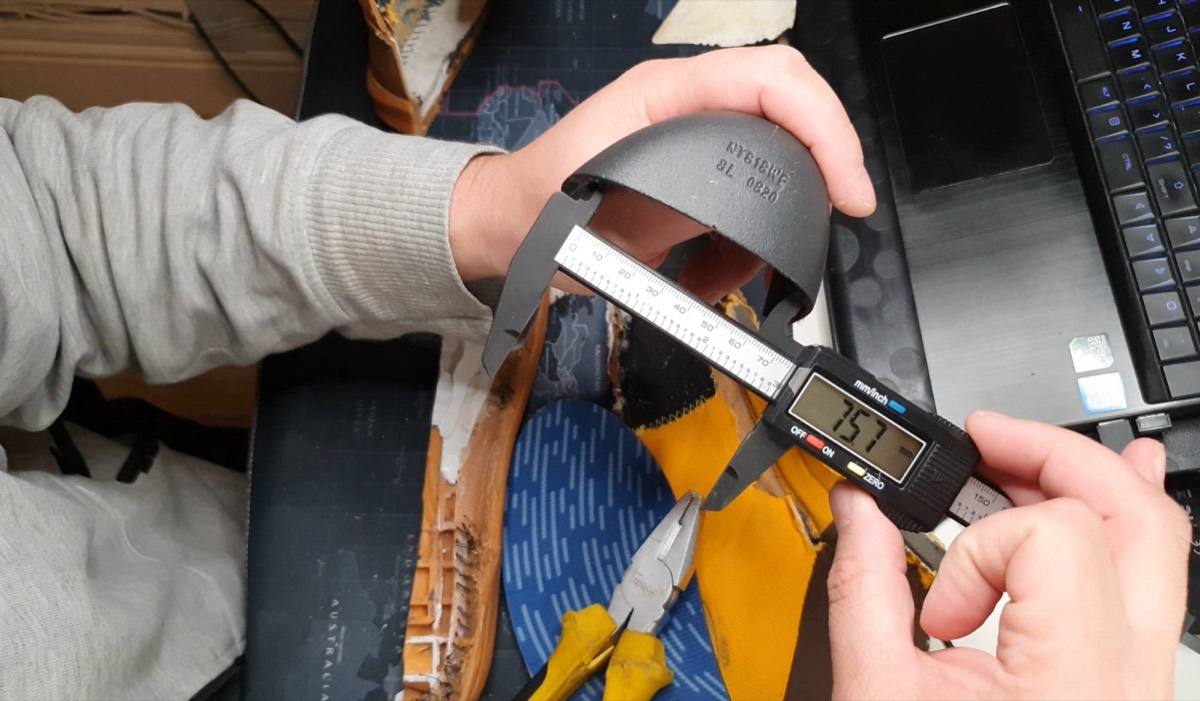
The most common sizing complaint on safety boots is pain at the tips or tops of the toes, and it has a cause a regular boot doesn't: the safety cap is a rigid shell. Leather stretches; a steel, alloy or composite cap does not. Ariat says it directly: “Remember that the toe box won't stretch over time, so it's important to have enough room for the widest part of your foot from the start.” CCOHS says the same in fewer words: “Do not expect footwear to stretch with wear.”
So the fit test for a safety boot happens at the front. Thorogood's guidance is that “Your toes should have about half an inch of room in front of them so your toes aren't completely pressed against the front of your boots, but they shouldn't slide forward as you walk and hit the front of the toecap.” CCOHS puts the gap at “about 12.5 mm”, which is the same half inch. Ariat adds the side-to-side check: wiggle your toes, and “you do not want to feel any tightness or pinching in the toe box.”
Should you size up? The makers don't agree, and we won't pretend they do. Wolverine says its products “tend to fit true to size” and recommends “sizing up to the next whole size if a half size is not offered.” Ariat says to stick to your standard size, but that with steel-toe boots “you may need to go half a size up for extra comfort.” Thorogood's sizing page tells readers to “always size up to account for socks!” Xena Workwear says its safety boots “fit either true-to-size or 1/2 size small depending on your selected model”, and flags individual styles, such as the Vega, as running half a size small. Brunt says most of its boots “run true to your typical boot size.”
The practical reading: measure, take the chart size for your length, and only go up if the maker itself says that style runs small or the toes touch the cap when you stand. Going up a full size to relieve toe pressure moves the cap forward, but it also lets your heel lift. Thorogood's test for a boot that's too big is exactly that: “your heel comes up as you step forward.” If your toes hit the top of the cap rather than the end, the problem is toe-box height or width, and a wider fitting, or a different toe shape, is the fix, not a longer boot.
Order online without guessing: a five-step check
A work boot size chart gets you close; a few checks before and after the box arrives get you the rest of the way. Fit is also a safety point, not only comfort: OSHA's general-industry PPE rule tells employers to “Select PPE that properly fits each affected employee” (29 CFR 1910.132(d)(1)(iii)), and the construction rule gained the same wording in December 2024 (1926.95(c)(2)). A boot that slides or pinches is a boot people take off.
Most makers make returns possible only on unworn boots. Timberland allows returns within 30 days for size or fit “as long as they're unworn, unwashed, unaltered, and undamaged”, and Red Wing's online chart carries a similar 30-day line. That means the try-on happens indoors, on carpet, before the boots ever see a job site. Xena suggests wearing new pairs at home for two to four days to confirm the size, and notes the footbed settles and the leather gives during that time. Check each maker's current return terms before you wear them outside.
- Measure both feet in work socks, late in the day, and keep the longer measurement.
- Find that length on the chart of the brand you are buying (use the converter above), not on a generic shoe chart.
- Check the width options on the product page itself; the letters differ by maker and by style.
- When the boots arrive, stand and check for about half an inch in front of the longest toe and no pinching across the toe box; walk on carpet and watch for heel lift.
- If the toes touch the cap, exchange for the next size or a wider fitting before wearing them outside; do not plan on the cap stretching.
Questions people ask
- Are work boot sizes the same as sneaker sizes?
- Not reliably. Each maker's work boot size chart publishes its own length per size, and those lengths differ. At US men's 10, Ariat lists a 10 5/8 in foot while CAT, Timberland PRO and Wolverine list about 11 in. Measure your foot and read the chart of the brand you're buying rather than assuming your sneaker size carries over.
- Should I size up in steel toe boots?
- Only if the maker or the fit says so. Wolverine says its boots tend to fit true to size, Ariat says steel-toe buyers may need half a size up, Thorogood tells readers to size up for socks, and Xena flags specific styles that run half a size small. Aim for about half an inch in front of your longest toe with no pinching and no heel lift.
- How much room should be at the toe of a work boot?
- About half an inch. Thorogood says about half an inch so your toes aren't pressed against the front but don't slide into the toecap as you walk; CCOHS gives about 12.5 mm, which is the same distance.
- How do I convert women's to men's work boot sizes?
- Use foot length rather than a fixed rule. Ariat's rule of thumb is to size down 1.5 sizes in men's work boots (a women's 9 is typically a men's 7.5), while Reebok Work's charts offset women's and men's by two sizes at the same length. CAT and Wolverine mark their unisex rows as running in men's sizing.
- What does EE mean on a work boot?
- EE (also written 2E) is a wide fitting in US men's sizing. Ariat defines its men's widths as B narrow, D standard, EE wide and EEEE extra wide, about 1/6 inch apart. Other brands use words such as Wide, EW or Regular/Wide, so check what each product page offers.
- Will a safety toe stretch if the boot is tight?
- No. The leather around it can give, but the steel, alloy or composite cap is rigid. Ariat warns that the toe box won't stretch over time and CCOHS says not to expect footwear to stretch with wear, so buy the toe-box room you need on day one.
Sources & further reading
- Ariat unisex work footwear size chart
- Ariat size guide (widths)
- Ariat: How should work boots fit
- Carhartt Size & Fit panel (Waterproof 6" Moc Toe Wedge Boot)
- CAT Footwear size charts
- Irish Setter size chart
- KEEN size guide
- Reebok Work men's sizing chart
- Reebok Work women's sizing chart
- Timberland size chart (PRO footwear tab)
- Wolverine size charts
- Wolverine FAQ (sizing)
- Thorogood boot sizing guide
- Thorogood printable boot size chart (PDF)
- Red Wing men's footwear size chart
- Skechers size chart
- Xena Workwear FAQ
- Brunt sizing guide
- CCOHS OSH Answers: Safety footwear
- ASTM F2413-24 abstract
- OSHA 29 CFR 1910.132
- eCFR 29 CFR 1926.95
Read next
- Women's Safety Toe Boots
Women's safety toe boots on women's lasts: 6 picks with ASTM lines, what the F on a label means, and how one women's size 8 varies across 7 brands' charts.
- Best Steel Toe Boots
Best steel toe boots for 2026: 8 picks across budget, waterproof, metal-free, EH, met guard, women's, slip-on and western, each with its published ASTM line.
- Composite Toe Shoes
Composite toe shoes compared on makers' published ASTM F2413 lines: 5 low-cut shoes and 4 low boots, what composite means, EH vs SD, and when a boot is better.
- ASTM F2413-18 Decoded
ASTM F2413-18 explained line by line: what I, C, Mt, EH, SD and PR mean, the test values behind each, what changed in F2413-24, and if an -18 boot meets OSHA.
- Wide Steel Toe Boots
Wide steel toe boots by published width: which safety boots come in EE, 4E or X-Wide, what each maker's width letters mean, and how to stop toe-cap pressure.
Part of Safety Toe Boots. Back to the The Boot Yard home page.
The Boot Yard editors · Editorial team
The Boot Yard's catalogue and guides are compiled by the site's editorial team from makers' published product pages, ASTM F2413 rating lines and OSHA's foot-protection rules. We do not wear-test boots, and we never claim to: every spec on the site links to the page it came from.
About this site · How pages are checked · Last updated November 8, 2026
As an Amazon Associate, The Boot Yard earns from qualifying purchases. It costs you nothing extra and never decides which boots we list.
The Boot Yard is an independent site. It is not affiliated with ASTM International, OSHA or any boot brand. Brand names and trademarks belong to their owners. Our guides explain published standards; your employer's safety program and the boot's own label decide what you must wear.