Safety-toe boots · ASTM F2413 · OSHA 1910.136
Steel Toe Boots: Find the Pair Your Job Actually Needs
By The Boot Yard editors · Updated 2026-11-08 · How we research · We may earn a commission from links.
Short answer
Buy steel toe boots by the safety line on the label, not the toe material. Every ASTM F2413 safety toe passes the same impact (I) and compression (C) tests; what changes between boots is the rest of the line: EH for live wiring, PR for nails underfoot, Mt for loads that hit the top of the foot. Match those codes to your job, then choose fit, height and waterproofing.
Pick your job or the hazards on your site. We turn them into the ASTM F2413 codes a boot must carry, then list the boots in our catalogue whose published rating line includes every one. Your employer's hazard assessment (OSHA 29 CFR 1910.132(d)) has the final word.
Hazards where you work
Your preferences
Codes your boots need
- IThe toe cap is struck by a 50 lb weight with a nominal 75 foot-pounds of energy and must keep a minimum interior clearance. 75 ft-lbf is an energy, not a weight. F2413-18 labels show it as 'I' on line 2 (e.g. 'M/I/C'); F2413-11 labels showed 'I/75'.
- CThe toe cap is squeezed with 2,500 lbf and must keep the same minimum clearance as the impact test. Older editions (F2413-05/-11) also had a lower class 50; OSHA's 2013 interpretation letter notes F2413-05 allowed a minimum of 50.
All 60 boots below meet the basic impact and compression tests. Pick your job or hazards to narrow them.
Nortiv 8 [Paladin-Steel] Men's Non-Slip Steel-Toe Work Boots
Steel toe · boot · men's
IC
slip-resistant outsole (maker's claim)
Carries I · Carries C
Specs: nortiv8.com product page (JS19004M-STEEL) (2026-11-09)
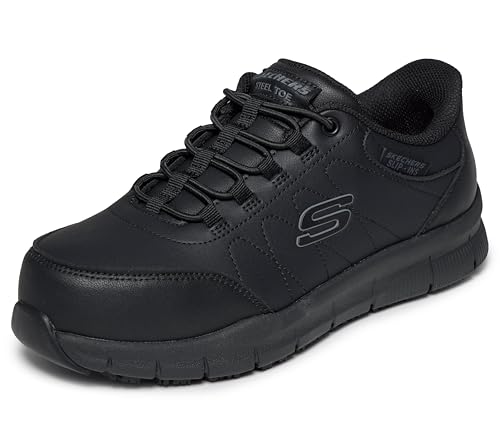
Skechers Slip-ins Work: Nampa - Enelo
Steel toe · shoe · women's
ICEH
slip-resistant outsole (maker's claim)
Carries I · Carries C
Specs: Skechers product page (style 108353) (2026-11-09)
Skechers Work Relaxed Fit: Cankton ST
Steel toe · shoe · men's
ICEH
Carries I · Carries C
Specs: Skechers product page (style 77055) (2026-11-09)
PUMA Safety ICONIC LOW Safety shoes ASTM EH SR
Composite toe · shoe · men's
ICEHSR
heat-resistant outsole (maker's claim)
Carries I · Carries C
Specs: PUMA Safety product page (Safety class EH; spec list) (2026-11-09)
Skechers Work: Rotund - Darragh ST
Steel toe · boot · 4 in · women's
ICEH
slip-resistant outsole (maker's claim)
Carries I · Carries C
Specs: Skechers product page (style 108055) (2026-11-09)
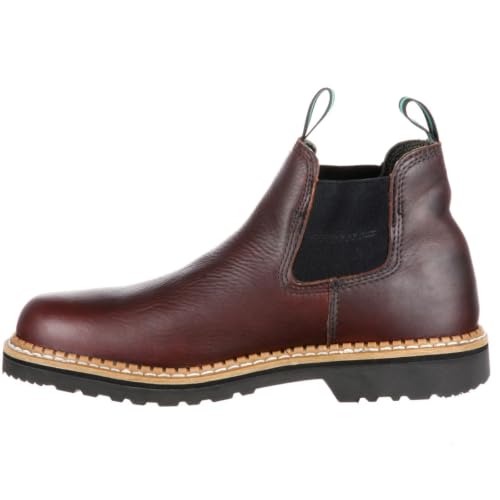
Georgia Boot Georgia Giant Waterproof Steel Toe Chelsea
Steel toe · chelsea · 5 in · men's · waterproof
ICEH
slip-resistant outsole (maker's claim)
Carries I · Carries C
Specs: Georgia Boot product page (2026-11-09)
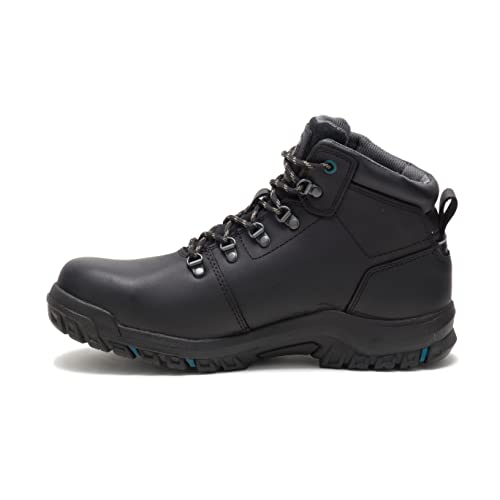
CAT Footwear Striver Steel Toe Work Boot
Steel toe · boot · men's
ICEH
slip-resistant outsole (maker's claim)
Carries I · Carries C
Specs: Cat Footwear product page (2026-11-09)
CAT Footwear Echo Waterproof Steel Toe Work Boot
Steel toe · boot · 8 in · women's · waterproof
ICEH
slip-resistant outsole (maker's claim)
Carries I · Carries C
Specs: Cat Footwear product page (2026-11-09)
HEYDUDE Wendy Work CT
Composite toe · shoe · women's
ICEH
slip-resistant outsole (maker's claim)
Carries I · Carries C
Specs: HEYDUDE product page (style 44289) (2026-11-09)
Reebok Work Sublite Cushion Work - RB4041
Alloy toe · shoe · men's
ICEH
slip-resistant outsole (maker's claim)
Carries I · Carries C
Specs: Reebok Work product page (2026-11-09)
Georgia Boot Georgia Boot Steel Toe Waterproof Logger Boot
Steel toe · logger · 8 in · men's · waterproof
ICEH
Carries I · Carries C
Specs: Georgia Boot product page (2026-11-09)
Timberland PRO Intercept Steel Toe
Steel toe · shoe · men's
ICEH
slip-resistant outsole (maker's claim)
Carries I · Carries C
Specs: Amazon listing (brand store) (2026-11-09)





Showing the 12 lowest-priced. .
Specs are makers' published figures, linked on every card. Prices as of 2026-11-13; product prices and availability are subject to change. As an Amazon Associate we earn from qualifying purchases.
Steel toe boots all look like they do the same job, and the toe cap part is true: every safety toe sold to the US market as meeting ASTM F2413 has passed the same impact and compression tests. The differences that matter for your job are in the rest of the label. One boot adds an electrical-hazard (EH) rating, another a puncture-resistant plate, another a metatarsal guard, and many carry nothing extra at all.
The Boot Yard compares 60 safety-toe boots and shoes from 21 brands by the line each maker publishes, with a link to the page it came from and Amazon's price as of the date shown. Start with the finder: tell it the hazards where you work, and it shows the codes you need and the boots that carry every one. We don't wear-test boots; we read labels, standards and size charts so you can check them yourself.
The best steel toe boots by need
1. Classic 6-inch EH steel toe
Timberland PRO Pit Boss 6" Steel Toe
Timberland PRO lists the Pit Boss with a steel safety toe meeting ASTM F2413-18 for impact and compression, plus Electrical Hazard protection and a slip-resistant outsole. It sits in the middle of the catalogue's price range.
Buy it if: A first pair for general site or shop work where a plain 6-inch lace-up is fine. Skip it if: You work in standing water; Timberland PRO doesn't list it as waterproof.
- Safety toe
- Steel toe
- Height
- 6 in
- Maker also claims
- slip-resistant outsole
Specs: Amazon listing (brand store) (2026-11-09)
2. Waterproof steel toe under about $100
Wolverine Floorhand Waterproof Steel-Toe 6" Work Boot
Wolverine prints the full line, ASTM F2413-18 M I/75 C/75 EH, and lists a breathable waterproof membrane with cement construction. That combination is uncommon at this price in the catalogue.
Buy it if: Wet yards, wash-down areas and outdoor work on a budget. Skip it if: You want a resoleable welted boot; this one is cemented.
- Safety toe
- Steel toe
- Rating line
- ASTM F2413-18 M I/75 C/75 EH
- Height
- 6 in
- Waterproof
- Breathable, waterproof membrane; waterproof full-grain leather upper
- Construction
- cement
- Widths
- M, EW
- Maker also claims
- slip-resistant outsole
Specs: Wolverine product page (2026-11-09)
3. Waterproof steel toe for ladders and scaffolds
KEEN Utility Pittsburgh 6" Waterproof Boot (Steel Toe)
KEEN publishes 'F2413-18 M I/75 C/75 EH' and F3445-21 slip resistance, a KEEN.DRY membrane, and a 90° heel it says is for ladders and scaffolding. KEEN's published shaft height is 7.01 in, taller than the '6"' in the name.
Buy it if: Trades who climb all day and need a waterproof boot. Skip it if: Price matters most; it sits near the top of the steel-toe range.
- Safety toe
- Steel toe
- Rating line
- Meets ASTM F3445-21 and F2413-18 M I/75 C/75 EH standards
- Height
- 7.01 in
- Waterproof
- KEEN.DRY waterproof, breathable membrane
- Construction
- cement
- Widths
- Regular, Wide
Specs: KEEN product page (2026-11-09)
4. Metatarsal protection with a metal-free toe
Wolverine Raider DuraShocks® Waterproof 6" Met-Guard Work Boot
Wolverine rates the Raider for impact, compression, Mt and EH with a CarbonMAX composite toe, and lists a waterproof membrane. It is one of three boots in the catalogue carrying Mt.
Buy it if: Fabrication, foundry or rigging work where something heavy can land on the top of the foot. Skip it if: Your hazard assessment calls for an external met guard you can see.
- Safety toe
- Composite toe
- Rating line
- ASTM F2413 M/I/C EH rated Mt EH rated CarbonMAX® composite-toe
- Height
- 6 in
- Waterproof
- Breathable waterproof membrane with moisture wicking mesh lining; waterproof full-grain leather upper
- Construction
- ContourWelt
- Widths
- M, EW
Specs: Wolverine product page (2026-11-09)
5. Slip-on waterproof steel toe
Ariat Groundbreaker Chelsea Waterproof Steel Toe Work Boot
Ariat lists 'ASTM F2413 I/C EH SR' with a DRYShield waterproof construction and elastic twin gore, so there are no laces to snag or come undone.
Buy it if: Workers who want on-and-off speed and no laces. Skip it if: You need ankle support for uneven ground; a lace-up holds the heel tighter.
- Safety toe
- Steel toe
- Rating line
- ASTM F2413 I/C EH SR rated
- Height
- 6 in
- Waterproof
- DRYShield™ waterproof, breathable construction
- Widths
- D, EE
- Maker also claims
- heat-resistant outsole
Specs: Ariat product page (2026-11-09)
6. Women's waterproof steel toe
CAT Footwear Mae Steel Toe Waterproof Work Boot
CAT Footwear says the Mae is built on a women's fit with a steel toe meeting ASTM F2413-18 and a waterproof full-grain leather upper, plus EH and slip resistance.
Buy it if: Women who keep getting sized into a men's boot. Skip it if: You need a composite toe; see the women's guide for the two metal-free options we list.
- Safety toe
- Steel toe
- Rating line
- ASTM F2413-18
- Waterproof
- Waterproof, quality full grain leather
- Construction
- cement
- Widths
- M, W
- Maker also claims
- slip-resistant outsole
Specs: Cat Footwear product page (2026-11-09)
7. Steel toe in a sneaker shape
Skechers Work Relaxed Fit: Cankton ST
Skechers states the Cankton's steel toe meets ASTM F2413 impact and compression and that it has an EH-safe design, with a memory-foam insole and Relaxed Fit last.
Buy it if: Warehouse and shop floors where a boot is more than the job needs. Skip it if: You work outside in mud or water; it isn't listed as waterproof.
- Safety toe
- Steel toe
- Rating line
- Steel safety toe meets ASTM F2413 impact and compression standards. ... Electrical Hazard (EH) safe design tested ASTM-F2413
- Widths
- Medium, Wide
Specs: Skechers product page (style 77055) (2026-11-09)


Product prices and availability are accurate as of 2026-11-13 and are subject to change. Amazon prices are for the size and colour linked and vary by size. Specs are the makers' published figures; we don't wear-test boots.
Read the label before you read the reviews
Inside the tongue or on the box of a US safety boot there is a short rating line. A typical one reads ASTM F2413-18 M I/75 C/75 EH: the standard and the year it was revised, then M or F for men's or women's footwear, then the protections. Labels made to the 2011 edition and earlier write the impact and compression ratings as I/75 and C/75; labels to the 2018 edition print just I and C.
Everything after I and C is optional, and that is where boots differ. EH means the boot was tested as secondary protection against stepping on a live conductor in dry conditions. PR means a puncture-resistant plate under the foot. Mt means a guard over the top of the foot. SD and Cd are opposite answers to static electricity. A slip-resistance claim (SR) refers to a separate standard, ASTM F3445.
If you only remember one thing: two boots with steel toes can protect you very differently, and two boots with different toe materials can protect you the same. The label settles it. Our label decoder explains any line you paste in.
| Code | Name | What it protects against | Test |
|---|---|---|---|
| I | Impact | Something heavy dropping on the toes | 50 lb weight, 75 ft-lbf; ≥0.500 in clearance left (men's), ≥0.468 in (women's) |
| C | Compression | Something rolling over or pinning the toes | 2,500 lbf load; same clearance as impact |
| Mt | Metatarsal | A load striking the top of the foot behind the toes | 75 ft-lbf impact 3.5 in back from the toe; 1.0 in clearance (men's) |
| EH | Electrical hazard | Stepping on a live conductor (secondary protection, dry conditions) | 18,000 V at 60 Hz for 1 minute, no more than 1.0 mA leakage |
| PR | Puncture resistant | Nails, screws or scrap underfoot | Plate resists 1,200 N (270 lbf); survives 1.5 million flexes |
| SD | Static dissipative | Static that can damage electronics | Resistance kept in a band: SD10, SD35 or SD100 (megohms) |
| Cd | Conductive | Static ignition near explosives or volatile chemicals | 0–500,000 ohms (F2413-11 summary) |
Steel, composite, alloy or carbon fiber?
In our catalogue, 37 of the 60 boots use a steel toe, 16 composite, 3 carbon fiber, 2 alloy, 1 aluminum and 1 a maker-described non-metallic toe. All of them that state ASTM F2413 have passed the same impact and compression tests; Thorogood's ASTM guide puts it plainly: all boots with a safety toe, steel or composite, meet the same impact and compression testing.
So the choice is about everything else. Composite and carbon-fiber caps contain no metal, which is why electricians and people who pass through metal detectors often ask for them. Steel caps are the long-standing default and are the most common at lower prices. Alloy and aluminum caps are metal too, just not steel. A non-metal toe does not, by itself, make a boot EH-rated: EH is tested on the whole boot, so look for EH on the label whatever the toe.
What OSHA actually requires
OSHA's general-industry rule, 29 CFR 1910.136(a), says the employer must ensure each affected employee uses protective footwear where there is a danger of foot injuries from falling or rolling objects, objects piercing the sole, or an electrical hazard that remains after other protective measures. Paragraph (b) says the footwear must comply with ASTM F2412-2005 and F2413-2005 (or ANSI Z41), or be shown to be at least as effective. Newer ASTM editions are accepted in practice through that 'at least as effective' route.
OSHA does not certify or approve boots. When a listing says 'OSHA approved', what it can truthfully mean is that the boot meets the ASTM standard OSHA points to. Composite toes are not second-class here: a composite toe that meets F2413 meets the same requirement as a steel one.
Which hazards apply to your job is decided by your employer's hazard assessment under 29 CFR 1910.132(d). OSHA's non-mandatory Appendix B gives the examples our finder uses: carrying heavy parts or tools calls for impact protection; skid trucks, bulk rolls and heavy pipes call for compression protection; nails, wire and scrap metal underfoot call for puncture protection.
Match the boot to the work
The finder at the top of this page turns hazards into codes, but it helps to know the common patterns before you choose:
- Electricians and anyone near energized equipment: EH on the label, and many choose a composite or carbon toe. Never combine EH with conductive (Cd) footwear.
- Construction, framing and demolition: impact and compression plus PR if nails and screws end up on the ground; only 4 boots in our catalogue publish PR, so check this one carefully.
- Welding, fabrication and foundry work: Mt for loads that can land on the top of the foot, and a design without exposed laces that can catch spatter.
- Warehouses and distribution centers: I and C for pallet jacks and dropped cartons; many people choose a safety-toe shoe rather than a boot.
- Electronics assembly: SD footwear, rated to a resistance band, never EH-only footwear in place of it.
- Wet, cold or outdoor work: a maker-stated waterproof membrane (30 boots in the catalogue list one) and, for cold, insulation in grams if the maker publishes it.
Fit is a safety issue, not just comfort
A safety toe can't stretch. If the cap sits on your toes, no amount of breaking in will move it, which is why sizing matters more than with ordinary boots. OSHA's PPE rule even says employers must select equipment that properly fits each employee (1910.132(d)(1)(iii)).
Sizes also differ between brands. Makers publish charts that map a US size to a foot length, and those lengths are not identical from brand to brand. Our size converter reads your foot length from the chart of the brand you already wear and finds the nearest size on eight other makers' charts, each linked to its source. Measure your foot later in the day, in the socks you work in, and check the width letters the maker offers: in our catalogue, widths range from a single medium width to several wide options.
What steel toe boots cost
Amazon prices for the 58 boots in the catalogue that had a price on 2026-11-08 ran from $49.99 to $289.99, with a middle value of $149.99. Prices are for the size and colour we link and move daily, so treat the table as a map of the market rather than a quote.
Two patterns stand out. Waterproof membranes and composite toes are not luxury features: both appear in every price band. And EH is nearly universal, so paying more doesn't buy you an EH rating; it buys construction, materials and fit options.
| Price band | Boots | Waterproof | Metal-free toe | EH |
|---|---|---|---|---|
| Under $100 | 11 | 3 | 2 | 10 |
| $100–$149 | 21 | 9 | 5 | 20 |
| $150–$199 | 18 | 12 | 9 | 14 |
| $200 and up | 8 | 5 | 4 | 8 |
Six mistakes people make buying safety boots
These come up again and again in the questions workers post on r/WorkBoots and trade forums, and each one has a simple fix:
- Buying your sneaker size. Boot makers' charts map sizes to foot length differently; measure and convert instead.
- Assuming composite is weaker. A composite toe that meets ASTM F2413 passes the same impact and compression tests as steel.
- Assuming a composite toe makes a boot EH-rated. EH is a whole-boot rating; look for EH on the label.
- Treating 'slip resistant' as one standard. Some makers cite ASTM F3445 test results, others only describe the outsole; read which.
- Expecting the toe cap to stretch. Leather softens, steel and composite caps don't; if the cap presses on your toes in the store, it will keep pressing.
- Skipping the hazard assessment. The boot only has to match the hazards where you work, and your employer's assessment says what those are.
Waterproof, insulated, welted: the other specs worth reading
Waterproofing claims come in two kinds. Some makers name a membrane (KEEN.DRY, DRYShield, UltraDry); others say water resistant, which is not the same promise. Rubber pull-on boots such as the Muck Chore are waterproof by construction. Only half of the catalogue lists a waterproof membrane, so filter for it if you work wet.
Insulation is published in grams of synthetic fill on cold-weather models; the catalogue holds only four insulated boots, from a 200 g women's Timberland PRO to a 1,200 g Rocky. Construction tells you whether a boot can be resoled: 15 boots in the catalogue list a Goodyear or similar welt, which a cobbler can usually resole, while cemented and direct-attach soles generally cannot be.
How we built this comparison
Every boot entry comes from the maker's own product page where we could read it, with the date we read it. Where a maker blocked access (Timberland PRO's site refused every automated request on 2026-11-09), we used the maker's Amazon brand-store listing and say so on the card. Prices come from Amazon's official API, refreshed daily, for the size and colour linked; they vary by size.
We don't publish star ratings, review counts or test results of our own, because we don't test boots. What we can offer is the thing a product grid can't: the standard, the label and the job, lined up so you can check every claim against its source.
Every guide on The Boot Yard
Questions people ask
- What is the purpose of a steel toe boot?
- It protects the toes from objects that fall on them or roll over them. In the US, a safety toe sold as meeting ASTM F2413 has passed a 75 ft-lbf impact test and a 2,500 lbf compression test while keeping a minimum space for the toes.
- Are composite toe boots as safe as steel toe boots?
- For impact and compression, yes: a composite toe that meets ASTM F2413 passes the same tests as a steel one. Composite caps contain no metal; steel caps are more common at lower prices. Compare the rest of the label (EH, PR, Mt) rather than the toe material.
- What are the most comfortable steel toe boots?
- Comfort depends on fit more than on any model. Choose the right length and width from the maker's own size chart, make sure the toe cap doesn't touch your toes, and compare stated features such as cushioned footbeds. Our comfortable steel toe shoes guide lists what makers publish for each model.
- Does OSHA require steel toe boots?
- OSHA requires protective footwear where there's a risk of foot injury from falling or rolling objects, punctures or electrical hazards (29 CFR 1910.136). It doesn't require steel specifically; any toe that meets the referenced ASTM standard qualifies.
- Do steel toe boots set off metal detectors?
- They can. Justin Boots notes steel toes can set off airport metal detectors, and TSA may screen further if they alarm. Since July 2025 TSA lets domestic travelers keep their shoes on at checkpoints, but other screening steps still apply.
- What does EH mean on work boots?
- Electrical hazard. The boot was tested to withstand 18,000 volts at 60 Hz for one minute with no more than 1.0 mA of leakage, in dry conditions. It is secondary protection if you accidentally step on a live conductor, not a substitute for de-energizing equipment.
- Does my employer have to pay for steel toe boots?
- Usually not. Under 29 CFR 1910.132(h)(2), employers don't have to pay for non-specialty safety-toe footwear if you may wear it off the job. Specialty footwear and some metatarsal protection are treated differently.
- How do I know my size in a different boot brand?
- Use the maker's foot-length chart rather than your sneaker size. Our size converter reads your foot length from the chart of the brand you wear and finds the nearest size on other makers' charts, with links to each one.
- Where's the best place to buy steel toe boots?
- Wherever you can return them if the fit is wrong. We link to Amazon and to each maker's own page; prices shown are Amazon's as of the date on the card and vary by size and colour.
Sources & further reading
- OSHA 29 CFR 1910.136 Foot protection
- OSHA 29 CFR 1910.132 General requirements (PPE, payment)
- OSHA 1910 Subpart I, Appendix B (selection guidelines)
- ASTM F2413-24 (abstract)
- Thorogood: A Guide to ASTM Ratings and OSHA Work Boots
- OH&S: Take a Walk Through the New Footwear Safety Standards (2019)
- University of Washington: ASTM F2413-11 summary (PDF)
- TSA: DHS ends shoes-off policy (July 8, 2025)
- Justin Boots: steel toe boots and airport security

The Boot Yard editors · Editorial team
The Boot Yard's catalogue and guides are compiled by the site's editorial team from makers' published product pages, ASTM F2413 rating lines and OSHA's foot-protection rules. We do not wear-test boots, and we never claim to: every spec on the site links to the page it came from.
About this site · How pages are checked · Last updated November 8, 2026
As an Amazon Associate, The Boot Yard earns from qualifying purchases. It costs you nothing extra and never decides which boots we list.
The Boot Yard is an independent site. It is not affiliated with ASTM International, OSHA or any boot brand. Brand names and trademarks belong to their owners. Our guides explain published standards; your employer's safety program and the boot's own label decide what you must wear.