Guide
Composite Toe Shoes: Low-Cut, Metal-Free Safety Picks and What the Label Must Say
By The Boot Yard editors · Updated 2026-11-08 · How we research
We may earn a commission when you buy through links on this page.
Short answer
Composite toe shoes put a non-metal toe cap (fiberglass, carbon or another composite) inside a low-cut shoe. A rated pair passes the same ASTM F2413 impact and compression tests as steel, so check the label for the F2413 line and I and C, then EH, SD or PR if your job needs them. Pick a shoe for flat indoor floors and a boot when ankles or debris are a concern.
Composite toe shoes and composite toe boots carry the same kind of toe cap; the difference is everything above the ankle bone. A shoe stops below it, weighs less and bends like a trainer. A boot covers the ankle, keeps out gravel and water, and usually adds height and stiffness. Both can carry the same ASTM F2413 impact and compression rating, because that test is run on the toe cap area, not on the collar.
"Composite" on a product page means the toe cap is not metal. Makers in our catalogue describe theirs in different words: a "composite-fiberglass toe cap" (PUMA), "non-metallic carbon toes" (KEEN), a "nano composite" toe (Brunt), "Nanotoe" carbon-nanotube technology (Irish Setter). Thorogood, a boot maker that quotes the standard, puts the key point plainly: all boots with a safety toe, steel or composite, meet the same impact and compression testing.
Of the 60 safety-toe models we track, 20 have a non-metal toe. Only five of those are low-cut shoes, so the picks below add a few low boots for readers whose employer or floor rules out a shoe. Every pick quotes the maker's own rating wording, because low-cut safety shoes are where vague listings like "safety shoe, composite" with no F2413 line are most common.
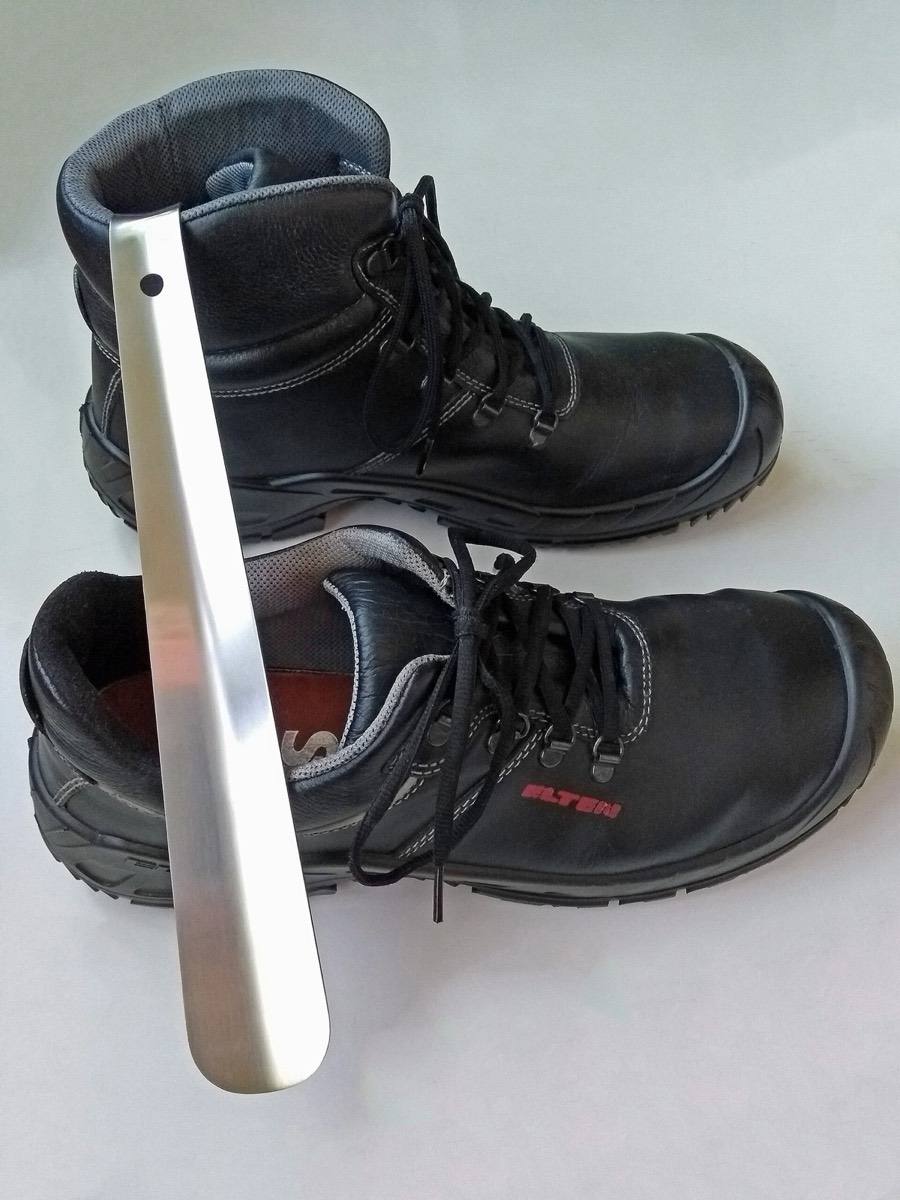
Composite toe shoes and low boots worth a look
1. Best sneaker-style composite toe shoe with a full ASTM statement
New Balance Fresh Foam Cremorne Mid CT
New Balance's listing spells out the composite toe as meeting "ASTM F2413-18 sections 5.1, 5.2, 5.3" plus the section 5.6 electrical hazard requirements, and says the outsole meets ASTM F3445-21 slip resistance. That is unusually specific wording for a sneaker-style safety shoe. New Balance also describes a "security-friendly design".
Buy it if: Warehouse, retail-floor and light manufacturing shifts on concrete where an athletic shoe is allowed. Skip it if: You need puncture resistance (no PR claim on this model) or ankle coverage.
- Safety toe
- Composite toe
- Rating line
- Composite safety toe meets ASTM F2413-18 sections 5.1, 5.2, 5.3 standards. Meets ASTM F2413-18 Electrical Hazard section 5.6 requirements. Slip-resistant AT Tread outsole meets or exceeds ASTM F3445-21 minimum slip resistance requirements
- Widths
- D, Wide, X-Wide
- Maker also claims
- heat-resistant outsole
Specs: Amazon listing (brand store) — New Balance Fresh Foam Cremorne Mid CT, style MUFCMCEHCO (2026-11-09)
2. Composite toe shoe with a puncture-resistant midsole claim
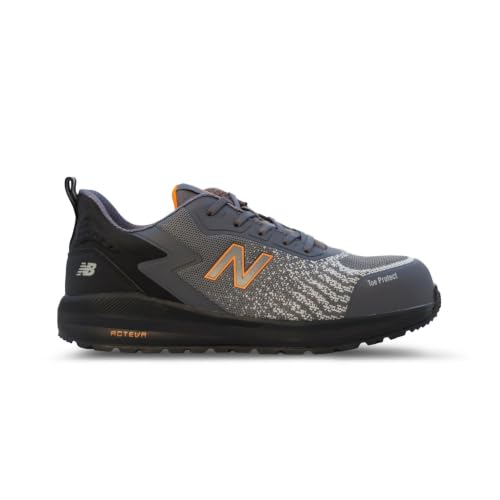
New Balance Speedware Comp Toe
The brand-store listing states it "meets or exceeds ASTM Specification F2413-18 I/75 C/75" with EH and an F2913-19 slip test, and adds an "anti-perforation midsole". The listing names no puncture standard, so treat PR as the maker's claim and confirm the label line reads PR before relying on it.
Buy it if: Sites with screws or scrap on the floor where a low shoe is still permitted. Skip it if: Your hazard assessment calls for a tested PR rating and the box label doesn't print it.
- Safety toe
- Composite toe
- Rating line
- meets or exceeds ASTM Specification F2413-18 I/75 C/75, ASTM F2412-18a (EH) ASTM F2913-19 (SR)
- Widths
- D (M), Wide
Specs: Amazon listing (brand store) — New Balance Speedware, style MIDSPWRGR (2026-11-09)
3. Budget composite toe shoe
PUMA Safety ICONIC LOW Safety shoes ASTM EH SR
PUMA Safety's brand listing cites ASTM F2413-18 and F2412-18a for toe impact and compression (I/75, C/75), F2913-19 and F3445-21 for slip, and the maker page shows "Safety class EH". The toe is a composite-fiberglass cap in a suede low-top. Check the live price on the card; it has sat well under $100.
Buy it if: A budget pair that looks like a casual suede trainer. Skip it if: You want waterproofing or a puncture plate; neither is claimed.
- Safety toe
- Composite toe
- Rating line
- These safety shoes meet or exceed the highest ASTM standards for toe impact I/75 and compression C/75 protection (ASTM F2413-18 and ASTM F2412-18a). ... meets ASTM F2913-19 non-slip testing standards and ASTM F3445-21.
- Maker also claims
- heat-resistant outsole
Specs: PUMA Safety product page (Safety class EH; spec list) (2026-11-09); Amazon listing (brand store) — ASTM rating text (2026-11-09)
4. Women's composite toe shoe with SD, PR and SRO wording
Xena Workwear Astra Athletic
Xena prints "Certified Composite Toe Option (F2413-24)", a puncture-resistant outsole (PR) and "Top Slip Resistant SRO Rated (Dry, Wet, and Oily)". Electrical protection depends on colour: the White Gold colourway linked here is the static-dissipative (SD) version, and Black Silver is the EH version. Xena does not publish a separate I/C line, so go by its wording.
Buy it if: Women in electronics, labs or plants that require SD footwear and oily-floor grip. Skip it if: You need EH; buy the Black Silver colourway instead, and never use SD footwear where live conductors are possible.
- Safety toe
- Composite toe
- Rating line
- Certified Composite Toe Option (F2413-24); Electrical Hazard (EH) or Static Dissipative (SD) Protection (varies by color); Puncture Resistant Outsole (PR); Top Slip Resistant SRO Rated (Dry, Wet, and Oily)
Specs: Xena Workwear product page (2026-11-09)
5. Lightest-looking women's composite toe slip-on
HEYDUDE Wendy Work CT
HEYDUDE rates it "ASTM F2413 M/I/C EH rated" and calls the shoe "100% metal free". The upper is mesh with a water-repellent spray, not waterproof, and HEYDUDE's slip wording is "CE slip-resistant" with no ASTM slip standard named.
Buy it if: Dry indoor work where you want a metal-free, easy-on shoe. Skip it if: Your floor is wet or oily, or you need puncture protection.
- Safety toe
- Composite toe
- Rating line
- ASTM F2413 M/I/C EH rated
- Maker also claims
- slip-resistant outsole
Specs: HEYDUDE product page (style 44289) (2026-11-09)
6. Best low boot when a shoe is too little
KEEN Utility Evanston 6" Waterproof Boot (Carbon Toe)
KEEN's line reads "Meets ASTM F3445-21 and F2413-18 M I/75 C/75 EH standards", with a non-metallic carbon toe and a KEEN.DRY waterproof membrane. Despite the 6" name, KEEN lists the shaft at 4.33 in, so it sits only a little above a mid shoe.
Buy it if: Outdoor or mixed indoor/outdoor work where you want ankle cover without a tall boot. Skip it if: You want a true 6-inch shaft; look at a full-height composite boot instead.
- Safety toe
- Carbon-fiber toe
- Rating line
- Meets ASTM F3445-21 and F2413-18 M I/75 C/75 EH standards
- Height
- 4.33 in
- Waterproof
- KEEN.DRY waterproof, breathable membrane
- Widths
- Regular, Wide
- Maker also claims
- heat-resistant outsole
Specs: KEEN product page (2026-11-09)
7. Men's metal-free easy-on low boot
HEYDUDE Bradley II Work CT Leather
Rated "ASTM F2413 I/C EH rated" by HEYDUDE, with an adjustable fixed lace, a heel pull and the same "100% metal free" claim. The leather upper is spray-treated to repel water, not waterproof.
Buy it if: Men who want slip-on convenience and a non-metal toe in a boot shape. Skip it if: You work in standing water or need a published height (HEYDUDE doesn't list one).
- Safety toe
- Composite toe
- Rating line
- ASTM F2413 I/C EH rated
- Maker also claims
- slip-resistant outsole
Specs: HEYDUDE product page (style 46122) (2026-11-09)



Product prices and availability are accurate as of 2026-11-13 and are subject to change. Amazon prices are for the size and colour linked and vary by size. Specs are the makers' published figures; we don't wear-test boots.
5 boots match.
PUMA Safety ICONIC LOW Safety shoes ASTM EH SR
Composite toe · shoe · men's
ICEHSR
heat-resistant outsole (maker's claim)
Specs: PUMA Safety product page (Safety class EH; spec list) (2026-11-09)
HEYDUDE Wendy Work CT
Composite toe · shoe · women's
ICEH
slip-resistant outsole (maker's claim)
Specs: HEYDUDE product page (style 44289) (2026-11-09)
New Balance Speedware Comp Toe
Composite toe · shoe · men's
ICEHSRPR
Specs: Amazon listing (brand store) — New Balance Speedware, style MIDSPWRGR (2026-11-09)
New Balance Fresh Foam Cremorne Mid CT
Composite toe · shoe · men's
ICEHSR
heat-resistant outsole (maker's claim)
Specs: Amazon listing (brand store) — New Balance Fresh Foam Cremorne Mid CT, style MUFCMCEHCO (2026-11-09)
Xena Workwear Astra Athletic
Composite toe · shoe · women's
ICSDPRSR
Specs: Xena Workwear product page (2026-11-09)
Specs are makers' published figures, linked on every card. Prices as of 2026-11-13; product prices and availability are subject to change. As an Amazon Associate we earn from qualifying purchases.
Shoe or boot: which one does your job allow?
Start with the rule, not the style. OSHA 1910.136(a) requires "protective footwear" where there is a danger of foot injuries from falling or rolling objects, objects piercing the sole, or electrical hazards. The regulation's text does not say "boot" and sets no shaft height. A rated shoe can therefore satisfy it where the hazard is to the toes. Many employers and sites write their own stricter policy, such as "6-inch leather boots" on construction sites, and that policy is what you will be checked against at the gate.
Where a shoe makes sense: warehouses and distribution centers on sealed concrete, retail back rooms, light assembly, food service with a slip requirement, machine shops with clean floors. Where a boot is the safer call: uneven ground, rebar and gravel, mud or standing water, ladders all day, and any job where something could strike above the toe, because a metatarsal guard needs boot-height uppers to mount on.
Weight is the usual reason people ask for composite toe shoes. KEEN, for example, states that its carbon toes are "15% lighter than steel"; that is the toe cap alone, and only the maker's claim. Whole-shoe weight depends far more on sole and upper, and most makers in our catalogue don't publish it, so we don't rank by it. Comfort claims are the same story: a maker's foam name tells you what is in the midsole, not how it will suit your feet over a ten-hour shift, so the picks lean on published ratings and fit options instead.
What composite actually changes (and what it doesn't)
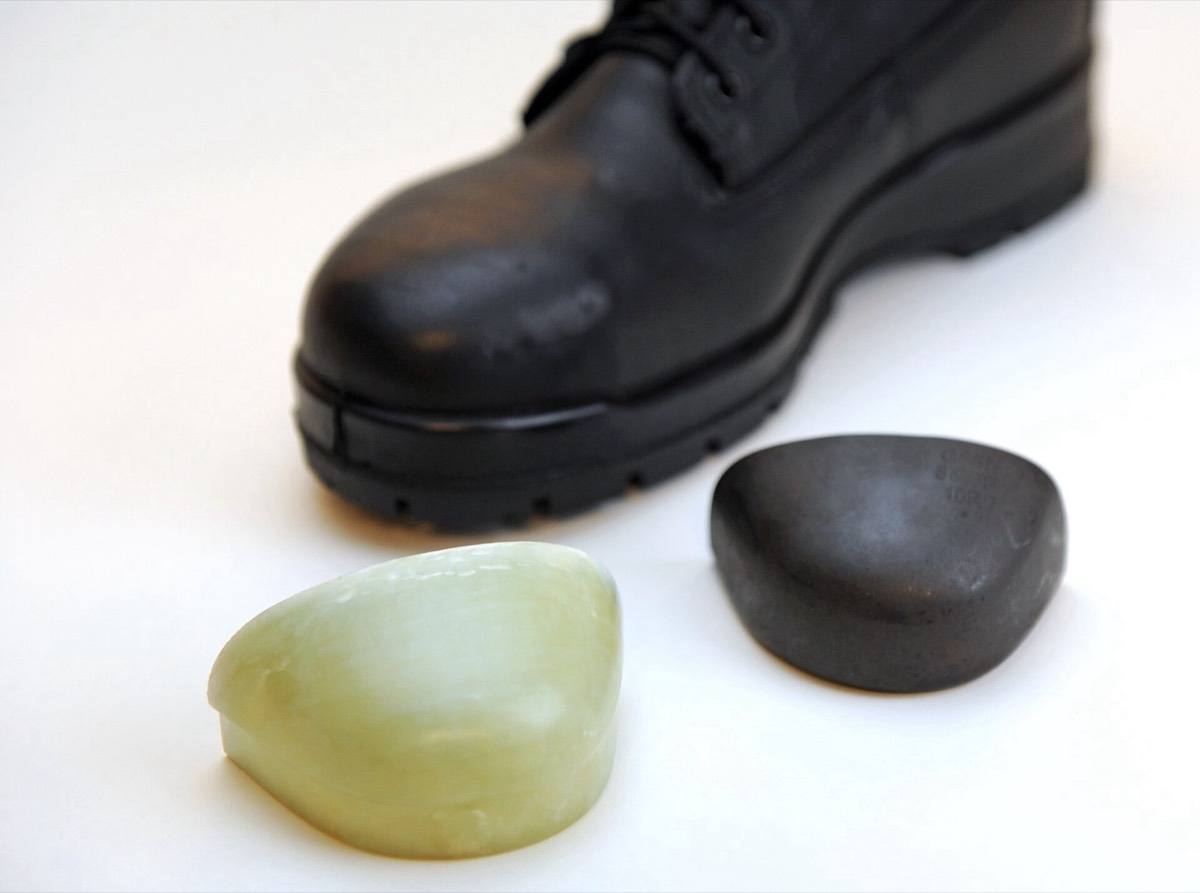
A composite toe changes the material, not the test. ASTM F2413 impact (I) means the toe area survives a nominal 75 ft-lbf of impact energy from a 50 lb weight; compression (C) means it holds up under 2,500 lbf. In both tests the toe must keep at least 0.500 in of interior clearance in men's footwear and 0.468 in in women's. Those numbers come from Thorogood's guide, which quotes F2413-18. A composite cap that carries I and C passed the same bar as a steel one.
What composite does change: there is no metal cap to conduct cold or to alarm a metal detector, and non-metal caps are often bulkier, which can make the toe box look rounder. What it does not change: electrical protection. A non-metal toe does not make a shoe EH-rated. EH is a separate test of the whole shoe and has to be printed on the label; steel-toe shoes can be EH-rated too.
Also check what else is metal. HEYDUDE calls both of its work models "100% metal free", and New Balance describes the Cremorne's design as "security-friendly". Most other listings say nothing about shanks, eyelets or puncture plates, any of which can be metal.
Side by side: every non-metal-toe shoe and low boot we track
The table copies each maker's wording exactly, because the wording is where listings differ. Some print a full F2413 line with classes ("I/75 C/75" is the older format; current labels print "I" and "C"). Others name the standard without a line, and a few cite section numbers. Where a maker gives no rating line at all, read the label inside the tongue before you wear the pair to work. A pair that only says "meets ASTM standards" without naming F2413 is the one to question: ask the seller for the label photo, and send it back if the tongue label is missing.
- Three New Balance models and PUMA come from the brands' Amazon brand-store listings, because the maker sites blocked our reader; the wording is still the brand's own.
- KEEN's heights are the shaft measurements KEEN publishes, which run shorter than the "6"" in the model names.
- HRO and other heat-resistant outsole claims are left out of the codes column: they are maker claims, not F2413 codes.
| Model | Cut | Toe (maker's words) | Rating wording as published | Other codes claimed |
|---|---|---|---|---|
| New Balance Fresh Foam Cremorne Mid CT | Mid shoe | composite safety toe | Meets ASTM F2413-18 sections 5.1, 5.2, 5.3; EH section 5.6; F3445-21 slip | EH, SR |
| New Balance Speedware Comp Toe | Low shoe | composite toe | F2413-18 I/75 C/75, F2412-18a (EH), F2913-19 (SR) | EH, SR, PR (claim) |
| PUMA Safety Iconic Low | Low shoe | Composite-fiberglass toe cap | I/75 C/75 (F2413-18, F2412-18a); F2913-19 and F3445-21 slip | EH, SR |
| Xena Astra Athletic (women's) | Low shoe | Certified Composite Toe Option | F2413-24; EH or SD by colour | SD (this colour), PR, SRO wording |
| HEYDUDE Wendy Work CT (women's) | Low slip-on | Composite toe, non-metallic | ASTM F2413 M/I/C EH rated | EH; slip-resistant outsole (maker claim) |
| KEEN Utility Evanston 6" (carbon) | Boot, 4.33 in | non-metallic carbon toes | F3445-21 and F2413-18 M I/75 C/75 EH | EH, SR |
| KEEN Utility Cincinnati 6" (carbon) | Boot, 4.92 in | non-metallic carbon toes | F2412-18 and F2413-18 M I/75 C/75 EH | EH, SR |
| New Balance Calibre Comp Toe | Ankle boot | lightweight composite toe | I/75 C/75 and F2913-19; EH per F2412-18a | EH, SR, PR (claim) |
| HEYDUDE Bradley II Work CT | Low boot | Composite toe, non-metallic | ASTM F2413 I/C EH rated | EH, SR |
EH, SD or PR: the codes that decide the right pair
After I and C, the next code on the label matters more than the toe material. EH (electrical hazard) is secondary protection if you accidentally step on a live conductor in dry conditions; the lab proof test is 18,000 V at 60 Hz for one minute with no more than 1.0 mA of leakage, per Thorogood's F2413-18 summary. It is not a working-voltage rating, and CCOHS notes shock resistance deteriorates with wear and in wet conditions.
SD (static dissipative) does the opposite job: it bleeds static from your body to protect electronics or prevent sparks. The Xena Astra colourway in our picks is SD, not EH, and CCOHS warns that SD footwear should not be used where contact with live electrical conductors can occur. If your employer hands you a list that says "EH", an SD pair does not satisfy it, and the reverse is also true.
PR (puncture resistant) means a plate or layer under the foot passed a 270 lbf puncture test and a flex test. Among the composite shoes in our catalogue, only the Xena Astra prints PR in its own wording; New Balance describes an "anti-perforation midsole" without naming a test. Your employer's hazard assessment and the shoe's label are what decide whether a pair qualifies; a product page is a starting point.
Metal detectors, airports and "metal-free" claims
This is the second most common reason people choose composite. Justin Boots, a maker, says steel toe boots can set off metal detectors and that TSA may then screen further. Since TSA's July 8, 2025 policy, passengers at domestic airports keep their shoes on through screening, so footwear still passes through the detector on your feet.
We could not find any TSA or other authoritative statement that composite toes will not alarm. The reasoning is simple, no metal cap means less metal, but shanks, eyelets, hooks and puncture plates can be metal, and most listings don't say. If a metal-free shoe matters for a secure facility, pick one whose maker states it in writing (HEYDUDE's "100% metal free" is the clearest wording in our catalogue) and keep the product page handy.
Fit checks before the first shift
Composite caps are often thicker than steel caps, so toe-box shape matters as much as size. Put the shoe on with your work socks, stand, and press on the toe: you should not feel the cap edge across the top of your toes. CCOHS suggests about 12.5 mm of space in front of the toes, trying footwear on around midday when feet are larger, and not counting on footwear to stretch with wear. A safety toe cap does not stretch at all.
If you add your own insoles, note that the ASTM F2413-24 abstract says after-market footbeds, inserts or resoling could make the ASTM marking invalid. Use the maker's removable insole or ask the maker which inserts keep the rating.
Replace a pair after a heavy impact even if it looks fine. CCOHS advises replacing safety footwear after a puncture or impact event because damage may not be visible, and that applies to composite caps as much as steel. For more on the material trade-offs, the composite toe vs steel toe guide covers the full comparison, and the guide to composite shoes for women lists the women's fits.
Questions people ask
- Are composite toe shoes as safe as steel toe shoes?
- For the toe tests, yes when both are rated: ASTM F2413 impact (75 ft-lbf of energy) and compression (2,500 lbf) are the same bar for every toe material. Look for I and C on the label rather than the word composite.
- Does a composite toe shoe meet OSHA's rule?
- OSHA does not approve or certify footwear. 1910.136 requires protective footwear that complies with the ASTM F2412/F2413 standards it references, or that the employer shows is at least as effective. A shoe whose label shows the F2413 line and I and C meets that test for toe protection.
- Does a composite toe make a shoe EH-rated?
- No. EH is a separate test of the whole shoe and must be printed on the label. Many composite-toe models are EH-rated, and so are many steel-toe shoes; the toe material alone tells you nothing about electrical protection.
- Can I wear a composite safety shoe on a construction site?
- Only if the site's footwear policy allows shoes. OSHA's construction rule, 1926.96, references safety-toe footwear without setting a boot height, but most general contractors require boots, and uneven ground favours ankle coverage. Check the written policy first.
- How long does a composite safety shoe last?
- No standard sets a lifespan and no maker in our catalogue publishes one. Replace them when the sole tread is worn, the upper splits at the toe, the label is unreadable, or after any heavy impact or puncture, since CCOHS notes damage may not be visible.
Sources & further reading
- OSHA 29 CFR 1910.136 Foot protection
- OSHA 29 CFR 1926.96 Occupational foot protection
- Thorogood, A Guide to ASTM Ratings and OSHA Work Boots (quotes ASTM F2413-18)
- Thorogood, ASTM Testing for Boots
- ASTM F2413-24 abstract (ASTM International)
- CCOHS OSH Answers: Safety Footwear
- TSA/DHS press release, July 8 2025 (shoes-on screening)
- Justin Boots, Steel toe boots and airport security
- New Balance Fresh Foam Cremorne Mid CT: Amazon listing (brand store) — New Balance Fresh Foam Cremorne Mid CT, style MUFCMCEHCO (read 2026-11-09)
- New Balance Speedware Comp Toe: Amazon listing (brand store) — New Balance Speedware, style MIDSPWRGR (read 2026-11-09)
- PUMA Safety ICONIC LOW Safety shoes ASTM EH SR: PUMA Safety product page (Safety class EH; spec list) (read 2026-11-09)
- Xena Workwear Astra Athletic: Xena Workwear product page (read 2026-11-09)
- HEYDUDE Wendy Work CT: HEYDUDE product page (style 44289) (read 2026-11-09)
- KEEN Utility Evanston 6" Waterproof Boot (Carbon Toe): KEEN product page (read 2026-11-09)
- KEEN Utility Cincinnati 6" Waterproof Boot (Carbon Toe): KEEN product page (read 2026-11-09)
- New Balance Calibre Comp Toe: Amazon listing (brand store) — New Balance Calibre, style MIDCLBR (read 2026-11-09)
- HEYDUDE Bradley II Work CT Leather: HEYDUDE product page (style 46122) (read 2026-11-09)
Read next
- Composite Toe vs Steel Toe
Composite toe vs steel toe, checked against ASTM F2413: both pass the same 75 ft-lbf impact and 2,500 lbf tests. Where they differ: metal, weight claims, price.
- Steel Toe Sneakers
Steel toe sneakers with a published ASTM F2413 rating: 6 true steel-toe shoes, 2 alloy options, the label check that separates safety shoes from look-alikes.
- Best Shoes for Warehouse Work
Best shoes for warehouse work, chosen by label: safety toe for pallet jacks and dropped cartons, SR vs SRO slip codes, shoes vs boots, and six cushioned picks.
- Safety Toe Boots
Safety toe boots explained: steel, composite, alloy, aluminum and carbon caps, what I, C, EH, Mt, PR and SD mean on the label, and which toe suits which job.
- Best Steel Toe Boots
Best steel toe boots for 2026: 8 picks across budget, waterproof, metal-free, EH, met guard, women's, slip-on and western, each with its published ASTM line.
Part of Best Steel Toe Boots. Back to the The Boot Yard home page.

The Boot Yard editors · Editorial team
The Boot Yard's catalogue and guides are compiled by the site's editorial team from makers' published product pages, ASTM F2413 rating lines and OSHA's foot-protection rules. We do not wear-test boots, and we never claim to: every spec on the site links to the page it came from.
About this site · How pages are checked · Last updated November 8, 2026
As an Amazon Associate, The Boot Yard earns from qualifying purchases. It costs you nothing extra and never decides which boots we list.
The Boot Yard is an independent site. It is not affiliated with ASTM International, OSHA or any boot brand. Brand names and trademarks belong to their owners. Our guides explain published standards; your employer's safety program and the boot's own label decide what you must wear.