Guide
Composite Toe vs Steel Toe: Same Test, Different Trade-offs
By The Boot Yard editors · Updated 2026-11-08 · How we research
We may earn a commission when you buy through links on this page.
Short answer
Composite toe vs steel toe is not a strength contest: any toe certified to ASTM F2413 passed the same 75 ft-lbf impact and 2,500 lbf compression tests. Choose steel for price and the widest choice; choose composite or carbon if you want no metal cap or a lighter toe. EH depends on the whole boot, not the cap.
Most composite toe vs steel toe arguments start from a myth: that steel is the “real” safety toe and composite is the lighter, weaker compromise. ASTM F2413 doesn't see it that way. A safety toe of any material earns the I and C codes on its label by surviving the same two lab tests: a 50 lb striker delivering 75 foot-pounds of energy, and a 2,500 lbf squeeze. Pass both and it's a protective toe; fail either and it isn't, whatever it's made of.
The other myths follow from that one. OSHA has never given composite any more approval than steel: it approves neither. A non-metal toe doesn't make a boot EH-rated. And the old story that steel caps cut off toes in a crush has no source we could find behind it. The real differences are smaller and more practical: metal in the boot, the weight makers claim, price, and choice. Each one is sourced below, with four certified picks, one per toe material.
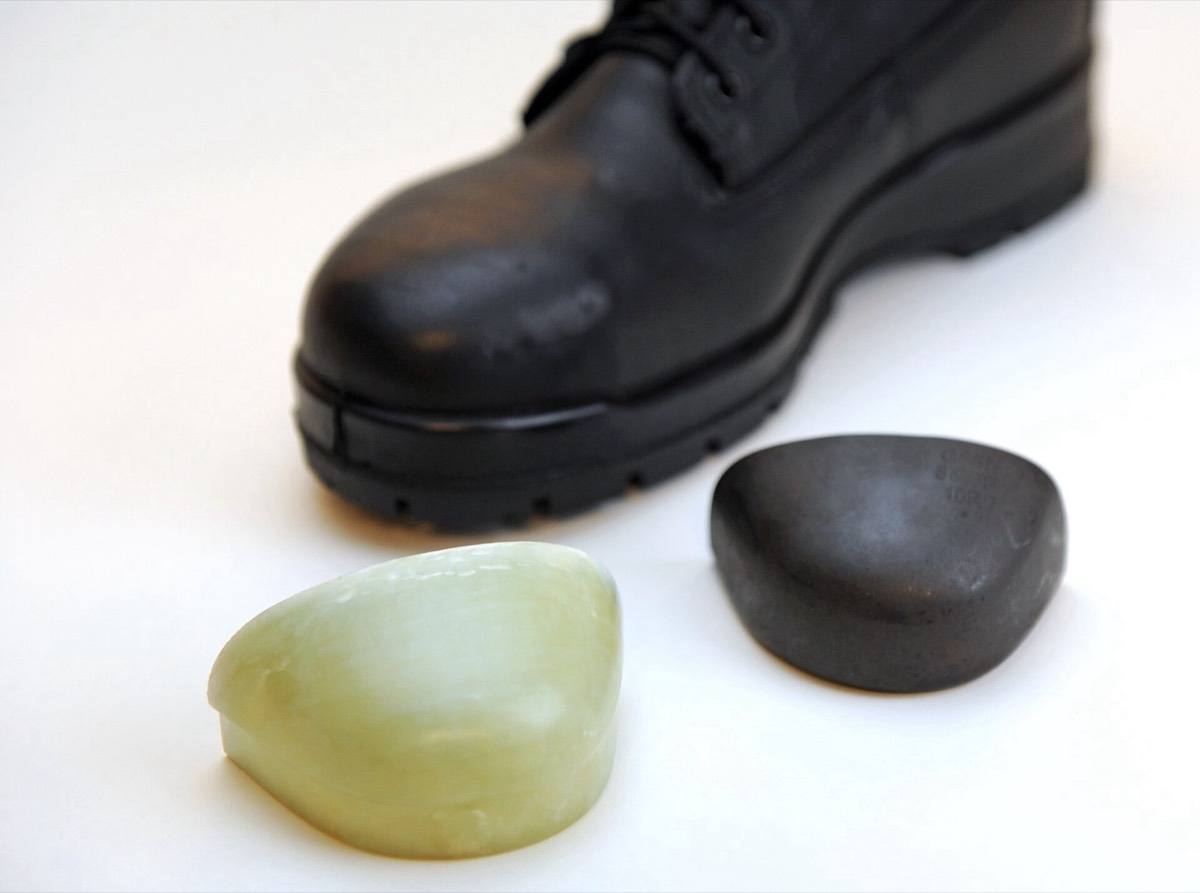
One certified boot per toe material
1. Steel toe, low price
Wolverine Floorhand Waterproof Steel-Toe 6" Work Boot
Wolverine prints its rating line as “ASTM F2413-18 M I/75 C/75 EH”, so this waterproof 6-inch lace-up carries the full toe tests plus electrical-hazard protection. It uses cement construction and a nylon shank, and comes in M and EW widths.
Buy it if: A first safety boot for warehouse, plant or general site work on a tight budget. Skip it if: You must pass metal detectors at work or want a welted boot.
- Safety toe
- Steel toe
- Rating line
- ASTM F2413-18 M I/75 C/75 EH
- Height
- 6 in
- Waterproof
- Breathable, waterproof membrane; waterproof full-grain leather upper
- Construction
- cement
- Widths
- M, EW
- Maker also claims
- slip-resistant outsole
Specs: Wolverine product page (2026-11-09)
2. Composite toe, mainstream
Wolverine Overpass CarbonMAX® 6" Boot
Wolverine's CarbonMAX composite toe is rated “ASTM F2413 M/I/C EH”: the same I and C tests as the Floorhand, with EH too. Waterproof leather, ContourWelt construction, a nylon shank, and M or EW widths.
Buy it if: Buyers who want a non-metal cap from a big brand with an extra-wide option. Skip it if: You need puncture resistance: PR is not on its rating line.
- Safety toe
- Composite toe
- Rating line
- ASTM F2413 M/I/C EH
- Height
- 6 in
- Waterproof
- Premium waterproof leather with abrasion resistant toe
- Construction
- ContourWelt
- Widths
- M, EW
Specs: Wolverine product page (2026-11-09)
3. Carbon toe
KEEN Utility Cincinnati 6" Waterproof Boot (Carbon Toe)
KEEN rates it “Meets ASTM F2412-18 and F2413-18 M I/75 C/75 EH standards” and says its carbon toes are 15% lighter than steel. Goodyear-welted, KEEN.DRY waterproof membrane, Regular and Wide, sizes up to 15.
Buy it if: A welted, waterproof non-metal boot with asymmetrical left and right toe caps. Skip it if: You want a true 6-inch shaft: KEEN lists the shaft at 4.92 in.
- Safety toe
- Carbon-fiber toe
- Rating line
- Meets ASTM F2412-18 and F2413-18 M I/75 C/75 EH standards
- Height
- 4.92 in
- Waterproof
- KEEN.DRY waterproof, breathable membrane
- Construction
- Goodyear welt
- Widths
- Regular, Wide
- Maker also claims
- heat-resistant outsole
Specs: KEEN product page (2026-11-09)
4. Aluminum (alloy) toe
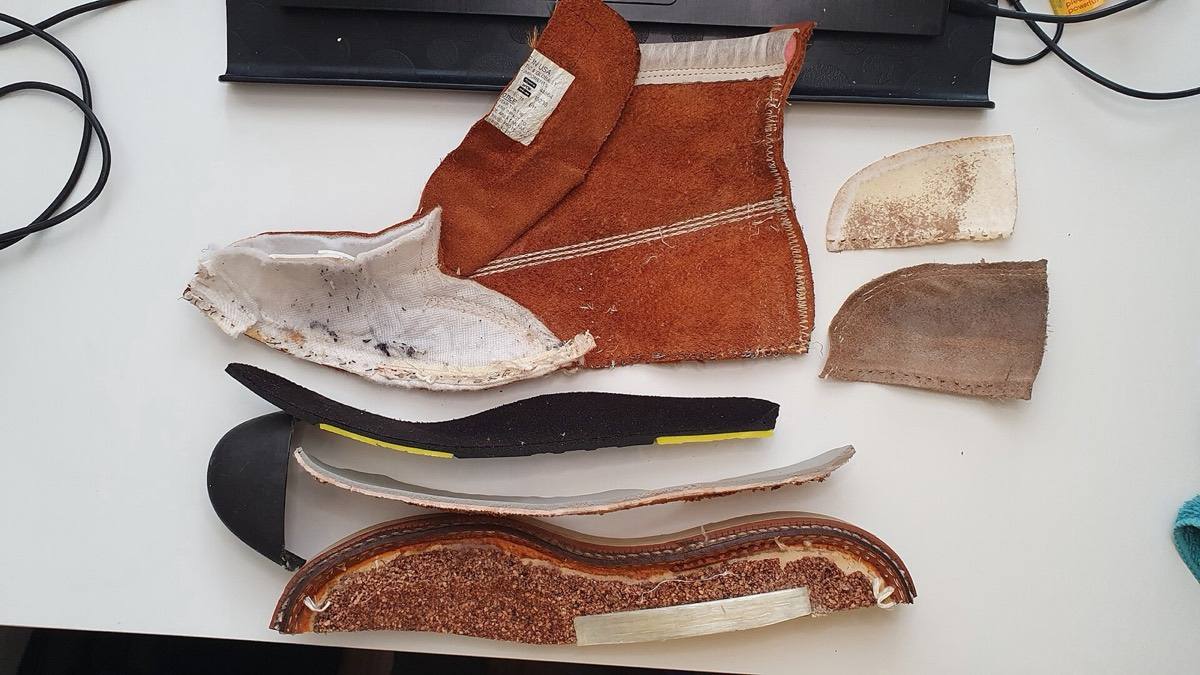
Irish Setter Ashby 6-inch Leather Safety Toe Boot
Irish Setter lists “ASTM F2413-24, I/C, EH SR” on this Goodyear-welted 6-inch boot, certified to the current edition. It comes in D and EE widths.
Buy it if: Buyers who want a thinner metal cap on a welted leather boot. Skip it if: You need it waterproof: the maker page makes no waterproof claim.
- Safety toe
- Aluminum toe
- Rating line
- ASTM F2413-24, I/C, EH SR
- Height
- 6 in
- Construction
- Goodyear welt
- Widths
- D, EE
- Maker also claims
- heat-resistant outsole
Specs: Irish Setter product page (2026-11-09)


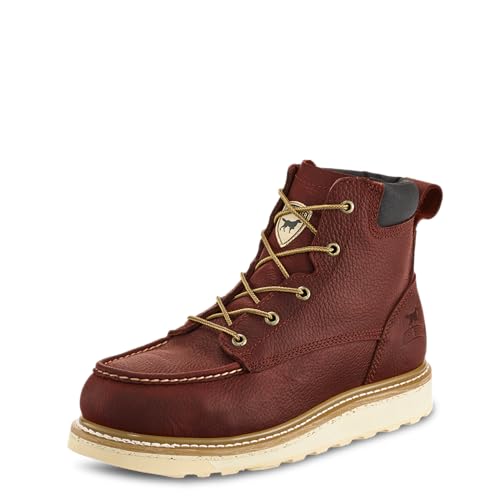
Product prices and availability are accurate as of 2026-11-13 and are subject to change. Amazon prices are for the size and colour linked and vary by size. Specs are the makers' published figures; we don't wear-test boots.
Side by side: steel, composite, alloy and carbon
The table compares the four toe materials on the points the standards and makers actually publish. Where no source states something, the cell says so rather than filling the gap with folklore.
| Steel | Composite | Alloy / aluminum | Carbon fibre | |
|---|---|---|---|---|
| F2413 impact test (I) | 75 ft-lbf, same test | 75 ft-lbf, same test | 75 ft-lbf, same test | 75 ft-lbf, same test |
| F2413 compression test (C) | 2,500 lbf, same test | 2,500 lbf, same test | 2,500 lbf, same test | 2,500 lbf, same test |
| Metal in the cap | Yes | No | Yes | No |
| Can set off metal detectors | Yes, can (Justin Boots) | No source says either way | Metal, so likely; no source | No source says either way |
| Weight vs steel | Baseline | Makers market as lighter; no standard figure | Makers market as lighter; no standard figure | KEEN: 15% lighter than steel |
| EH available | Yes (33 of 37 in our catalogue) | Yes (14 of 16) | Yes (3 of 3) | Yes (3 of 3) |
| Boots in our catalogue | 37 | 16 | 3 (2 alloy, 1 aluminum) | 3, plus 1 listed as nonmetallic |
Is composite toe as strong as steel toe?
For the purpose that matters on a job site, yes. Thorogood's ASTM guide says “All boots with a safety toe (either steel or composite) meet or exceed the following IMPACT and COMPRESSION testing”: 75 ft-lb of impact, 2,500 lbs of compression, with at least 0.500 inch of interior clearance left in a men's boot and 0.468 inch in a women's. Thorogood's separate testing page states that composite toes meet the same certification as steel.
What the standard doesn't do is rank materials above the pass mark. F2413 is pass/fail. A label doesn't tell you that one cap survived more than 75 ft-lbf, and no public source publishes per-material results beyond the test. Any page claiming steel is “twice as strong” is quoting a number the standard doesn't produce.
Myth: steel toes will cut your toes off
This one circulates in every composite toe vs steel toe thread: if something heavy enough crushes a steel cap, the folded edge will amputate the toes inside, so you're better off without. We looked for a source behind it. None of the regulators, standards bodies or test labs in our source register says it, and we found no published study supporting it. So we won't repeat it as fact, and we won't repeat the reverse claim either.
What the sources do say: the caps are tested to keep a minimum interior space under 75 ft-lbf of impact and 2,500 lbf of compression. Past those loads, no public source describes how either material fails. The practical advice that does exist is CCOHS's, in the section on replacement below.
Weight: maker claims, not measurements
Lighter weight is the main reason people choose composite, and it's the hardest point to verify. Makers market composite and carbon caps as lighter; KEEN's Cincinnati page says “Carbon toes are 15% lighter than steel.” That's a maker's claim about its own caps, not a figure from a standards body, and it describes the cap, not the whole boot.
Comparing whole boots doesn't settle it either, because a boot's weight is mostly sole, leather and construction. In our catalogue, makers publish weight in different forms or not at all: KEEN gives 34.57 oz per shoe for the welted Cincinnati and 25.82 oz per shoe for the Evanston INT MET; Irish Setter gives “3 lbs. 8 oz.” for the Ashby without saying per pair or per boot. Those numbers can't be lined up fairly. If weight is the deciding factor, compare the maker's published weights for the specific boots you're considering, and treat the toe material as one part of it.
EH is a property of the whole boot, not the toe
A common claim, repeated on at least one page-one competitor, is that a composite toe makes a boot safe around electricity. It doesn't. EH is its own test in F2413: the whole boot as built must withstand 18,000 volts at 60 Hz for one minute with no more than 1.0 mA of leakage, dry. A composite boot without EH on its label hasn't passed it, and a steel-toe boot with EH has.
Our catalogue shows how little the toe material predicts. Of 37 steel-toe boots, 33 carry EH; of 16 composite-toe boots, 14 do. The share is almost identical. For electrical work, filter on the EH code, then choose the toe material on other grounds.
Airports, secure sites and metal detectors
For flying in the US, the question changed in July 2025. TSA announced a policy that “will allow passengers traveling through domestic airports to keep their shoes on while passing through security screening at TSA checkpoints.” Other screening steps still apply. Justin Boots, a maker, says “Yes, steel toe boots can set off metal detectors at airport security”, that TSA “does not prohibit steel toe boots in carry-on or checked luggage”, and that “If your boots trigger the alarm, TSA officers may conduct extra screening”.
Composite is where we have to be careful. The reasoning is simple: a composite or carbon cap has no metal, so the cap itself shouldn't trigger a metal detector. But no TSA page or other authoritative source we found says composite-toe boots won't alarm, and a boot can contain metal elsewhere: eyelets, a steel shank, a metal puncture plate. Wolverine lists nylon shanks on both the Overpass and the Floorhand, for example, but eyelet and hardware materials are rarely published. If you pass a walk-through detector every shift at a plant or secure site, ask whether your site has a policy on safety footwear before you buy.
Alloy and carbon: the other two options
Alloy toes, usually aluminium, are still metal, so they don't solve the metal-detector question. Makers use them to make a thinner cap than steel. In our catalogue they appear on Timberland PRO's Powertrain Sport and Reebok Work's Sublite Cushion (both low-cut safety shoes) and Irish Setter's Ashby, which Irish Setter rates “ASTM F2413-24, I/C, EH SR”.
Carbon-fibre and other nonmetallic caps sit with composite: no metal in the cap. KEEN uses asymmetrical left and right carbon toes on its Cincinnati and Evanston boots, and says its carbon safety toes “have a lower-profile fit and weigh 15% less than steel.” Irish Setter's Wingshooter ST is listed as nonmetallic with the same “ASTM F2413-24, I/C, EH SR” line as the Ashby. Both are certified to the same impact and compression tests as everything else here.
After a hard hit, replace it, whatever the cap
CCOHS, Canada's occupational safety agency, advises replacing safety footwear after a puncture or impact event, because the damage may not be visible. That applies to steel and composite alike. A cap that took a real blow has done its job once, and the standard only tells you it passed when new.
Two other things can quietly cancel a boot's certification regardless of toe material. ASTM F2413-24 §1.4 says after-market footbeds or inserts, or resoling, could make the ASTM marking invalid. Don't count on a resole to extend a safety boot's working life without checking with the maker and your employer first.
Does OSHA prefer one over the other?
No. OSHA's foot-protection rule, 29 CFR 1910.136, requires protective footwear that complies with the referenced ASTM or ANSI standards, or that the employer demonstrates is at least as effective. It never names a toe material. Thorogood's guide states that “OSHA does not test, approve, certify, or endorse any product.” An employer can still write “steel toe” into its own policy; that's a company rule, and the place to ask about composite is your supervisor or safety lead, with the boot's rating line in hand. Our OSHA requirements guide quotes the rule in full.
Verdict: which toe for which job
Since both pass the same test, choose on the practical differences. Prices below are bands from our catalogue's live Amazon prices on 9 November 2026: check the card for today's price.
- Tight budget or first pair: steel. Steel-toe boots in our catalogue start under $50 and the middle of the range sits around $115; composite starts around $65 with a middle around $155.
- Widest choice of styles, widths and brands: steel. It's 37 of the 60 boots in our catalogue, including wellingtons, loggers and western pull-ons.
- Walk-through metal detectors at work: composite or carbon, with the caveat that eyelets, shanks and puncture plates may be metal. Ask your site.
- Electrical work: either, as long as EH is on the label. The toe material doesn't decide it.
- Weight-sensitive (long walking shifts): composite or carbon is the maker-claimed lighter option, but compare published weights for whole boots.
- Heavy-load or metatarsal exposure: either with the codes the job needs (Mt, PR). In our catalogue, Mt appears on steel, composite and carbon boots.
Questions people ask
- Is composite toe as safe as steel toe?
- Yes, by the standard. A composite toe certified to ASTM F2413 passed the same 75 ft-lbf impact test and 2,500 lbf compression test as a steel toe with the same codes. The standard is pass/fail and doesn't rank materials above the pass mark.
- Does OSHA allow composite toe boots?
- Yes. OSHA 1910.136 requires footwear that meets the referenced standards or is shown at least as effective; it never specifies steel. OSHA doesn't approve any boot, steel or composite. Your employer's own policy can still be stricter.
- Can composite toe boots go through a metal detector?
- The cap has no metal, so it shouldn't trigger one by itself, but no TSA or other authoritative source confirms composite boots won't alarm, and eyelets, shanks or puncture plates may be metal. At US domestic airports, TSA's July 2025 policy lets passengers keep shoes on through screening, with other screening steps still applying.
- Are composite toe boots lighter than steel toe?
- Makers say so. KEEN, for example, says its carbon toes are 15% lighter than steel. No standards body publishes a weight comparison, and whole-boot weight depends far more on the sole and construction than on the cap.
- Do steel toe boots cut off your toes in an accident?
- We found no source that supports this. The standard tests that the cap keeps a minimum space for the toes under 75 ft-lbf impact and 2,500 lbf compression; no public source describes how either material behaves beyond those loads.
- Are composite toe boots better for electricians?
- Not because of the toe. Electrical-hazard protection (EH) is tested on the whole boot. In our catalogue, 33 of 37 steel-toe boots and 14 of 16 composite-toe boots carry EH. Filter on EH first.
- What's the difference between alloy toe and composite toe?
- Alloy (usually aluminum) toes are metal and are made thinner than steel; composite and carbon toes have no metal. All pass the same F2413 impact and compression tests when certified.
- Should I replace my boots after something heavy falls on them?
- Yes. CCOHS advises replacing safety footwear after an impact or puncture event because damage may not be visible. That applies to steel and composite toes alike.
Sources & further reading
- Thorogood: A Guide to ASTM Ratings and OSHA Work Boots
- Thorogood: ASTM Testing for Boots
- ASTM F2413-24 abstract
- OSHA 29 CFR 1910.136 Foot protection
- TSA/DHS press release, July 8, 2025: shoes-on policy
- Justin Boots: Steel toe boots and airport security
- CCOHS OSH Answers: Safety footwear
- KEEN Cincinnati 6" carbon-toe product page
- Wolverine Overpass CarbonMAX 6" product page
- Wolverine Floorhand Waterproof Steel-Toe 6" product page
- Irish Setter Ashby product page
- Irish Setter Wingshooter ST product page
Read next
- Composite Toe Shoes
Composite toe shoes compared on makers' published ASTM F2413 lines: 5 low-cut shoes and 4 low boots, what composite means, EH vs SD, and when a boot is better.
- OSHA Steel Toe Requirements
OSHA steel toe requirements quoted from 1910.136 and 1926.96: when foot protection is required, which standards count, and why composite toes qualify too.
- ASTM F2413-18 Decoded
ASTM F2413-18 explained line by line: what I, C, Mt, EH, SD and PR mean, the test values behind each, what changed in F2413-24, and if an -18 boot meets OSHA.
- Electrician Boots
Electrician boots need an EH line on the label, not just a composite toe. What the 18,000 V test covers, EH vs SD vs Cd, lineman boots and six EH-rated picks.
- Best Steel Toe Boots
Best steel toe boots for 2026: 8 picks across budget, waterproof, metal-free, EH, met guard, women's, slip-on and western, each with its published ASTM line.
Part of Safety Toe Boots. Back to the The Boot Yard home page.

The Boot Yard editors · Editorial team
The Boot Yard's catalogue and guides are compiled by the site's editorial team from makers' published product pages, ASTM F2413 rating lines and OSHA's foot-protection rules. We do not wear-test boots, and we never claim to: every spec on the site links to the page it came from.
About this site · How pages are checked · Last updated November 8, 2026
As an Amazon Associate, The Boot Yard earns from qualifying purchases. It costs you nothing extra and never decides which boots we list.
The Boot Yard is an independent site. It is not affiliated with ASTM International, OSHA or any boot brand. Brand names and trademarks belong to their owners. Our guides explain published standards; your employer's safety program and the boot's own label decide what you must wear.