Guide
Slip On Work Boots With a Safety Toe: Chelsea, Western and Rubber Pull-Ons
By The Boot Yard editors · Updated 2026-11-08 · How we research
We may earn a commission when you buy through links on this page.
Short answer
The best slip on work boots for safety-toe jobs are pull-ons whose maker states ASTM F2413 impact and compression protection: Chelsea styles like the Wolverine Rancher Level or Ariat Groundbreaker for everyday wear, an 11-inch western such as the Irish Setter Marshall for mud and yards, and a rubber Muck Chore Classic for standing water. None in our catalogue offers a metatarsal guard or puncture plate.
Picture the site trailer at 6:45: one person is double-knotting laces that came undone in the mud yesterday, and the next is already out the door because slip on work boots go on in five seconds. That speed is why pull-ons are popular, and laces snagging on rebar or a step are the other reason workers ask for them. The trade-off is fit: with no laces, the boot has to hold your heel and instep by its shape alone.
In our catalogue of 60 safety-toe models, 11 boots and 3 shoes have no laces. The boots fall into four families, each suited to different work. Every one carries a maker statement of ASTM F2413 toe protection, but none offers a metatarsal guard or a puncture-resistant plate. That alone rules pull-ons out of some jobs. The picks above cover the main uses; the sections below show all 11, when to choose a pull-on over laces, how to check fit without laces to adjust, and which codes to look for.
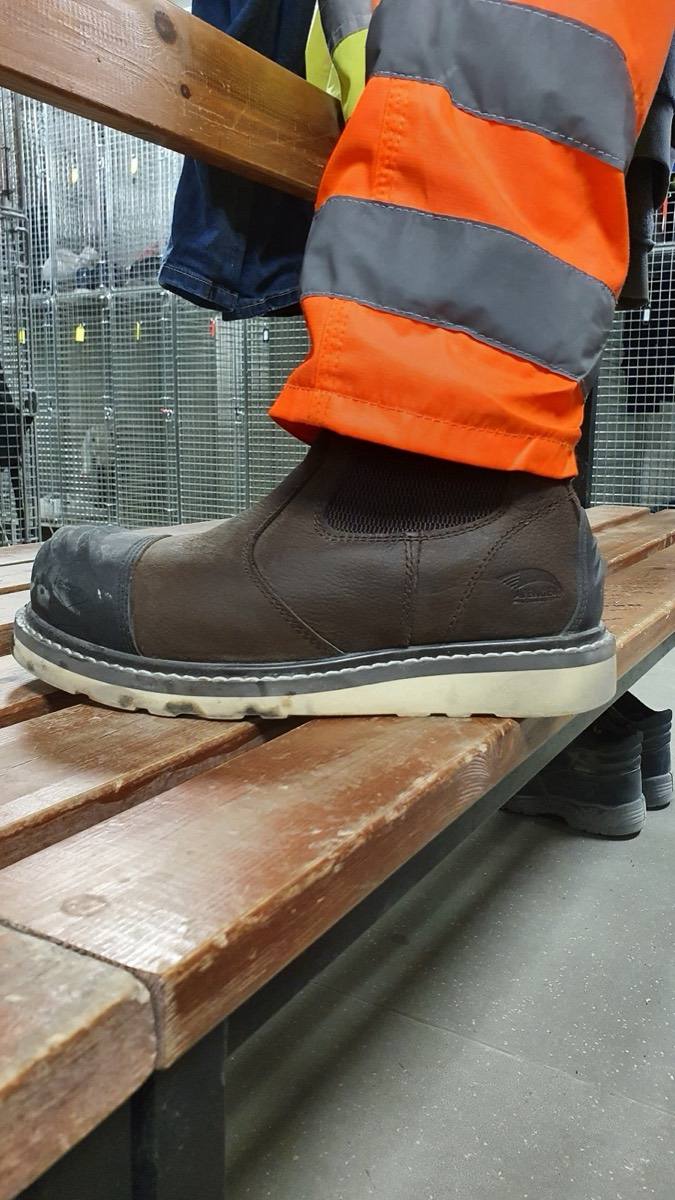
Slip-on safety boots by job
1. Best everyday steel-toe Chelsea
Wolverine Rancher Level Chelsea Slip-On Steel-Toe Work Boot
Wolverine rates it "ASTM F2413-24 I/C EH SR", one of the few pull-ons here rated to the newest edition with slip resistance on the rating line itself. The upper is waterproof oiled nubuck leather on a cement build with a removable EVA footbed. Height isn't published.
Buy it if: Shop, plant and yard work where you want a light Chelsea that handles wet ground. Skip it if: You want a resoleable welt.
- Safety toe
- Steel toe
- Rating line
- ASTM F2413-24 I/C EH SR
- Waterproof
- Waterproof oiled nubuck leather upper
- Construction
- cement
- Widths
- M, EW
Specs: Wolverine product page (2026-11-09)
2. Best waterproof Chelsea
Ariat Groundbreaker Chelsea Waterproof Steel Toe Work Boot
Ariat lists "ASTM F2413 I/C EH SR rated" with DRYShield waterproof, breathable construction, twin elastic gores, a back pull tab and reflective heel details. The maker gives a 6-inch height and D and EE widths. Some Amazon bullets claim metatarsal protection and insulation; Ariat's own page supports neither.
Buy it if: Wet-weather work where you still want a low, easy boot. Skip it if: You need a narrow fit; Ariat lists D and EE only.
- Safety toe
- Steel toe
- Rating line
- ASTM F2413 I/C EH SR rated
- Height
- 6 in
- Waterproof
- DRYShield™ waterproof, breathable construction
- Widths
- D, EE
- Maker also claims
- heat-resistant outsole
Specs: Ariat product page (2026-11-09)
3. Best tall western-style pull-on
Irish Setter Marshall 11-inch Waterproof Leather Safety Toe Pull-On Boot
An 11-inch square-toe pull-on that Irish Setter rates "ASTM F2413-24, I/C, EH SR", with the UltraDry waterproofing system, a steel shank and a Goodyear welt. The tall shaft keeps mud and brush out better than a Chelsea.
Buy it if: Ranch, oil-field and yard work in mud. Skip it if: You kneel or squat all day; tall pull-ons bind at the shin.
- Safety toe
- Steel toe
- Rating line
- ASTM F2413-24, I/C, EH SR
- Height
- 11 in
- Waterproof
- UltraDry™ Waterproofing System
- Construction
- Goodyear welt
- Widths
- D, EE
- Maker also claims
- heat-resistant outsole
Specs: Irish Setter product page (2026-11-09)
4. Budget slip-on safety boot
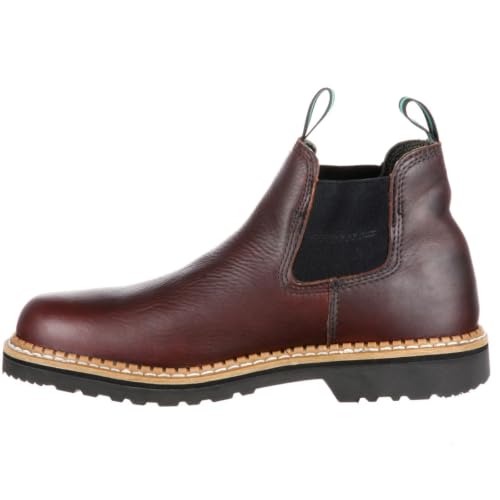
Georgia Boot Georgia Giant Waterproof Steel Toe Chelsea
Georgia states the Giant Chelsea "meets ASTM standards for protective toe and electrical hazard" (ASTM F2413 protective toe classification) and backs it with Georgia Waterproof. Georgia publishes no I/C line, so quote its wording to your supervisor. A 5-inch shaft and an oil-resistant PU outsole; its live price has sat under $100.
Buy it if: A first safety pull-on on a budget. Skip it if: You want tall coverage or a heat-resistant outsole.
- Safety toe
- Steel toe
- Rating line
- ASTM F2413 protective toe classification
- Height
- 5 in
- Waterproof
- Georgia waterproof system
- Construction
- Goodyear welt
- Widths
- D, EE
- Maker also claims
- slip-resistant outsole
Specs: Georgia Boot product page (2026-11-09)
5. Best composite-toe pull-on
Ariat WorkHog Waterproof Composite Toe Work Boot
Ariat rates the WorkHog "ASTM F2413 I/C EH SR rated" with a non-metallic composite toe, DRYShield waterproofing, an 11-inch shaft and a resoleable Goodyear welt. Ariat's U-Turn entry system is built for people with high arches, a common pull-on problem.
Buy it if: High insteps that struggle to get into a standard pull-on, and anyone avoiding a metal toe. Skip it if: Budget is tight; it is one of the dearest pull-ons here.
- Safety toe
- Composite toe
- Rating line
- ASTM F2413 I/C EH SR rated
- Height
- 11 in
- Waterproof
- DRYShield™ waterproof, breathable construction
- Construction
- Goodyear welt
- Widths
- B, D, EE
- Maker also claims
- heat-resistant outsole
Specs: Ariat product page (2026-11-09)
6. Best for standing water
Muck Boot Company Chore Classic Men's Steel Toe Boot
A 16-inch rubber boot over a 5 mm neoprene bootie. Muck's wording is "CERTIFIED IMPACT & COMPRESSION (ASTM OR CAN/CSA); ASTM Certified Against Electrical Hazard; ASTM F3445 slip-resisting", and it describes the boot as "100% Waterproof".
Buy it if: Farms, wash bays, concrete and drainage work. Skip it if: You need more than one width; Muck lists Medium (D) only.
- Safety toe
- Steel toe
- Rating line
- CERTIFIED IMPACT & COMPRESSION (ASTM OR CAN/CSA); ASTM Certified Against Electrical Hazard; ASTM F3445 slip-resisting
- Height
- 16 in
- Waterproof
- 100% Waterproof, 100% MUCKPROOF
- Widths
- Medium (D)
Specs: Muck Boot Company product page (style CHS000A) (2026-11-09); Amazon listing (brand store) — rating line only (2026-11-09)
7. Best women's slip-on safety boot
Carhartt Women's Frontier Water Resistant Steel Toe Chelsea
Carhartt states it "Meets ASTM F2413-24 EH standards" and "Meets ASTM F3445-24 SR standards" for its women's steel-toe Chelsea, with a heat-resistant outsole rated to 300°C/572°F. It is water resistant (Rain Defender, "light rain"), not waterproof.
Buy it if: Women who want a pull-on built on a women's pattern for mostly dry work. Skip it if: You stand in puddles, or need a width other than M.
- Safety toe
- Steel toe
- Rating line
- Meets ASTM F2413-24 EH standards; Meets ASTM F3445-24 SR standards
- Widths
- M
- Maker also claims
- heat-resistant outsole
Specs: Carhartt product page (2026-11-09)




Product prices and availability are accurate as of 2026-11-13 and are subject to change. Amazon prices are for the size and colour linked and vary by size. Specs are the makers' published figures; we don't wear-test boots.
14 boots match.
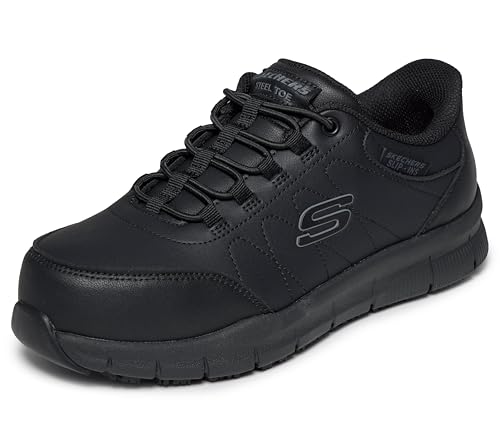
Skechers Slip-ins Work: Nampa - Enelo
Steel toe · shoe · women's
ICEH
slip-resistant outsole (maker's claim)
Specs: Skechers product page (style 108353) (2026-11-09)
Georgia Boot Georgia Giant Waterproof Steel Toe Chelsea
Steel toe · chelsea · 5 in · men's · waterproof
ICEH
slip-resistant outsole (maker's claim)
Specs: Georgia Boot product page (2026-11-09)
HEYDUDE Wendy Work CT
Composite toe · shoe · women's
ICEH
slip-resistant outsole (maker's claim)
Specs: HEYDUDE product page (style 44289) (2026-11-09)
Wolverine Rancher Level Chelsea Slip-On Steel-Toe Work Boot
Steel toe · chelsea · men's · waterproof
ICEHSR
Specs: Wolverine product page (2026-11-09)
Muck Boot Company Chore Classic Men's Steel Toe Boot
Steel toe · rubber · 16 in · men's · waterproof
ICEHSR
Specs: Muck Boot Company product page (style CHS000A) (2026-11-09)
Skechers Slip-ins Work: Cankton - Faison
Steel toe · shoe · men's
ICEH
Specs: Skechers product page (style 200211) (2026-11-09)
HEYDUDE Bradley II Work CT Leather
Composite toe · boot · men's
ICEH
slip-resistant outsole (maker's claim)
Specs: HEYDUDE product page (style 46122) (2026-11-09)
Ariat Groundbreaker Chelsea Waterproof Steel Toe Work Boot
Steel toe · chelsea · 6 in · men's · waterproof
ICEHSR
heat-resistant outsole (maker's claim)
Specs: Ariat product page (2026-11-09)
Carhartt Women's Frontier Water Resistant Steel Toe Chelsea
Steel toe · chelsea · women's
ICEHSR
heat-resistant outsole (maker's claim)
Specs: Carhartt product page (2026-11-09)
Ariat Groundbreaker Wide Square Toe Steel Toe Work Boot
Steel toe · western · 10 in · men's
ICEHSR
heat-resistant outsole (maker's claim)
Specs: Ariat product page (2026-11-09)
Muck Boot Company Men's Arctic Sport Steel Toe Insulated Boot
Steel toe · rubber · 16 in · men's · waterproof · 5mm Neoprene Bootie; 2mm Thermal Foam Under Foot; Warm Fleece Lining
ICEH
Specs: Muck Boot Company product page (style ASP-STL) (2026-11-09)
Irish Setter Marshall 11-inch Waterproof Leather Safety Toe Pull-On Boot
Steel toe · pull-on · 11 in · men's · waterproof
ICEHSR
heat-resistant outsole (maker's claim)
Specs: Irish Setter product page (2026-11-09)
Ariat WorkHog Waterproof Composite Toe Work Boot
Composite toe · western · 11 in · men's · waterproof
ICEHSR
heat-resistant outsole (maker's claim)
Specs: Ariat product page (2026-11-09)
Danner Bull Run Chelsea 6" Brown - Steel Toe
Steel toe · chelsea · 6 in · men's
ICEH
slip-resistant outsole (maker's claim)
Specs: Danner product page (style 15484) (2026-11-09)


Specs are makers' published figures, linked on every card. Prices as of 2026-11-13; product prices and availability are subject to change. As an Amazon Associate we earn from qualifying purchases.
Four kinds of pull-on safety boot
The families differ in height, how they grip your foot, and how well they keep out water and debris.
Height is the first decision. A Chelsea's 5- to 6-inch shaft is about the same as a standard lace-up work boot, but it has an open elastic gore on each side, so gravel, sawdust and spatter find their way in more easily than past a laced tongue. Western and wellington styles add 4 to 5 inches of leather and close the top around the calf. Rubber boots go to 16 inches and seal completely, at the cost of weight, heat and a looser heel.
Construction is the second. Cement-built pull-ons such as the Wolverine Rancher Level are generally lighter and lower in price; welted ones (Irish Setter Marshall, Ariat WorkHog, Georgia Giant) are built to be resoled by the maker or a cobbler. Ask the maker which resole keeps the safety rating before you send a pair off.
- Chelsea (5 to 6 in, elastic side gores): Wolverine Rancher Level, Ariat Groundbreaker Chelsea, Georgia Giant, Danner Bull Run, Carhartt Women's Frontier. Light and quick, with the lowest shaft, so water and gravel get in sooner.
- Western or wellington (10 to 11 in, pull loops): Irish Setter Marshall, Ariat Groundbreaker Wide Square Toe, Ariat WorkHog. Taller coverage for mud and brush, heavier, and more snug at the calf.
- Rubber (16 in): Muck Chore Classic and Muck Arctic Sport. The only fully waterproof-by-material group; the Arctic Sport is insulated with a neoprene bootie.
- Easy-on lace-look: HEYDUDE Bradley II Work CT, with an adjustable fixed lace and heel pull, metal-free with a composite toe. It looks like a lace-up and goes on like a slip-on.
| Boot | Height | Toe | Water | Maker's ASTM wording |
|---|---|---|---|---|
| Wolverine Rancher Level Chelsea | - | Steel | Waterproof oiled nubuck | ASTM F2413-24 I/C EH SR |
| Ariat Groundbreaker Chelsea WP | 6 in | Steel | DRYShield | ASTM F2413 I/C EH SR rated |
| Georgia Giant Chelsea | 5 in | Steel | Georgia waterproof | ASTM F2413 protective toe classification; EH |
| Danner Bull Run Chelsea 6" | 6 in | Steel | Water-resistant | ASTM F2413-24 I/C EH |
| Carhartt Women's Frontier Chelsea | - | Steel | Water resistant | Meets ASTM F2413-24 EH; F3445-24 SR |
| Irish Setter Marshall 11" | 11 in | Steel | UltraDry | ASTM F2413-24, I/C, EH SR |
| Ariat Groundbreaker Wide Square | 10 in | Steel | Not waterproof (this version) | ASTM F2413 I/C EH SR rated |
| Ariat WorkHog WP | 11 in | Composite | DRYShield | ASTM F2413 I/C EH SR rated |
| Muck Chore Classic | 16 in | Steel | 100% waterproof rubber | Certified impact & compression (ASTM or CAN/CSA); EH; F3445 |
| Muck Arctic Sport Tall | 16 in | Steel | 100% waterproof rubber | ASTM F2413-11 M I/75 C/75 EH |
| HEYDUDE Bradley II Work CT | - | Composite | Water-repellent spray | ASTM F2413 I/C EH rated |
When a pull-on beats laces, and when it doesn't
Laces let you tighten the boot around the instep and ankle; a pull-on can't be adjusted after you buy it. Workers who prefer pull-ons usually accept some heel lift in exchange for speed and no snags. Whether that trade suits you depends on the ground you work on more than on the boot.
The speed argument is real. Laces get cut, caked with mud and come undone, and a lace caught on a rebar end or ladder rung can trip you. Pull-ons remove that failure point. The counter-argument is also real: a boot you can't snug down lets the foot move inside it, and on uneven ground that movement is where a rolled ankle starts. Workers on forums tend to split along job lines, which matches the list below.
- Good fit: flat yards, shops and plants; jobs where you take boots off often (drivers, inspectors, people moving between site and office); oil-field and ranch work where laces cake with mud; anyone with limited hand mobility.
- Good fit: hot-work areas where a lace can catch a spark or snag. Several pull-ons here list heat-resistant outsoles (Ariat's Duratread passes hot contact testing at 300°C/572°F by Ariat's statement), but that is a sole claim, not a welding rating.
- Think twice: ladders and scaffolds all day. A loose heel slips on rungs. If you go pull-on, choose one with a defined heel; Ariat specifies a 90-degree heel on the Groundbreaker Wide Square for ladders and rungs.
- Think twice: uneven ground, slopes and rebar mats, where a snug ankle helps you stay upright.
- Not an option: jobs that require a metatarsal guard (none of the 11 has Mt) or puncture resistance (none has PR). See met guard boots and construction boots for those.
- Not an option: sites whose written policy requires lace-up boots. Some contractors write this into their safety plan; ask before buying.
Fit checklist for a boot with no laces
Laceless boots are less forgiving of the wrong size, because there is nothing to tighten. Go through this list in the store or within the return window, wearing your work socks.
Sizing also varies by brand more than people expect, and western and Chelsea lasts are often cut differently from the same maker's lace-ups. If you know your size in one brand's lace-up, convert it through the makers' own foot-length charts on our work boot size chart page before ordering a pull-on from another brand. Width options are narrow in this category: Ariat, Irish Setter, Georgia and Danner list D and EE (Ariat adds a B width on the WorkHog), so a foot wider than EE has few laceless choices, Wolverine lists M and EW, Muck lists Medium (D) only, and Carhartt's women's Frontier lists M.
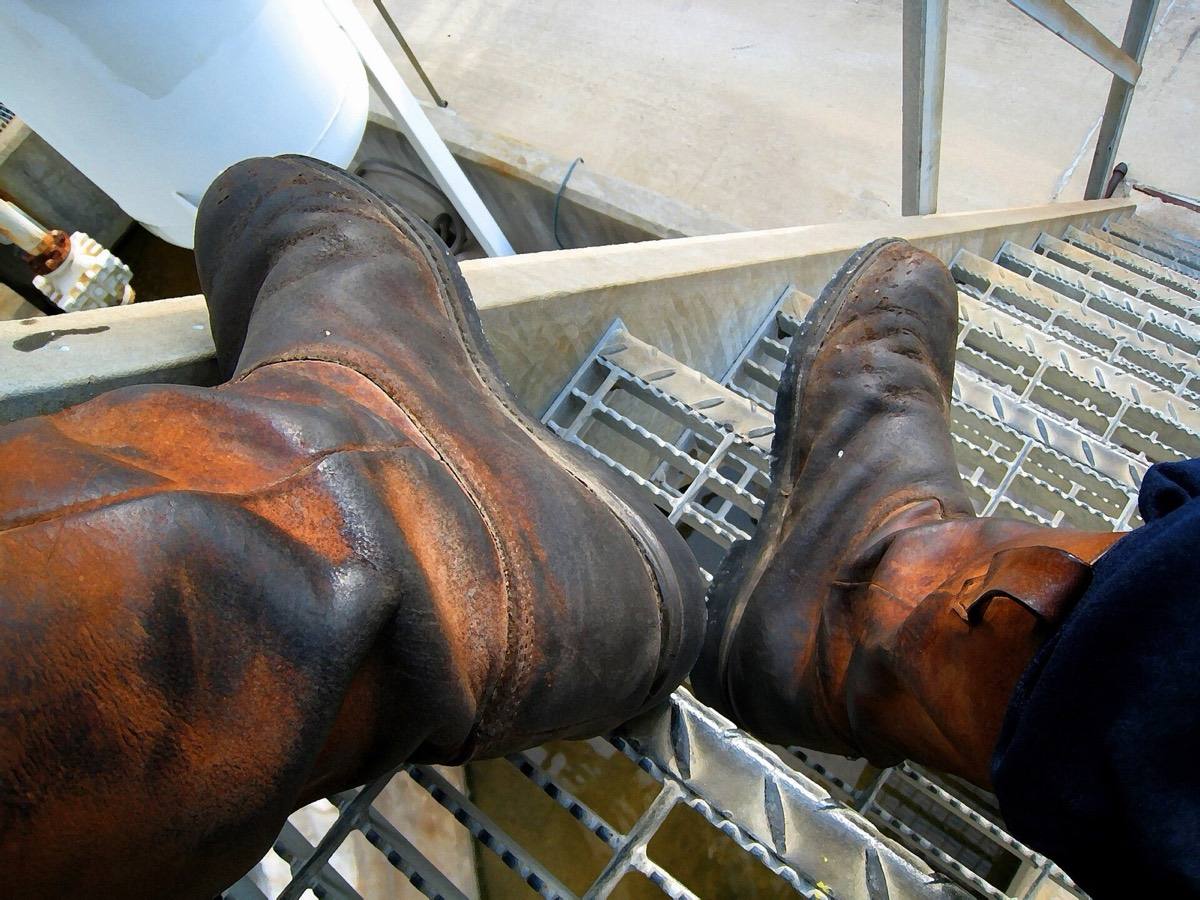
- Try them on around midday, when feet are larger. CCOHS recommends this for all safety footwear.
- Check toe room: about 12.5 mm in front of the longest toe (CCOHS), and the safety cap edge should not press on top of your toes when you flex.
- Walk up a slope or stairs. Some heel lift is normal in a new pull-on; a heel that slides up and back with every step will rub and will let your foot push forward into the cap.
- Check the instep. It should feel firm going in. If it slides on with no effort at all, the boot will loosen further as the leather softens; leather softens, but CCOHS warns not to expect footwear to stretch, and the safety cap never will.
- Kneel and squat if your job involves it. Tall western shafts can press on the shin; Chelsea gores can dig in at the ankle bone.
- High arch? Pull-ons are hardest to enter with a high instep. Ariat's U-Turn entry on the WorkHog is built for that problem, and a Chelsea's elastic gores give more than a solid western shaft. Try the boot on at the end of a work day if you can, when the instep is at its fullest.
- Don't fix a loose fit with thick aftermarket insoles. The ASTM F2413-24 abstract says after-market footbeds or inserts could make the ASTM marking invalid; ask the maker which inserts keep the rating.
- Getting them off matters too. A pull-on that fits well should need a firm tug at the heel or a boot jack at the end of the day. If it falls off when you lift your heel, it is too big; if you can't get it off without help, the instep is too tight and will hurt by mid-shift.
Codes to check before you buy a pull-on
Pull-ons in our catalogue carry fewer codes than lace-ups, so read the label with your job in mind. Every one states toe protection; beyond that they differ. Run through these before ordering, and photograph the tongue label when the boots arrive so you can show it at the gate.
Your employer's hazard assessment and the boot's label decide what is required. If the site needs Mt or PR, none of the slip on work boots we track will qualify, so a lace-up is the answer. For the waterproof and insulated side of the choice, see waterproof work boots and insulated work boots; for western styling with a lace-free shaft, steel toe western boots goes deeper.
- I and C (impact and compression): every boot above has a maker statement. Older labels print I/75 C/75; F2413-18 and -24 labels print I and C. Carhartt and Georgia name the standard without printing an I/C line, so quote their wording.
- EH (electrical hazard): all 11 claim it. EH is secondary protection in dry conditions; CCOHS notes it deteriorates with wear and in wet environments, which matters for rubber boots used in water.
- SR (slip resistance): written into the rating line by Wolverine, Ariat and Irish Setter; Carhartt and Muck name ASTM F3445. Georgia and Danner describe oil and slip resistance without a standard.
- Heat-resistant outsoles (Ariat, Carhartt) are maker claims and not an F2413 code.
- Edition year: Wolverine, Irish Setter, Danner and Carhartt cite F2413-24; Muck's Arctic Sport cites F2413-11. OSHA's rule references the 2005 editions and accepts footwear shown to be at least as effective, so an older edition isn't automatically non-compliant, but a newer one is easier to show a safety manager.
Questions people ask
- Are slip-on boots allowed on construction sites?
- It depends on the site. OSHA's construction rule, 1926.96, requires safety-toe footwear meeting the referenced standard and says nothing about laces, but many contractors' own policies require 6-inch lace-up boots. Ask for the written policy.
- Do pull-on boots give less ankle support than lace-ups?
- They can't be tightened, so they hold the ankle by shape alone, and many workers say lace-ups feel more secure on rough ground. A tall western shaft gives more coverage; a Chelsea gives the least. No standard tests ankle support.
- Which slip-on safety boots are waterproof?
- In our catalogue: Wolverine Rancher Level, Ariat Groundbreaker Chelsea WP, Ariat WorkHog WP, Irish Setter Marshall, Georgia Giant, and the two Muck rubber boots. Carhartt's women's Frontier and Danner's Bull Run are water resistant only.
- Are there women's slip-on safety boots?
- Few. The Carhartt Women's Frontier Chelsea is the only women's slip-on boot in our catalogue; the Skechers Nampa - Enelo and HEYDUDE Wendy Work CT are women's slip-on shoes with steel and composite toes.
Sources & further reading
- CCOHS OSH Answers: Safety Footwear
- ASTM F2413-24 abstract (ASTM International)
- OSHA 29 CFR 1910.136 Foot protection
- OSHA 29 CFR 1926.96 Occupational foot protection
- Thorogood, A Guide to ASTM Ratings and OSHA Work Boots (quotes ASTM F2413-18)
- r/WorkBoots thread on pull-on safety boots (worker opinion)
- Quora: pros and cons of slip-on vs lace-up shoes (opinion)
- Wolverine Rancher Level Chelsea Slip-On Steel-Toe Work Boot: Wolverine product page (read 2026-11-09)
- Ariat Groundbreaker Chelsea Waterproof Steel Toe Work Boot: Ariat product page (read 2026-11-09)
- Irish Setter Marshall 11-inch Waterproof Leather Safety Toe Pull-On Boot: Irish Setter product page (read 2026-11-09)
- Georgia Boot Georgia Giant Waterproof Steel Toe Chelsea: Georgia Boot product page (read 2026-11-09)
- Ariat WorkHog Waterproof Composite Toe Work Boot: Ariat product page (read 2026-11-09)
- Muck Boot Company Chore Classic Men's Steel Toe Boot: Muck Boot Company product page (style CHS000A) (read 2026-11-09)
- Carhartt Women's Frontier Water Resistant Steel Toe Chelsea: Carhartt product page (read 2026-11-09)
- Danner Bull Run Chelsea 6" Brown - Steel Toe: Danner product page (style 15484) (read 2026-11-09)
- Ariat Groundbreaker Wide Square Toe Steel Toe Work Boot: Ariat product page (read 2026-11-09)
- Muck Boot Company Men's Arctic Sport Steel Toe Insulated Boot: Muck Boot Company product page (style ASP-STL) (read 2026-11-09)
- HEYDUDE Bradley II Work CT Leather: HEYDUDE product page (style 46122) (read 2026-11-09)
Read next
- Waterproof Work Boots
Waterproof work boots with safety toes, sorted by how each maker keeps water out: membrane, sealed seams, waterproof leather or rubber. 7 picks, 30 compared.
- Work Boot Size Chart
Work boot size chart built from eight makers' own published charts: measure your foot once, see the US size each brand lists for it, and find width letters.
- Construction Boots
Construction boots for new and working tradespeople: which ASTM codes a site calls for, what PR puncture resistance means, mud and ladder features, and 7 picks.
- Best Steel Toe Boots
Best steel toe boots for 2026: 8 picks across budget, waterproof, metal-free, EH, met guard, women's, slip-on and western, each with its published ASTM line.
Part of Best Steel Toe Boots. Back to the The Boot Yard home page.

The Boot Yard editors · Editorial team
The Boot Yard's catalogue and guides are compiled by the site's editorial team from makers' published product pages, ASTM F2413 rating lines and OSHA's foot-protection rules. We do not wear-test boots, and we never claim to: every spec on the site links to the page it came from.
About this site · How pages are checked · Last updated November 8, 2026
As an Amazon Associate, The Boot Yard earns from qualifying purchases. It costs you nothing extra and never decides which boots we list.
The Boot Yard is an independent site. It is not affiliated with ASTM International, OSHA or any boot brand. Brand names and trademarks belong to their owners. Our guides explain published standards; your employer's safety program and the boot's own label decide what you must wear.