Guide
Construction Boots: What the Site Needs, PR Explained, and 7 Picks
By The Boot Yard editors · Updated 2026-11-08 · How we research
We may earn a commission when you buy through links on this page.
Short answer
For most construction work, buy a safety-toe boot with I and C on the label, a waterproof upper and a defined heel for ladders. Add PR (puncture resistance) if nails and screws are underfoot. OSHA's construction rule, 1926.96, only requires a safety toe. Puncture and slip resistance come from your employer's hazard assessment, so ask before you buy.
Rebar ends, a nail sticking up from a form board, a bundle of studs sliding off a forklift, then forty minutes in ankle-deep mud: one day on site tests construction boots in more ways than any one ASTM code covers. The toe cap handles what falls. A puncture-resistant plate handles what's underfoot. The upper, the height and the heel handle the water, the mud and the ladders.
The stakes are real. A BLS-based analysis presented in Foot & Ankle Orthopaedics (2020) put the median time away from work after a construction foot injury at 19.76 days. This guide maps site hazards to codes, explains PR (the code most new workers haven't heard of), and corrects the widespread claim that OSHA requires puncture-resistant boots in construction. Then it compares seven boots by what their makers actually publish.
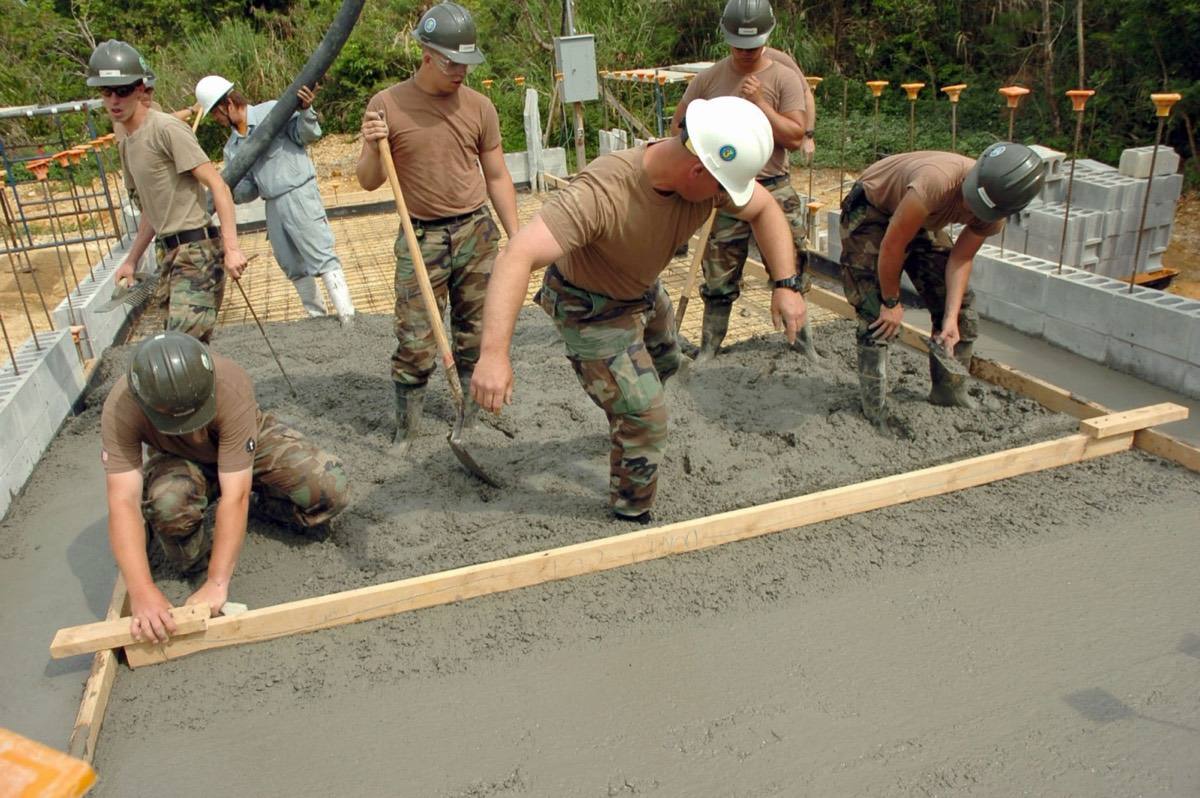
Construction boots we'd shortlist
1. Best all-round construction boot
KEEN Utility Pittsburgh 6" Waterproof Boot (Steel Toe)
KEEN states it 'Meets ASTM F3445-21 and F2413-18 M I/75 C/75 EH standards', which makes it one of the few picks with a named slip standard. It has a KEEN.DRY waterproof membrane and what KEEN calls a '90° heel (5/8'') for ladders and scaffolding'. The published shaft is 7.01 inches, and it comes in regular and wide.
Buy it if: Framers, carpenters and general laborers who climb ladders and work in wet conditions. Skip it if: Nails are a daily hazard and your site requires PR; it doesn't list puncture protection.
- Safety toe
- Steel toe
- Rating line
- Meets ASTM F3445-21 and F2413-18 M I/75 C/75 EH standards
- Height
- 7.01 in
- Waterproof
- KEEN.DRY waterproof, breathable membrane
- Construction
- cement
- Widths
- Regular, Wide
Specs: KEEN product page (2026-11-09)
2. Best for steady daily wear
Timberland PRO Pit Boss 6" Steel Toe
Timberland PRO's Amazon brand-store listing says the steel toe meets 'ASTM F2413-18 I and C' and lists EH protection to F2413-18. The heat-resistant rubber outsole is described as offering 'enhanced slip, oil and abrasion resistance', with no slip standard named. The listing doesn't say waterproof.
Buy it if: Dry-site trades who want a familiar 6-inch steel-toe boot with EH. Skip it if: You work in mud or standing water.
- Safety toe
- Steel toe
- Height
- 6 in
- Maker also claims
- slip-resistant outsole
Specs: Amazon listing (brand store) (2026-11-09)
3. Best moc-toe for slab and framing work
Thorogood American Heritage – 6″ Trail Crazy Horse Safety Toe – Moc Toe MAXWear 90™
Thorogood marks this boot 'SAFETY TOE BOOTS [ASTM F2413-18]' with an EH icon, a Goodyear storm welt and a MAXWear 90 slip-resistant outsole, made in the USA with USA and globally sourced components. Thorogood's spec table says non-waterproof and unlined. D and EE widths.
Buy it if: Workers on flat slabs and decks who want a resoleable moc-toe from a US factory. Skip it if: You stand in mud or wet concrete; it isn't waterproof.
- Safety toe
- Steel toe
- Rating line
- ASTM F2413-18
- Height
- 6 in
- Construction
- Goodyear storm welt
- Widths
- D, EE
- Maker also claims
- slip-resistant outsole
Specs: Thorogood product page (2026-11-09)
4. Best budget waterproof boot
Wolverine Floorhand Waterproof Steel-Toe 6" Work Boot
Wolverine prints 'ASTM F2413-18 M I/75 C/75 EH' with a waterproof membrane and a slip-resistant outsole, at a maker list price around $110. Cement construction keeps the cost down, but you can't resole it.
Buy it if: New hires who need a waterproof safety-toe boot before their first paycheck. Skip it if: You want a boot you can rebuild after a year of hard use.
- Safety toe
- Steel toe
- Rating line
- ASTM F2413-18 M I/75 C/75 EH
- Height
- 6 in
- Waterproof
- Breathable, waterproof membrane; waterproof full-grain leather upper
- Construction
- cement
- Widths
- M, EW
- Maker also claims
- slip-resistant outsole
Specs: Wolverine product page (2026-11-09)
5. Best tall laced boot for rough ground
Georgia Boot Georgia Boot Steel Toe Waterproof Logger Boot
Georgia Boot cites the ASTM F2413 protective-toe and electrical-hazard standards for this 8-inch steel-toe logger. It has Georgia waterproofing, a Goodyear welt, a removable kiltie and 'stud hooks & eyelets set on steel washers'. Georgia publishes two weights: 6.1 lb per pair for size 10, and 3.00 lb in its spec table.
Buy it if: Site prep, excavation and outdoor crews on uneven ground who want ankle support and a lug sole. Skip it if: You climb ladders most of the day and prefer a lighter boot.
- Safety toe
- Steel toe
- Rating line
- ASTM F2413 protective toe classification; ASTM F2413 electrical hazard standard
- Height
- 8 in
- Waterproof
- Georgia waterproof system
- Construction
- Goodyear welt
- Widths
- D, EE
Specs: Georgia Boot product page (2026-11-09)
6. Best for concrete pours and deep mud
Muck Boot Company Chore Classic Men's Steel Toe Boot
Muck lists 'CERTIFIED IMPACT & COMPRESSION', 'ASTM Certified Against Electrical Hazard' and 'ASTM F3445 slip-resisting' for this 16-inch rubber steel-toe boot with a 5 mm neoprene bootie and a steel shank. Muck calls it 100% waterproof. It comes in medium (D) width only.
Buy it if: Concrete finishers and anyone working in standing water or deep mud. Skip it if: You walk or climb all day; a 16-inch rubber boot is heavy going on ladders.
- Safety toe
- Steel toe
- Rating line
- CERTIFIED IMPACT & COMPRESSION (ASTM OR CAN/CSA); ASTM Certified Against Electrical Hazard; ASTM F3445 slip-resisting
- Height
- 16 in
- Waterproof
- 100% Waterproof, 100% MUCKPROOF
- Widths
- Medium (D)
Specs: Muck Boot Company product page (style CHS000A) (2026-11-09); Amazon listing (brand store) — rating line only (2026-11-09)
7. Best light boot with puncture protection
New Balance Calibre Comp Toe
New Balance's Amazon brand-store listing says it 'meets ASTM rating- I/75 C/75' with a composite toe, EH to ASTM F2412-18a, and slip testing to ASTM F2913-19. PR comes from an 'anti-perforation midsole', and the listing names no puncture standard. The upper is water resistant, not waterproof. Wide and extra-wide widths.
Buy it if: Interior and finishing trades on sites with screws and nails underfoot who want an athletic-style boot. Skip it if: You need a confirmed PR label line or a waterproof boot; read the tongue label on arrival.
- Safety toe
- Composite toe
- Rating line
- meets ASTM rating- I/75 C/75 and ASTM F2913-19. Electrical hazard shoes pass ASTM F2412-18a
- Widths
- Wide, X-Wide
Specs: Amazon listing (brand store) — New Balance Calibre, style MIDCLBR (2026-11-09)


Product prices and availability are accurate as of 2026-11-13 and are subject to change. Amazon prices are for the size and colour linked and vary by size. Specs are the makers' published figures; we don't wear-test boots.
Pick your job or the hazards on your site. We turn them into the ASTM F2413 codes a boot must carry, then list the boots in our catalogue whose published rating line includes every one. Your employer's hazard assessment (OSHA 29 CFR 1910.132(d)) has the final word.
A starting point drawn from the hazard examples in OSHA's Appendix B; your employer's hazard assessment decides. OSHA 1910 Subpart I, App. B
Hazards where you work
Your preferences
Codes your boots need
- IThe toe cap is struck by a 50 lb weight with a nominal 75 foot-pounds of energy and must keep a minimum interior clearance. 75 ft-lbf is an energy, not a weight. F2413-18 labels show it as 'I' on line 2 (e.g. 'M/I/C'); F2413-11 labels showed 'I/75'.
- CThe toe cap is squeezed with 2,500 lbf and must keep the same minimum clearance as the impact test. Older editions (F2413-05/-11) also had a lower class 50; OSHA's 2013 interpretation letter notes F2413-05 allowed a minimum of 50.
- PRA puncture-resistant device under the foot that must resist a 270 lbf puncture load and survive a flex test without cracking.
2 boots in our catalogue match
New Balance Calibre Comp Toe
Composite toe · boot · men's
ICEHSRPR
Carries I · Carries C · Carries PR
Specs: Amazon listing (brand store) — New Balance Calibre, style MIDCLBR (2026-11-09)
Timberland PRO Endurance 6" Steel Toe Puncture Resistant External Met Guard
Steel toe · boot · 6 in · men's
ICMtPR
slip-resistant outsole (maker's claim)
Carries I · Carries C · Carries PR
Specs: Amazon listing (brand store) (2026-11-09)

Specs are makers' published figures, linked on every card. Prices as of 2026-11-13; product prices and availability are subject to change. As an Amazon Associate we earn from qualifying purchases.
Site hazards and the code for each
OSHA's selection guide for foot protection (Appendix B to 29 CFR 1910 Subpart I) gives the clearest map from hazard to boot feature. It is non-mandatory and written for general industry, but construction safety managers use the same logic. Our finder's construction preset starts from these three rows. Water, mud and ladders aren't ASTM codes, so they're design choices, and they appear at the bottom of the table.
| Hazard on site | OSHA's wording (App. B) | Code or feature | Test or spec |
|---|---|---|---|
| Dropped materials and tools | 'carrying or handling materials such as packages, objects, parts or heavy tools, which could be dropped' | I and C (safety toe) | 75 ft-lbf impact; 2,500 lbf compression |
| Loads that roll over feet | 'skid trucks … around bulk rolls … and around heavy pipes' | C | 2,500 lbf compression |
| Nails, screws, scrap underfoot | 'sharp objects such as nails, wire, tacks, screws, large staples, scrap metal' | PR | 1,200 N (270 lbf) puncture load |
| Mud and standing water | Not covered | Waterproof upper (maker claim) | Membrane or rubber, per maker |
| Ladders and scaffolds | Not covered | Defined heel, shank (design) | Maker's description |
OSHA's construction footwear rule is from 1967
Construction follows its own OSHA standard, and it's short. 29 CFR 1926.96 reads, in full, that 'Safety-toe footwear for employees shall meet the requirements and specifications in American National Standard for Men's Safety-Toe Footwear, Z41.1-1967.' That's it. No puncture resistance, no slip resistance, no electrical hazard. General industry uses 1910.136, which references the ASTM F2412/F2413 2005 editions and accepts footwear shown to be 'at least as effective'.
You'll still read that OSHA requires puncture and slip resistance for construction boots, even on major boot makers' sites. It doesn't. Those features come from your employer's hazard assessment and site rules, which can go further than the federal minimum. That's why the first thing to ask a new foreman is what the site requires, not what the regulation says.
Two other construction rules affect what you buy. 1926.95(c)(2), added in December 2024, says PPE must be 'selected to ensure that it properly fits each affected employee'. And 1926.95(d)(2) carries the same payment exception as general industry: employers don't have to pay for non-specialty safety-toe boots that you're allowed to wear off the job.
PR, puncture resistance, explained
PR means a puncture-resistant device built into the sole, usually a thin plate between the insole and the outsole. Under ASTM F2413 (quoted by Thorogood from the 2018 edition), it must resist a puncture force of 1,200 newtons, or 270 pounds-force, and show no cracking after 1.5 million flexes. That flex test is why a PR plate doesn't stop you bending your foot. Metal plates also have to pass a 24-hour salt-spray corrosion test (ASTM B117), according to the University of Washington's F2413-11 summary.
When does a construction worker need PR? OSHA's wording is the test: where 'sharp objects such as nails, wire, tacks, screws, large staples, scrap metal etc., could be stepped on'. Canada makes it more visible. Under CSA Z195, a green triangle marks puncture protection plus a Grade 1 toe, and CCOHS says it's for heavy industrial work, 'especially … construction where sharp objects (such as nails) are present'. If your site involves demolition, framing, roofing tear-offs or any messy deck, PR is worth having even when nobody requires it.
Read the wording carefully when you shop. A rated plate appears as PR on the ASTM label line. Some listings use looser terms. New Balance's Calibre listing says 'anti-perforation midsole' without naming a puncture standard, so check the tongue label when the boots arrive. Timberland PRO's Endurance lists its plate as 'ASTM F2892-18 PR', which is the puncture test from ASTM's soft-toe standard, paired here with a separately rated steel toe. In our catalogue only two boots list PR, the Endurance and the Calibre, so if your site requires it, filter for PR first and choose from there.
The seven picks, compared
The table copies each maker's own safety wording, because that's what a site safety officer will check. Where a maker prints no single rating line, we quote its statements as published. The chart below shows each boot's published shaft height. Taller boots keep mud out but take longer to lace and weigh more on ladders.
| Boot | Toe | Safety wording as published | PR | Waterproof | Widths |
|---|---|---|---|---|---|
| KEEN Pittsburgh 6-inch | Steel | F3445-21 and F2413-18 M I/75 C/75 EH | No | KEEN.DRY | Regular, Wide |
| Timberland PRO Pit Boss 6-inch | Steel | F2413-18 I and C; EH to F2413-18 | No | Not stated | Not listed |
| Thorogood American Heritage 6-inch | Steel | Safety toe ASTM F2413-18; EH | No | No (maker: non-waterproof) | D, EE |
| Wolverine Floorhand WP 6-inch | Steel | F2413-18 M I/75 C/75 EH | No | Waterproof membrane | M, EW |
| Georgia Boot Logger 8-inch | Steel | F2413 protective toe; F2413 electrical hazard | No | Georgia Waterproof | D, EE |
| Muck Chore Classic 16-inch | Steel | Certified impact & compression; ASTM EH; F3445 slip | No | Rubber, 100% waterproof (maker) | Medium (D) |
| New Balance Calibre | Composite | I/75 C/75; EH per F2412-18a; F2913-19 slip | Listed ('anti-perforation midsole') | Water resistant | Wide, X-Wide |
Mud, water and wet concrete
Waterproofing isn't an ASTM code, so it rests on what the maker says. The phrases matter. 'Waterproof membrane' (KEEN.DRY, Wolverine's membrane, Georgia Waterproof) means a liner behind the leather. 'Water resistant' (New Balance Calibre) means a treated upper that sheds splashes. A rubber boot like the Muck Chore Classic is waterproof by construction up to its 16-inch top. Thorogood's own spec table calls the American Heritage 6-inch non-waterproof.
Wet concrete is its own case. For pours, tall rubber safety-toe boots are the practical answer, like the white rubber boots in the photo at the top of the page, because no leather work boot is tall enough to stand in wet concrete. If you only pour occasionally, a pair of rubber steel-toe boots kept in the truck may make more sense than one boot for everything. Under OSHA's payment rules, rubber boots count as weather gear (1910.132(h)(4)(iii) and 1926.95(d)(4)(ii)), so employers usually don't have to buy them.
Wedge sole or lug sole?
This is the most common style question from new hires. A Reddit thread on starting a construction job lists all the usual wants in one breath, quoted below. The answer depends on your ground.
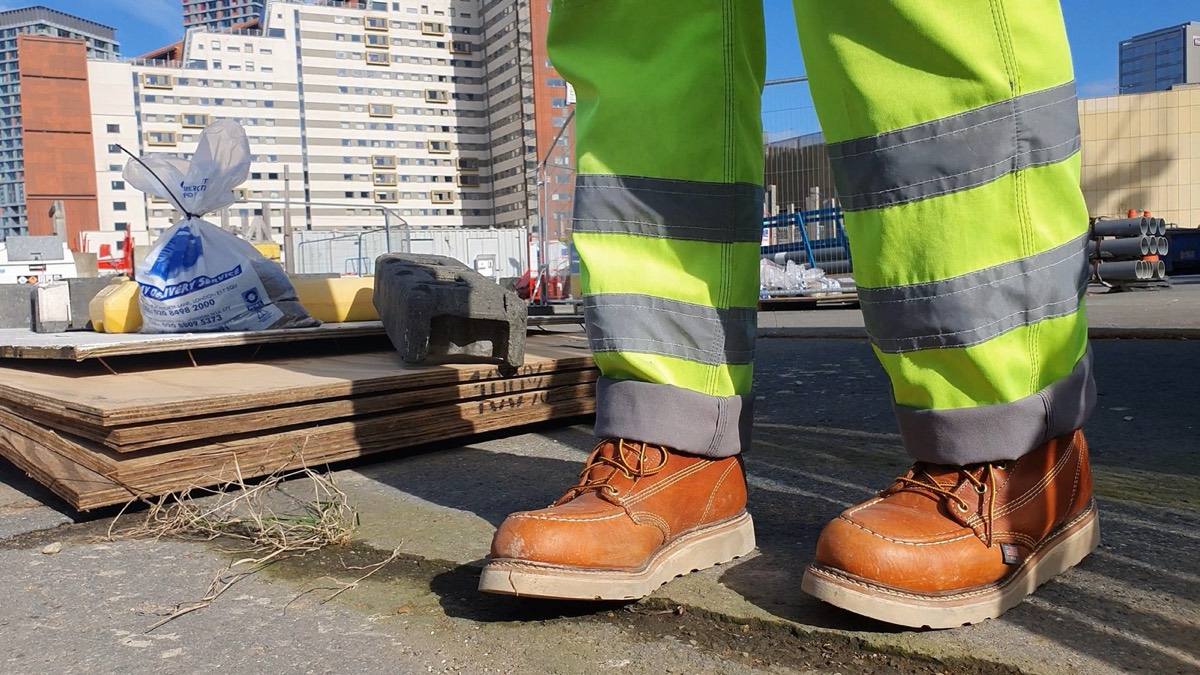
Wedge soles (flat from heel to toe) suit slabs, decks and roofs, where a full-length contact patch feels stable and doesn't track mud. Lug soles with a defined heel suit dirt, gravel and ladders, where the heel edge catches a rung. Makers say the same in their own copy. KEEN gives the Pittsburgh a 90° heel 'for ladders and scaffolding'. Danner warns that its wedge-sole Bull Run Chelsea is 'Not recommended for daily use on asphalt'. If you split your week between framing a deck and walking an excavated lot, a lug sole with a squared heel is the safer middle ground.
New job requires Steel/Comp toe boots. Best USA made, moc toe, steel toe, wedge s...
— r/Construction thread title (worker question)
Fit your boots before day one
Ill-fitting safety boots are more than uncomfortable. Toes jammed against a steel cap blister fast, and a heel that slips makes ladder work less secure. The steps below follow CCOHS's fitting advice, which makes a good short checklist.
- Shop or try boots on around midday, when your feet have swelled from a morning on them.
- Wear the socks you'll wear on site, thicker if you work in winter.
- Leave about 12.5 mm (half an inch) between your longest toe and the front of the boot. The safety cap doesn't flex, so the toe box never gets roomier.
- Don't count on stretch. CCOHS says not to expect footwear to stretch with wear.
- Keep the factory footbed unless the maker approves another. ASTM F2413-24 says after-market inserts can invalidate the ASTM marking.
- If you need wide sizes, check the width list before falling for a model. Several picks come only in D or medium.
When construction boots are done
Construction wears boots out faster than most trades, and the protection can fail before the boot looks finished. Replace a pair after any heavy impact to the toe or a nail through the sole. CCOHS says damage may not be visible, and a cracked cap or a pierced plate won't protect you a second time. Also replace them when the tread has worn smooth under the ball of the foot, when the shank no longer supports your arch on a rung, or when the waterproofing gives out and you're working in wet socks.
Resoling a welted boot (Thorogood, Georgia, KEEN Cincinnati) can add years, but ASTM F2413-24 lists resoling among the changes that could void the ASTM marking. Ask the maker, or use the maker's own recrafting service, before you send safety boots to a local cobbler.
Questions people ask
- Do construction workers need steel toe boots?
- Construction workers need safety-toe footwear where there's a foot hazard, under 29 CFR 1926.96. The toe can be steel, composite or alloy. What matters is that it meets the impact and compression requirements, shown as I and C on an ASTM F2413 label.
- Does OSHA require puncture-resistant boots in construction?
- No. 1926.96 refers only to safety-toe footwear meeting ANSI Z41.1-1967. Puncture resistance (PR) comes from your employer's hazard assessment or site rules, which may require it where nails and scrap are underfoot.
- What does PR mean on work boots?
- PR means the sole has a puncture-resistant device tested to resist 1,200 N (270 lbf) and survive 1.5 million flexes without cracking. It shows up as PR on the ASTM label line.
- Are waterproof boots worth it for construction?
- For most outdoor site work, yes. Mud, rain and concrete washout keep feet wet for hours. Check the maker's wording: waterproof membrane or rubber construction is waterproof; 'water resistant' only sheds splashes.
- Is a wedge sole OK for construction?
- On slabs, decks and roofs, yes. On mud, gravel and ladders, a lug sole with a defined heel grips better. Danner's own wedge-sole page says it's not recommended for daily use on asphalt.
- Who pays for construction boots?
- Usually you do. Under 1926.95(d)(2), employers don't have to pay for non-specialty safety-toe footwear you can wear off site. Some employers offer a boot allowance anyway, so ask.
- How long do construction boots last?
- We don't publish a lifespan, because no source in our register measures one and it varies with the site. Replace after any heavy impact or puncture, when the tread is worn smooth, or when the waterproofing fails.
Sources & further reading
- OSHA 29 CFR 1926.96 Occupational foot protection
- eCFR 29 CFR 1926.95 Criteria for PPE (construction)
- OSHA 29 CFR 1910.136 Foot protection
- OSHA 29 CFR 1910 Subpart I, Appendix B
- OSHA 29 CFR 1910.132 (payment for PPE)
- Thorogood: A Guide to ASTM Ratings and OSHA Work Boots (quotes F2413-18)
- University of Washington: ASTM F2413-11 performance requirements (PDF)
- ASTM F2413-24 abstract
- CCOHS OSH Answers: Safety Footwear
- Foot & Ankle Orthopaedics 2020: A Detailed Analysis of Workplace Foot and Ankle Injuries (PMC8705644)
- Danner: Bull Run Chelsea Steel Toe product page
- r/Construction thread (worker question)
Read next
- Best Work Boots by Trade
Best work boots by trade: construction, electrical, welding, warehouse, food and oil field, with the ASTM codes each job needs and boots that carry them.
- Waterproof Work Boots
Waterproof work boots with safety toes, sorted by how each maker keeps water out: membrane, sealed seams, waterproof leather or rubber. 7 picks, 30 compared.
- Met Guard Boots
Met guard boots explained: what the ASTM Mt test measures, internal vs external guards, when OSHA expects one, who pays for built-in guards, and three picks.
- OSHA Steel Toe Requirements
OSHA steel toe requirements quoted from 1910.136 and 1926.96: when foot protection is required, which standards count, and why composite toes qualify too.
- Electrician Boots
Electrician boots need an EH line on the label, not just a composite toe. What the 18,000 V test covers, EH vs SD vs Cd, lineman boots and six EH-rated picks.
Part of Best Work Boots by Trade. Back to the The Boot Yard home page.

The Boot Yard editors · Editorial team
The Boot Yard's catalogue and guides are compiled by the site's editorial team from makers' published product pages, ASTM F2413 rating lines and OSHA's foot-protection rules. We do not wear-test boots, and we never claim to: every spec on the site links to the page it came from.
About this site · How pages are checked · Last updated November 8, 2026
As an Amazon Associate, The Boot Yard earns from qualifying purchases. It costs you nothing extra and never decides which boots we list.
The Boot Yard is an independent site. It is not affiliated with ASTM International, OSHA or any boot brand. Brand names and trademarks belong to their owners. Our guides explain published standards; your employer's safety program and the boot's own label decide what you must wear.