Guide
Met Guard Boots: Internal vs External Guards, the Mt Test, and Who Pays
By The Boot Yard editors · Updated 2026-11-08 · How we research
We may earn a commission when you buy through links on this page.
Short answer
Met guard boots add a tested guard over the top of the foot. The ASTM Mt code means it took a 75 ft-lbf impact 3.5 inches back from the toe and kept 1 inch of clearance on men's sizes. Choose an external guard for the most coverage and a cover over the laces. Choose an internal guard if you kneel and climb. If your employer provides strap-on guards and you ask for built-in ones instead, OSHA doesn't require the employer to pay for the boots.
Met guard boots are safety-toe boots with a second guard over the metatarsals, the long bones between your toes and your ankle. OSHA's non-mandatory selection guide (Appendix B to 29 CFR 1910 Subpart I) says only that 'in some work situations, metatarsal protection should be provided'. That one sentence is all the federal guidance there is on when you need them. Canada's CCOHS is more concrete: its 'M' marking is 'for industrial work environments where heavy objects can hurt the metatarsal region of the foot'.
In ASTM F2413 the guard has its own code, Mt, with its own impact test. A boot only counts as a met guard boot if that code is on its label. A thicker tongue or a rubber toe bumper does not count. This guide explains what the test measures, how internal and external guards differ, the OSHA payment rule that catches many people out, and the three met guard boots in our catalogue.
Met guard boots in our catalogue
1. Best external met guard
Timberland PRO Endurance 6" Steel Toe Puncture Resistant External Met Guard
The Timberland PRO listing says its external guard 'meets ASTM F2413-18 and CAN/CSA-Z195-14 metatarsal impact resistance'. The steel toe meets 'ASTM F2413-18 I and C', and a flexible steel plate is rated ASTM F2892-18 PR. The listing does not mention EH. Timberland's own site blocked our reads, so these specs come from the brand's Amazon store listing.
Buy it if: Steel mills, scrap yards and welding bays where you want the widest top-of-foot cover plus puncture protection. Skip it if: You need EH, or you kneel and crouch for much of the shift.
- Safety toe
- Steel toe
- Height
- 6 in
- Met guard
- external
- Maker also claims
- slip-resistant outsole
Specs: Amazon listing (brand store) (2026-11-09)
2. Best internal met guard
KEEN Utility Evanston 6" Waterproof Boot INT MET (Carbon Toe)
KEEN states the Evanston INT MET 'Meets ASTM F3445-21 and F2413-18 M I/75 C/75 MT/75 EH standards', with carbon toes and an internal guard that is 'flexible and lightweight for comfort, but hardens and protects upon direct impact'. KEEN lists the shaft at 4.33 in and the weight at 25.82 oz per shoe.
Buy it if: Workers who need Mt plus EH and spend time kneeling, crouching or climbing. Skip it if: You need ankle coverage; the published shaft is under 4.5 inches.
- Safety toe
- Carbon-fiber toe
- Rating line
- Meets ASTM F3445-21 and F2413-18 M I/75 C/75 MT/75 EH standards
- Height
- 4.33 in
- Waterproof
- KEEN.DRY waterproof, breathable membrane
- Met guard
- internal
- Widths
- Regular, Wide
- Maker also claims
- heat-resistant outsole
Specs: KEEN product page (2026-11-09)
3. Best waterproof Mt + EH boot
Wolverine Raider DuraShocks® Waterproof 6" Met-Guard Work Boot
Wolverine prints 'ASTM F2413 M/I/C EH rated Mt EH rated CarbonMAX composite-toe' (the maker's own repetition) and describes a 'TPU Met-Guard' on the upper. Wolverine doesn't say whether the guard is internal or external. It is a 6-inch waterproof boot with ContourWelt construction in medium and extra-wide.
Buy it if: Outdoor heavy-materials work in wet conditions where both Mt and EH are on the list. Skip it if: You need a steel toe or a specific guard type your site requires; confirm the guard style on the actual boot.
- Safety toe
- Composite toe
- Rating line
- ASTM F2413 M/I/C EH rated Mt EH rated CarbonMAX® composite-toe
- Height
- 6 in
- Waterproof
- Breathable waterproof membrane with moisture wicking mesh lining; waterproof full-grain leather upper
- Construction
- ContourWelt
- Widths
- M, EW
Specs: Wolverine product page (2026-11-09)


Product prices and availability are accurate as of 2026-11-13 and are subject to change. Amazon prices are for the size and colour linked and vary by size. Specs are the makers' published figures; we don't wear-test boots.
Pick your job or the hazards on your site. We turn them into the ASTM F2413 codes a boot must carry, then list the boots in our catalogue whose published rating line includes every one. Your employer's hazard assessment (OSHA 29 CFR 1910.132(d)) has the final word.
A starting point drawn from the hazard examples in OSHA's Appendix B; your employer's hazard assessment decides. OSHA 1910 Subpart I, App. B
Hazards where you work
Your preferences
Codes your boots need
- IThe toe cap is struck by a 50 lb weight with a nominal 75 foot-pounds of energy and must keep a minimum interior clearance. 75 ft-lbf is an energy, not a weight. F2413-18 labels show it as 'I' on line 2 (e.g. 'M/I/C'); F2413-11 labels showed 'I/75'.
- CThe toe cap is squeezed with 2,500 lbf and must keep the same minimum clearance as the impact test. Older editions (F2413-05/-11) also had a lower class 50; OSHA's 2013 interpretation letter notes F2413-05 allowed a minimum of 50.
- MtA guard over the top of the foot (metatarsal bones) is tested with a 75 ft-lb impact landing 3.5 in back from the toe. Toe protection is also required.
3 boots in our catalogue match
KEEN Utility Evanston 6" Waterproof Boot INT MET (Carbon Toe)
Carbon fiber toe · boot · 4.33 in · men's · waterproof
ICMtEHSR
heat-resistant outsole (maker's claim)
Carries I · Carries C · Carries Mt
Specs: KEEN product page (2026-11-09)
Timberland PRO Endurance 6" Steel Toe Puncture Resistant External Met Guard
Steel toe · boot · 6 in · men's
ICMtPR
slip-resistant outsole (maker's claim)
Carries I · Carries C · Carries Mt
Specs: Amazon listing (brand store) (2026-11-09)
Wolverine Raider DuraShocks® Waterproof 6" Met-Guard Work Boot
Composite toe · boot · 6 in · men's · waterproof
ICMtEH
Carries I · Carries C · Carries Mt
Specs: Wolverine product page (2026-11-09)
Specs are makers' published figures, linked on every card. Prices as of 2026-11-13; product prices and availability are subject to change. As an Amazon Associate we earn from qualifying purchases.
What the Mt test measures, and how it differs from the toe test
The metatarsal test uses the same striker energy as the toe impact test, but lands somewhere else and is judged differently. Thorogood's summary of F2413-18 gives the numbers. A 50 lb weight delivers a nominal 75 foot-pounds of energy (101.7 J) at a point 3.5 inches back from the toe (3.375 in on women's sizes). Afterwards the guard must still leave 1.0 inch of clearance over the foot form on men's sizes, or 0.937 inch on women's. The toe impact test uses the same 75 ft-lbf on the toe cap, and the cap must keep 0.500 inch of clearance (0.468 inch women's). Both numbers are energy in foot-pounds. Neither is the weight of the striker.
ASTM also requires toe protection on any boot with an Mt rating, so every met guard boot is a safety-toe boot first. On the label, Mt shows up in different forms depending on the edition and the maker. KEEN prints 'MT/75' in the older style, alongside 'I/75 C/75'. Wolverine prints 'Mt'. Timberland PRO's listing describes it in a sentence instead of a code line. All of them refer to the same test.
What the test doesn't cover is just as useful to know. It doesn't rate compression across the instep (the C code applies to the toe cap). It doesn't test the guard after it has been crushed or bent. And it doesn't cover the ankle or shin. CCOHS advises replacing footwear after a significant impact or puncture, because damage may not be visible, and a met guard that has taken a hit is no exception.
Internal vs external met guards
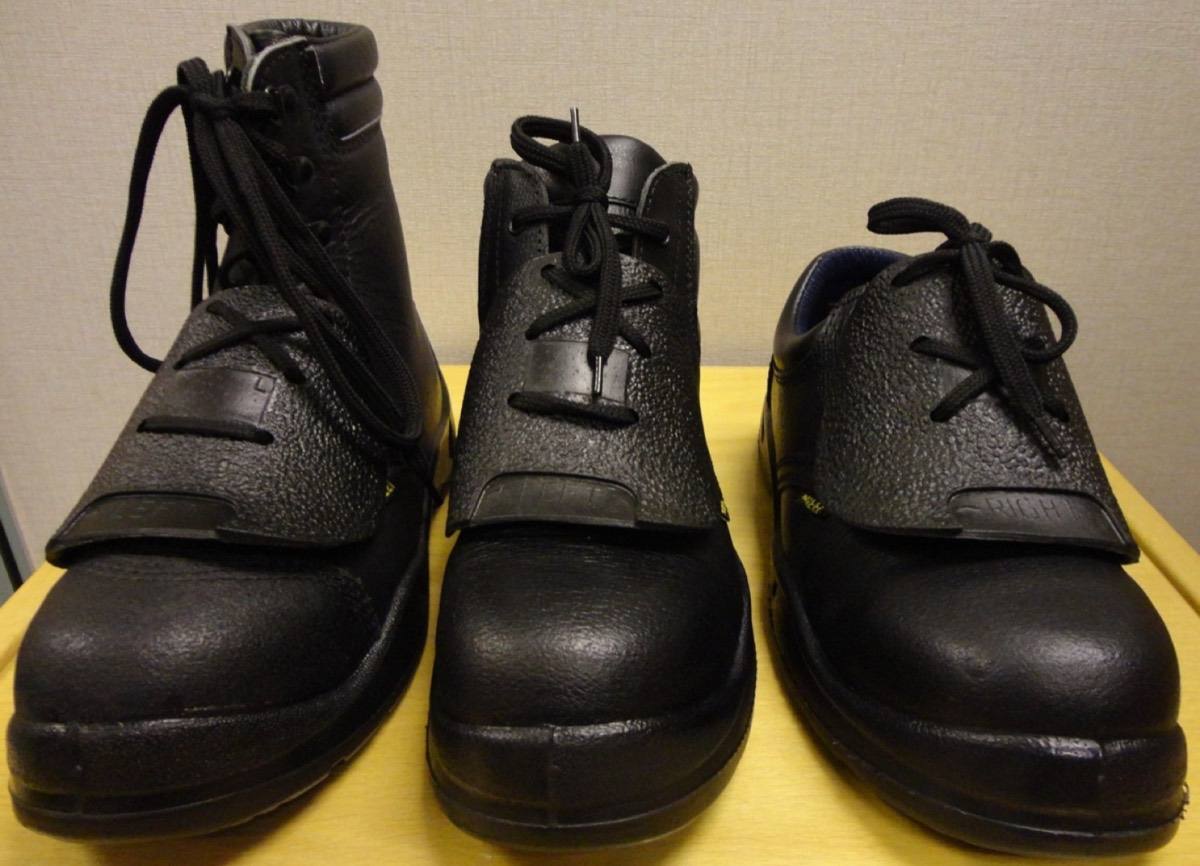
Both designs can carry the same Mt rating, because the test sets a minimum, not a design. The difference is where the guard sits and what that does to your day. An external guard is a hard, padded flap fixed to the outside of the boot over the laces and instep, like the boots in the photo above. An internal guard is built into the upper under the leather, so the boot looks almost normal. KEEN's Evanston uses a material it describes as flexible that 'hardens and protects upon direct impact'.
For welders and anyone working near hot spatter, the external flap has a side benefit: it covers the laces. For anyone who kneels, climbs ladders or drives, the internal guard usually suits better because there is no flap to snag or press into the shin. Strap-on guards are a third option. They are a separate product that buckles over an ordinary safety-toe boot, and they are what many employers issue. If you use one, check which standard its own maker cites, because the boot's label doesn't cover an add-on.
A few common mistakes. A boot with a 'met guard look' but no Mt line is not rated. A soft-toe boot with a strap-on guard is missing the toe protection that Mt boots must have. Some makers don't say which type their guard is: Wolverine calls the Raider's a 'TPU Met-Guard' on the upper and stops there. When your site requires one style, confirm it on the boot itself before buying.
| External guard | Internal guard | Strap-on guard | |
|---|---|---|---|
| Where it sits | Flap on the outside, over laces and instep | Inside the upper, under the leather | Buckles over any boot |
| Covers the laces | Yes | No | Usually |
| Bend when kneeling | Stiffer; the flap can press the shin | Flexes with the upper | Depends on the product |
| Looks like | Obvious hinged flap | A normal work boot | An add-on shield |
| Rated with the boot | Yes, if Mt is on the label | Yes, if Mt is on the label | No; it carries its own maker's claim |
| Catalogue example | Timberland PRO Endurance | KEEN Evanston INT MET | None (not a boot) |
Do you actually need metatarsal protection?
Your employer's hazard assessment decides, and federal OSHA doesn't publish a list of jobs that require Mt. The hazard it targets is clear enough: heavy objects that can fall on or strike the top of the foot, not just the toes. It shows up where long, heavy loads are handled close to the feet, such as foundries, steel mills and heavy fabrication. In our finder, the 'Foundry / steel mill / heavy materials' preset adds the top-of-foot hazard to dropped objects and rolling loads for that reason.
General construction usually doesn't call for it, and that question comes up a lot. An r/Construction thread title asks it plainly. The answer depends on your tasks. A framer or finisher usually needs I/C and often PR. A crew setting steel or handling heavy pipe may be told to add Mt. If you are unsure, ask the safety lead what the hazard assessment says, not what other crews wear.
If you need Mt only some of the time, a strap-on guard over your normal boots can be the practical answer, especially when your employer issues them. If you need it every shift, built-in guards are less to manage and can't be left in the truck.
Do I need metatarsal boots if I have steel toe boots for construction
— r/Construction thread title (worker question)
Who pays for met guard boots? OSHA's built-in guard exception
This is where most people get it wrong. Under 29 CFR 1910.132(h)(1), employers must provide required PPE at no cost, with listed exceptions. Plain safety-toe boots are one exception: (h)(2) says employers don't have to pay for 'non-specialty safety-toe protective footwear' that workers may wear off the job. Metatarsal guards are not in that exception. If your hazard assessment requires met protection, your employer has to provide it.
The catch is (h)(3), quoted in full: 'When the employer provides metatarsal guards and allows the employee, at his or her request, to use shoes or boots with built-in metatarsal protection, the employer is not required to reimburse the employee for the shoes or boots.' So if your employer hands out strap-on guards and you would rather wear met guard boots, you can usually choose that, but you pay. Construction has the same rule in 29 CFR 1926.95(d)(3).
Ask two questions before you buy. Does your employer issue met guards, strap-on or built-in, for your job? And does it run a boot allowance or voucher program that covers met guard boots anyway? Some employers do as a matter of policy, even where the rule doesn't require it.
The three picks compared, and what's missing
Our catalogue tracks every boot by the codes its maker publishes, and only three carry Mt today. That's partly because met guard boots are a narrow category, and partly because we include only boots whose Mt rating we could read on a maker or brand page. The table below shows how they differ on the things buyers ask about: guard type, toe, EH, puncture and waterproofing.
There are clear gaps. None of the three is a women's boot. An r/WorkBoots thread title is a woman asking how to find 'women's steel toe metatarsal/met guard work boots on Amazon', and our catalogue can't answer it yet. Women can try a men's size with the help of our size chart, but the Mt test's clearance point is set lower for women's sizes (3.375 in from the toe) for a reason. A men's boot puts the guard where a man's foot would be. Also, only the Endurance lists puncture protection, and only the KEEN and Wolverine list EH. If you need Mt, PR and EH together, none of these three covers all three, so widen your search and check labels.
On fit: a guard can take up room over the instep, and an internal guard can make the throat of the boot feel stiffer. Size them in the afternoon with your work socks on, and make sure you can flex your foot fully without the guard digging into the top. Fitting the PPE to the worker is the employer's job too: 1910.132(d)(1)(iii) requires PPE 'that properly fits each affected employee'.
| Boot | Guard type | Toe | Mt as published | EH | PR | Waterproof |
|---|---|---|---|---|---|---|
| Timberland PRO Endurance 6-inch | External | Steel | Metatarsal guard meets ASTM F2413-18 and CAN/CSA-Z195-14 | Not listed | Yes (F2892-18 PR, steel plate) | Not stated |
| KEEN Evanston 6-inch INT MET | Internal | Carbon | MT/75 (F2413-18) | Yes | Not listed | KEEN.DRY membrane |
| Wolverine Raider DuraShocks 6-inch | Not stated (TPU Met-Guard on upper) | Composite (CarbonMAX) | ASTM F2413 M/I/C EH rated Mt | Yes | Not listed | Waterproof membrane |
Questions people ask
- What does Mt mean on a work boot label?
- Mt is the ASTM F2413 metatarsal code. The guard over the top of the foot took a 75 ft-lbf impact 3.5 inches back from the toe and kept at least 1.0 inch of clearance (0.937 inch on women's sizes). Some makers print it as MT/75.
- Are internal or external met guards better?
- Neither is better in every case. Both pass the same Mt test. External guards cover more of the instep and the laces. Internal guards flex better for kneeling and climbing and look like normal boots. Pick by your tasks and by what your site allows. If your site requires one style in writing, that settles it.
- Does my employer have to pay for met guard boots?
- Your employer must provide required metatarsal protection at no cost. But under OSHA 1910.132(h)(3), if the employer provides met guards and you ask to wear boots with built-in guards instead, the employer doesn't have to reimburse you for the boots.
- Can I add a met guard to my steel toe boots?
- Yes. Strap-on metatarsal guards buckle over an existing safety-toe boot, and many employers issue them. The guard carries its own maker's rating, not the boot's, so check what standard it cites and whether your site accepts it. A strap-on guard also has to fit over your laces and stay put when you walk, so try it with the boots you'll actually wear. If it slides sideways or lifts at the buckle, it won't sit over your metatarsals when something lands.
Sources & further reading
- OSHA 29 CFR 1910 Subpart I, Appendix B
- OSHA 29 CFR 1910.132 (payment for PPE; (h)(3) metatarsal exception)
- eCFR 29 CFR 1926.95 (construction PPE payment)
- Thorogood: A Guide to ASTM Ratings and OSHA Work Boots (quotes F2413-18)
- CCOHS OSH Answers: Safety Footwear
- ASTM F2413-24 abstract
- KEEN Utility: Evanston 6-inch INT MET product page
- Wolverine: Raider DuraShocks 6-inch Met-Guard product page
- Timberland PRO Endurance (Amazon brand-store listing)
- r/Construction thread (worker question)
- r/WorkBoots thread on women's met guard boots (worker question)
Read next
- Best Work Boots by Trade
Best work boots by trade: construction, electrical, welding, warehouse, food and oil field, with the ASTM codes each job needs and boots that carry them.
- Welding Boots
Welding boots compared by hazard: safety toe, no exposed laces, met guards and heat-resistant soles, with each maker's own heat rating and six picks.
- Construction Boots
Construction boots for new and working tradespeople: which ASTM codes a site calls for, what PR puncture resistance means, mud and ladder features, and 7 picks.
- ASTM F2413-18 Decoded
ASTM F2413-18 explained line by line: what I, C, Mt, EH, SD and PR mean, the test values behind each, what changed in F2413-24, and if an -18 boot meets OSHA.
- OSHA Steel Toe Requirements
OSHA steel toe requirements quoted from 1910.136 and 1926.96: when foot protection is required, which standards count, and why composite toes qualify too.
- Work Boot Size Chart
Work boot size chart built from eight makers' own published charts: measure your foot once, see the US size each brand lists for it, and find width letters.
Part of Best Work Boots by Trade. Back to the The Boot Yard home page.

The Boot Yard editors · Editorial team
The Boot Yard's catalogue and guides are compiled by the site's editorial team from makers' published product pages, ASTM F2413 rating lines and OSHA's foot-protection rules. We do not wear-test boots, and we never claim to: every spec on the site links to the page it came from.
About this site · How pages are checked · Last updated November 8, 2026
As an Amazon Associate, The Boot Yard earns from qualifying purchases. It costs you nothing extra and never decides which boots we list.
The Boot Yard is an independent site. It is not affiliated with ASTM International, OSHA or any boot brand. Brand names and trademarks belong to their owners. Our guides explain published standards; your employer's safety program and the boot's own label decide what you must wear.