Guide
Welding Boots: Pull-Ons, Met Guards and Heat-Rated Soles Compared
By The Boot Yard editors · Updated 2026-11-08 · How we research
We may earn a commission when you buy through links on this page.
Short answer
A welder needs an ASTM F2413 safety toe (I and C) for dropped steel, a design that keeps spatter out of the laces, and Mt (metatarsal) protection where heavy parts can hit the top of the foot. Spatter protection usually means a pull-on boot or a met guard that covers the laces. Heat-resistant outsoles are the maker's own claim, not an ASTM code, so compare the temperature each maker prints.
Spatter lands on your welding boots all shift, and every so often a length of flat bar slides off the table onto your foot. Those are two different hazards, and they need two different answers. The bar is a safety-toe job: ASTM F2413's I and C codes cover impact and compression on the toe, and Mt covers the top of the foot. The spatter is a design job. No ASTM F2413 code covers molten metal, so it comes down to how the boot is built: no laces, or something covering them.
OSHA's selection guide (Appendix B to 29 CFR 1910 Subpart I) lists welders among the jobs where foot protection 'should be routinely considered'. Below, each welding hazard is mapped to what deals with it, the heat ratings makers print on their soles are compared, and six boots are picked across pull-on, internal and external met guard styles.
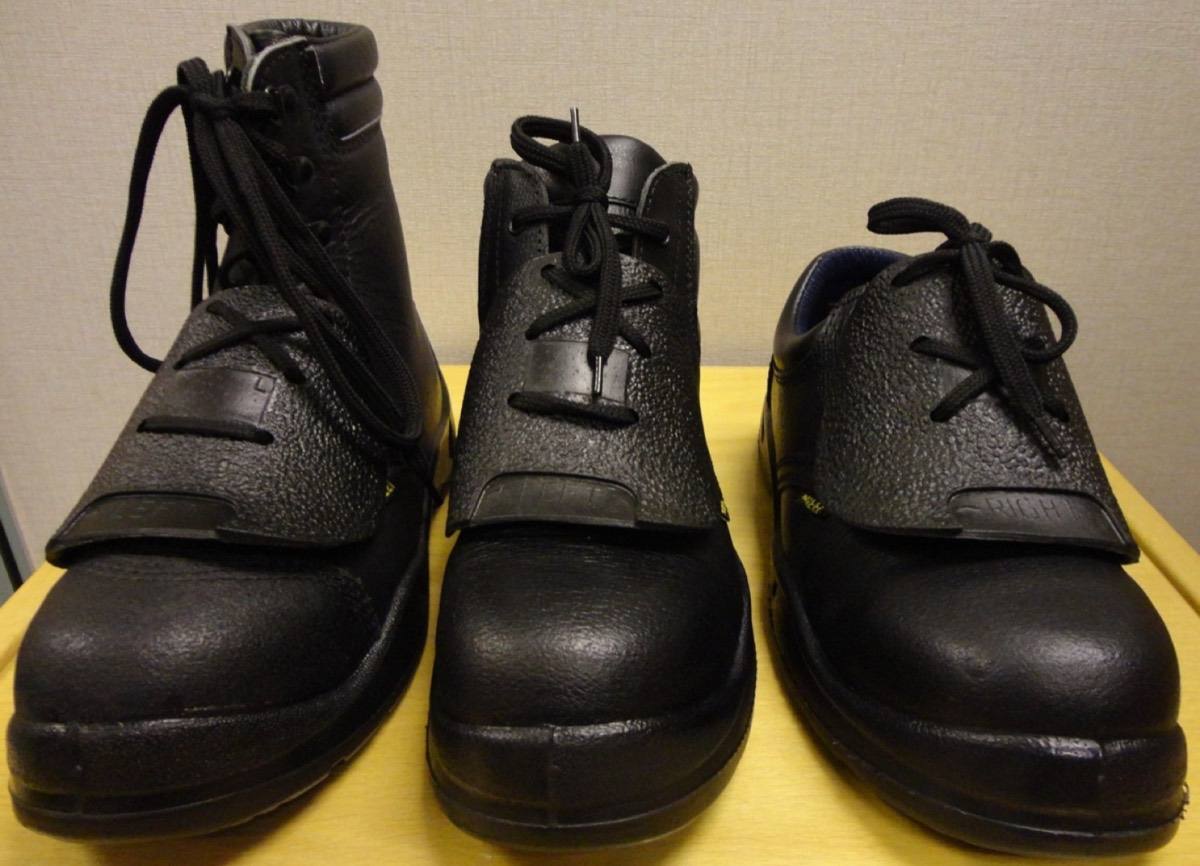
Picks for welders and fabricators
1. Best pull-on welding boot overall
Irish Setter Marshall 11-inch Waterproof Leather Safety Toe Pull-On Boot
Irish Setter rates the Marshall 'ASTM F2413-24, I/C, EH SR' on a steel toe, and describes the outsole as 'HRO, heat resistant to melting at a minimum of 475º Fahrenheit'. It is an 11-inch pull-on with no laces, UltraDry waterproofing and a Goodyear welt, in D and EE widths up to size 16.
Buy it if: Shop and field welders who want a tall pull-on on the current F2413-24 edition. Skip it if: You need a met guard; the Marshall has none.
- Safety toe
- Steel toe
- Rating line
- ASTM F2413-24, I/C, EH SR
- Height
- 11 in
- Waterproof
- UltraDry™ Waterproofing System
- Construction
- Goodyear welt
- Widths
- D, EE
- Maker also claims
- heat-resistant outsole
Specs: Irish Setter product page (2026-11-09)
2. Best value pull-on
Ariat Groundbreaker Wide Square Toe Steel Toe Work Boot
Ariat rates it 'ASTM F2413 I/C EH SR rated' with a steel toe and says the Duratread sole 'passes hot contact testing at 300°C/572°F'. It is a 10-inch western pull-on with a 90° heel for ladders and rungs. Ariat's page showed it sold out on 2026-11-09, so check the live card.
Buy it if: Welders who climb ladders and scaffolds and want a pull-on with a squared heel. Skip it if: You stand in water; this version is not waterproof.
- Safety toe
- Steel toe
- Rating line
- ASTM F2413 I/C EH SR rated
- Height
- 10 in
- Widths
- D, EE
- Maker also claims
- heat-resistant outsole
Specs: Ariat product page (2026-11-09)
3. Best composite-toe pull-on (resoleable)
Ariat WorkHog Waterproof Composite Toe Work Boot
Ariat lists 'ASTM F2413 I/C EH SR rated' on a non-metallic composite toe, a waterproof DRYShield build and a 'resoleable Goodyear welt'. The same 572°F hot-contact sole claim applies. It comes in B, D and EE widths at 11 inches tall.
Buy it if: Welders who want no metal cap, a waterproof pull-on, and the option to rebuild the boot. Skip it if: You want a lighter boot for walking long distances; this is a tall welted western.
- Safety toe
- Composite toe
- Rating line
- ASTM F2413 I/C EH SR rated
- Height
- 11 in
- Waterproof
- DRYShield™ waterproof, breathable construction
- Construction
- Goodyear welt
- Widths
- B, D, EE
- Maker also claims
- heat-resistant outsole
Specs: Ariat product page (2026-11-09)
4. Best lace-up with an internal met guard
KEEN Utility Evanston 6" Waterproof Boot INT MET (Carbon Toe)
KEEN states it 'Meets ASTM F3445-21 and F2413-18 M I/75 C/75 MT/75 EH standards' with a carbon toe and an internal met guard that KEEN says 'hardens and protects upon direct impact'. KEEN rates the outsole heat resistant to 572°F/300°C. The laces are exposed, so pair it with spats if spatter falls on your feet.
Buy it if: Fabricators who need Mt protection and can't stand the bulk of an external guard. Skip it if: You weld overhead or out of position all day and want no laces at all.
- Safety toe
- Carbon-fiber toe
- Rating line
- Meets ASTM F3445-21 and F2413-18 M I/75 C/75 MT/75 EH standards
- Height
- 4.33 in
- Waterproof
- KEEN.DRY waterproof, breathable membrane
- Met guard
- internal
- Widths
- Regular, Wide
- Maker also claims
- heat-resistant outsole
Specs: KEEN product page (2026-11-09)
5. Best external met guard over the laces
Timberland PRO Endurance 6" Steel Toe Puncture Resistant External Met Guard
The Timberland PRO listing says the metatarsal guard 'meets ASTM F2413-18 and CAN/CSA-Z195-14 metatarsal impact resistance', and that the toe meets 'ASTM F2413-18 I and C'. It adds a puncture-resistant steel plate (ASTM F2892-18 PR) and a 'heat-resistant' rubber outsole without a temperature. The external flap sits over the laces.
Buy it if: Steel shops and yards where both dropped parts and spatter land on the top of the foot. Skip it if: You kneel and crouch a lot; external guards are stiffer than internal ones.
- Safety toe
- Steel toe
- Height
- 6 in
- Met guard
- external
- Maker also claims
- slip-resistant outsole
Specs: Amazon listing (brand store) (2026-11-09)
6. Best women's pull-on
Carhartt Women's Frontier Water Resistant Steel Toe Chelsea
Carhartt states the Frontier 'Meets ASTM F2413-24 EH standards' on a steel toe and describes a 'heat-resistant outsole rated up to 300°C/572°F'. It is a women's Chelsea pull-on. Carhartt calls it water resistant (Rain Defender), not waterproof, and publishes no shaft height.
Buy it if: Women welders who want a pull-on in true women's sizes. Skip it if: You need a tall shaft to tuck under welding pants or wide widths; it comes in M only.
- Safety toe
- Steel toe
- Rating line
- Meets ASTM F2413-24 EH standards; Meets ASTM F3445-24 SR standards
- Widths
- M
- Maker also claims
- heat-resistant outsole
Specs: Carhartt product page (2026-11-09)


Product prices and availability are accurate as of 2026-11-13 and are subject to change. Amazon prices are for the size and colour linked and vary by size. Specs are the makers' published figures; we don't wear-test boots.
Pick your job or the hazards on your site. We turn them into the ASTM F2413 codes a boot must carry, then list the boots in our catalogue whose published rating line includes every one. Your employer's hazard assessment (OSHA 29 CFR 1910.132(d)) has the final word.
A starting point drawn from the hazard examples in OSHA's Appendix B; your employer's hazard assessment decides. OSHA 1910 Subpart I, App. B
Hazards where you work
Your preferences
Codes your boots need
- IThe toe cap is struck by a 50 lb weight with a nominal 75 foot-pounds of energy and must keep a minimum interior clearance. 75 ft-lbf is an energy, not a weight. F2413-18 labels show it as 'I' on line 2 (e.g. 'M/I/C'); F2413-11 labels showed 'I/75'.
- CThe toe cap is squeezed with 2,500 lbf and must keep the same minimum clearance as the impact test. Older editions (F2413-05/-11) also had a lower class 50; OSHA's 2013 interpretation letter notes F2413-05 allowed a minimum of 50.
- MtA guard over the top of the foot (metatarsal bones) is tested with a 75 ft-lb impact landing 3.5 in back from the toe. Toe protection is also required.
3 boots in our catalogue match
KEEN Utility Evanston 6" Waterproof Boot INT MET (Carbon Toe)
Carbon fiber toe · boot · 4.33 in · men's · waterproof
ICMtEHSR
heat-resistant outsole (maker's claim)
Carries I · Carries C · Carries Mt
Specs: KEEN product page (2026-11-09)
Timberland PRO Endurance 6" Steel Toe Puncture Resistant External Met Guard
Steel toe · boot · 6 in · men's
ICMtPR
slip-resistant outsole (maker's claim)
Carries I · Carries C · Carries Mt
Specs: Amazon listing (brand store) (2026-11-09)
Wolverine Raider DuraShocks® Waterproof 6" Met-Guard Work Boot
Composite toe · boot · 6 in · men's · waterproof
ICMtEH
Carries I · Carries C · Carries Mt
Specs: Wolverine product page (2026-11-09)

Specs are makers' published figures, linked on every card. Prices as of 2026-11-13; product prices and availability are subject to change. As an Amazon Associate we earn from qualifying purchases.
Welding hazards and what deals with each one
Start with what can actually hurt your feet in your shop. The rows marked 'ASTM code' are tested properties that appear on the boot's label. The rows marked 'design' or 'maker claim' are not covered by the F2413 label, so you judge them by construction and by what the maker publishes.
Shop and field welding put different loads on the same boot. In a fab shop you mostly stand on concrete next to a table, so the toe, the met area and spatter matter most. On a pipeline or a structural job you also walk through mud and climb ladders, so a waterproof upper, a tall shaft and a defined heel move up the list. Two of our picks cover that field profile: the waterproof Marshall at 11 inches and the WorkHog at 11 inches. The Groundbreaker's squared 90° heel is for ladders, but it is not waterproof.
| Hazard in the shop | What deals with it | Type | What to check |
|---|---|---|---|
| Plate, pipe or parts dropped on the toes | I (impact, 75 ft-lbf) and C (compression, 2,500 lbf) | ASTM code | I and C, or M/I/C, on the label |
| Heavy pieces striking the top of the foot | Mt (metatarsal guard, 75 ft-lbf impact 3.5 in back from the toe) | ASTM code | Mt or MT/75 on the label |
| Spatter and slag landing on laces and tongue | Pull-on design, or an external met flap over the laces | Design | No exposed laces, or a cover over them |
| Standing on hot material or hot floors | Heat-resistant outsole | Maker claim | The maker's stated temperature |
| Carts, bundles or pipe rolling over feet | C (compression) | ASTM code | C on the label |
Laces or pull-ons? Why welders argue about it
A lace-up boot has an open throat: eyelets, a gusseted tongue and loops of lace sitting right where spatter falls when you weld low or vertical. A hot bead that drops in there sits against your sock until you notice it. A pull-on has a closed front, so there is nowhere for spatter to catch. That is the whole argument for pull-ons.
Pull-ons have downsides. The heel can lift because there are no laces to lock it, which matters on ladders and long walks. Wide or high-arched feet can struggle to get in. Ariat sells a 'U-Turn Entry System for people with high arches' on the WorkHog for that reason. If you need a lace-up for fit, an external metatarsal flap like the Timberland PRO Endurance's covers the laces. Leather spats or boot covers over a lace-up are the other common fix.
Fit a pull-on more carefully than a lace-up, because there is nothing to tighten later. CCOHS's fitting advice applies to both: leave about 12.5 mm (half an inch) between your longest toe and the front, try boots on around midday when your feet have swelled, and 'do not expect footwear to stretch with wear'. A pull-on that grips your instep firmly and lets your heel lift only slightly while walking is about right. If the heel slides freely in the store, it will rub at the end of a ten-hour shift.
Rubber clogs and synthetic sneakers are the wrong idea entirely. Thin mesh and foam do nothing against spatter, as the thread title below suggests.
Apparently crocs aren't the best welding shoes.
— r/Welding thread title (worker opinion)
Heat-resistant soles: read the number, not the acronym
Many welding boots carry 'HRO' (heat-resistant outsole) in their marketing. HRO is not an ASTM F2413 code. It comes from other labelling schemes, and on US boots it is the maker's own claim about the outsole. No source in our register gives a shared ASTM test for it, so we can't say that two makers' numbers mean the same thing. What you can compare is the temperature each maker publishes, and whether they publish one at all.
Across our picks the published figures cluster at two levels. Irish Setter says its soles are 'heat resistant to melting at a minimum of 475º Fahrenheit'. Ariat, KEEN and Carhartt all quote 300°C/572°F, and Ariat words it as passing 'hot contact testing'. Timberland PRO calls the Endurance's rubber 'heat-resistant' with no number. A higher figure does not make a boot safe to stand on glowing scrap. It tells you how much heat the sole compound tolerates before it melts or marks.
In practice, the heat rating matters most to welders who stand on cut-offs, grind over the floor or work near torch-cutting stations, where hot slag and offcuts end up underfoot. If that's your station, choose a sole with a published figure over one that just says 'heat-resistant'. Check the edges of the sole for glazing every few weeks.
When a welder needs metatarsal protection
Toe caps stop at the toes. A beam flange or a casting that lands two inches farther back hits the metatarsal bones, and only an Mt-rated guard is tested for that. Under F2413-18, as Thorogood quotes it, the Mt test drops 75 foot-pounds of energy 3.5 inches back from the toe (3.375 in on women's sizes), and the guard must keep 1.0 inch of clearance (0.937 in for women). OSHA's Appendix B says only that 'in some work situations, metatarsal protection should be provided', so your employer's hazard assessment decides whether you need it.
If you do need it, you choose between an internal guard built into the upper (KEEN Evanston INT MET) and an external flap (Timberland PRO Endurance). For welders the external flap has a bonus: it covers the laces. The internal guard bends more easily when you kneel at the bench. One payment rule matters too. Under 29 CFR 1910.132(h)(3), if your employer provides strap-on met guards and you ask to wear boots with built-in guards instead, the employer doesn't have to reimburse you for the boots. Our met guard boots guide compares the two designs in detail.
Steel or composite toe for welding?
Both meet the same impact and compression test if the label says I and C. That is the protection that counts when a drop hits your toes. Welders argue that steel caps get hot or cold, and a WeldingWeb thread titled 'Preferences on foot ware for welding? Steel toe or not!' shows how long the argument has run. We found no source that measures how hot a steel cap gets inside a welding boot, so we don't rank boots on it. Among our picks, the Marshall, Groundbreaker, Endurance and Frontier are steel, the WorkHog is composite and the Evanston is carbon.
There is one practical difference. If your site screens with metal detectors, or you fly between jobs, a composite or carbon cap removes the largest metal part. Shanks and puncture plates can still be steel, though. The Endurance's PR plate is steel, according to the listing.
Women welders face a separate problem: few welding boots are made on women's lasts. A WeldingWeb thread asks for the 'Best boots for a new female welder?' The Carhartt Frontier is a women's pull-on with a heat-rated sole. In the finder, the women filter shows every women's boot in the catalogue with I and C.
Keeping welding boots in service
Welding boots wear out from the top as often as from the bottom. Burn pits in the vamp, hardened leather and melted spots on the sole edge all build up over a few months of shop work. Check them on a schedule rather than waiting for a hole.
How your welding pants meet your boots matters as much as the boots themselves. Let the pant leg fall over the shaft instead of tucking it in. A tucked cuff opens a gap at the top of the boot that catches spatter, while a leg hanging over the outside sheds it. The same reasoning is why taller pull-on welding boots pair well with straight-leg pants.
- Look for burn-throughs over the toe cap and met guard. A hole in the leather is not a failed toe cap, but it lets heat and spatter reach your sock.
- Press the outsole edges for melted or glazed rubber, especially if you stand near hot cut-offs.
- Replace the boots after a heavy impact on the toe or met guard. CCOHS says damage may not be visible.
- Before resoling a welted boot such as the WorkHog or Marshall, ask the maker. ASTM F2413-24 §1.4 says resoling could make the ASTM marking invalid.
- Keep the factory footbed unless the maker approves a replacement. The same §1.4 covers after-market inserts.
Questions people ask
- Do welders need steel toe boots?
- Most shop and field welders need a safety toe, because dropped plate and parts are the main foot hazard OSHA's Appendix B describes. It can be steel, composite or carbon as long as the label carries I and C. Your employer's hazard assessment sets the rule. A welding-specific boot is not required by any rule we found. What matters is the label: I and C, plus Mt if your station needs it.
- Why do welders wear pull-on boots?
- Pull-ons have no laces or eyelets for hot spatter and slag to drop into. Lace-up boots can work if an external met flap or leather spats cover the laces. Pull-ons also come off fast if something hot does get inside. If you need a lace-up for fit or ankle support, tuck the lace bow under the tongue and wear your pant leg over the top.
- What does HRO mean on welding boots?
- Heat-resistant outsole. It is not an ASTM F2413 code. On US boots it is the maker's claim about the sole compound. Compare the temperature each maker prints, for example 475°F (Irish Setter) or 572°F/300°C (Ariat, KEEN, Carhartt).
- Are EH rated boots needed for welding?
- EH covers stepping on live electrical conductors, not the welding circuit, and none of our sources ties welding to EH footwear. Many welding boots carry EH anyway, and five of our six picks do. Follow your employer's hazard assessment.
Sources & further reading
- OSHA 29 CFR 1910 Subpart I, Appendix B
- OSHA 29 CFR 1910.132 (payment for PPE, (h)(3) metatarsal)
- Thorogood: A Guide to ASTM Ratings and OSHA Work Boots (quotes F2413-18)
- ASTM F2413-24 abstract
- CCOHS OSH Answers: Safety Footwear
- Irish Setter: Marshall 11-inch product page
- Ariat: Groundbreaker Wide Square Toe Steel Toe product page
- Ariat: WorkHog Waterproof Composite Toe product page
- KEEN Utility: Evanston 6-inch INT MET product page
- Timberland PRO Endurance (Amazon brand-store listing)
- Carhartt: Women's Frontier Steel Toe Chelsea product page
- r/Welding thread (worker opinion)
- WeldingWeb: steel toe or not (worker opinion)
- WeldingWeb: best boots for a new female welder (worker opinion)
Read next
- Best Work Boots by Trade
Best work boots by trade: construction, electrical, welding, warehouse, food and oil field, with the ASTM codes each job needs and boots that carry them.
- Met Guard Boots
Met guard boots explained: what the ASTM Mt test measures, internal vs external guards, when OSHA expects one, who pays for built-in guards, and three picks.
- Construction Boots
Construction boots for new and working tradespeople: which ASTM codes a site calls for, what PR puncture resistance means, mud and ladder features, and 7 picks.
- Slip On Work Boots
Slip on work boots with steel or composite safety toes: 11 pull-ons compared by height, waterproofing and ASTM wording, plus a fit checklist for laceless boots.
- Composite Toe vs Steel Toe
Composite toe vs steel toe, checked against ASTM F2413: both pass the same 75 ft-lbf impact and 2,500 lbf tests. Where they differ: metal, weight claims, price.
Part of Best Work Boots by Trade. Back to the The Boot Yard home page.

The Boot Yard editors · Editorial team
The Boot Yard's catalogue and guides are compiled by the site's editorial team from makers' published product pages, ASTM F2413 rating lines and OSHA's foot-protection rules. We do not wear-test boots, and we never claim to: every spec on the site links to the page it came from.
About this site · How pages are checked · Last updated November 8, 2026
As an Amazon Associate, The Boot Yard earns from qualifying purchases. It costs you nothing extra and never decides which boots we list.
The Boot Yard is an independent site. It is not affiliated with ASTM International, OSHA or any boot brand. Brand names and trademarks belong to their owners. Our guides explain published standards; your employer's safety program and the boot's own label decide what you must wear.