Guide
Best Shoes for Warehouse Work: Safety Toe, Slip Codes and 6 Picks
By The Boot Yard editors · Updated 2026-11-08 · How we research
We may earn a commission when you buy through links on this page.
Short answer
For most warehouse jobs, wear a lightweight safety-toe work shoe with I and C on the ASTM label, a cushioned midsole for concrete, and a slip rating you can verify. Composite or alloy toes keep the weight down. Choose a shoe over a boot unless you work outdoors, in a freezer, or on a site that requires ankle coverage. Your employer's footwear policy decides what's allowed.
The best shoes for warehouse work have to stand up to a real number: over 96,000 foot and ankle injuries caused lost workdays in 2018, according to a BLS-based analysis in Foot & Ankle Orthopaedics (2022). In transportation and warehousing, the median foot injury cost 16.82 days away from work. Two things wear you down on a warehouse floor: concrete under every step, and loads around your feet that can drop or roll. OSHA's own selection guide names 'skid trucks' and 'bulk rolls' as the kind of rolling loads that call for compression protection, and pallet jacks are today's version.
So a warehouse shoe has two jobs. It has to pass the toe tests (I and C on the ASTM label) and still be light and cushioned enough for ten hours on concrete. Many also need a real slip rating for wet docks and freezer doorways. Below: what each code covers on a warehouse floor, shoes vs boots, how to read slip claims, and six picks chosen from what their makers publish.
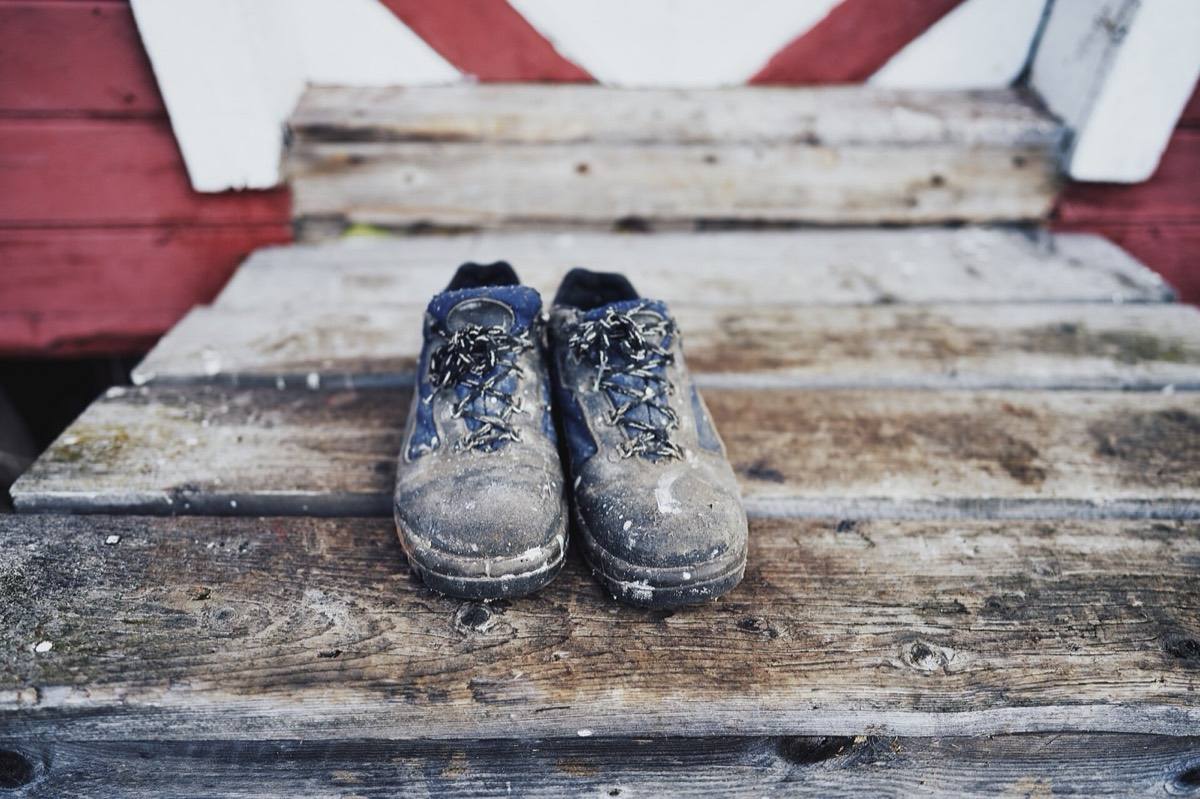
Six warehouse shoes worth shortlisting
1. Best all-round warehouse shoe
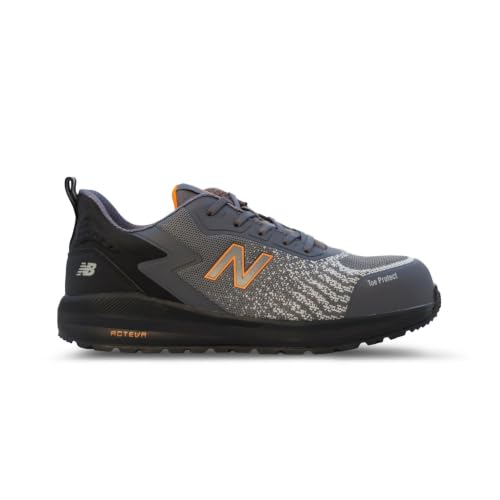
New Balance Speedware Comp Toe
New Balance's Amazon brand-store listing says the Speedware 'meets or exceeds ASTM Specification F2413-18 I/75 C/75', with EH to ASTM F2412-18a, slip testing to ASTM F2913-19, and an 'anti-perforation midsole' (PR). It has an Acteva foam midsole and a composite toe, in D and wide.
Buy it if: Pickers and packers who walk all shift and may step on staples or broken pallet nails. Skip it if: Your site requires a named F3445 slip rating; the listing cites the F2913 test method, not F3445.
- Safety toe
- Composite toe
- Rating line
- meets or exceeds ASTM Specification F2413-18 I/75 C/75, ASTM F2412-18a (EH) ASTM F2913-19 (SR)
- Widths
- D (M), Wide
Specs: Amazon listing (brand store) — New Balance Speedware, style MIDSPWRGR (2026-11-09)
2. Best for wide feet
Reebok Work Sublite Cushion Work - RB4041
Reebok Work lists 'ASTM F2413, Alloy Toe, XTR Brand Alloy Toe Cap, Slip Resistant, Electrical Hazard Protection', with a Sublite EVA cushion midsole and an 'Extra Wide Toe'. It comes in M, W and 4E, the widest range among these picks. Reebok names no slip standard.
Buy it if: Wide or swollen-by-evening feet on long concrete shifts. Skip it if: You need a published slip standard; Reebok only says 'Slip Resistant'.
- Safety toe
- Alloy toe
- Rating line
- ASTM F2413
- Widths
- M, W, 4E
- Maker also claims
- slip-resistant outsole
Specs: Reebok Work product page (2026-11-09)
3. Best low-price steel-toe shoe
Skechers Work Relaxed Fit: Cankton ST
Skechers says the steel toe 'meets ASTM F2413 impact and compression standards' and the shoe is 'Electrical Hazard (EH) safe design tested ASTM-F2413'. It has a Relaxed Fit last and a Memory Foam insole, at a maker price around $95. Skechers makes no slip-resistance claim on this model.
Buy it if: Dry warehouse floors on a tight budget. Skip it if: Your floors get wet or oily; no slip claim is published.
- Safety toe
- Steel toe
- Rating line
- Steel safety toe meets ASTM F2413 impact and compression standards. ... Electrical Hazard (EH) safe design tested ASTM-F2413
- Widths
- Medium, Wide
Specs: Skechers product page (style 77055) (2026-11-09)
4. Best lightweight alloy-toe sneaker
Timberland PRO Powertrain Sport Alloy Toe
The Timberland PRO Amazon brand-store listing says the alloy toe meets 'ASTM F2413-18 I and C' and lists EH. It describes a 'lightweight polyurethane outsole' with 'slip, oil and abrasion resistance' and Anti-Fatigue Technology, and names no slip standard. Timberland's own site blocked our reads, so check the tongue label on arrival.
Buy it if: Fast-paced pick lines where a light shoe matters most. Skip it if: You want a slip rating backed by a named standard.
- Safety toe
- Alloy toe
- Maker also claims
- slip-resistant outsole
Specs: Amazon listing (brand store) (2026-11-09)
5. Best women's slip-on
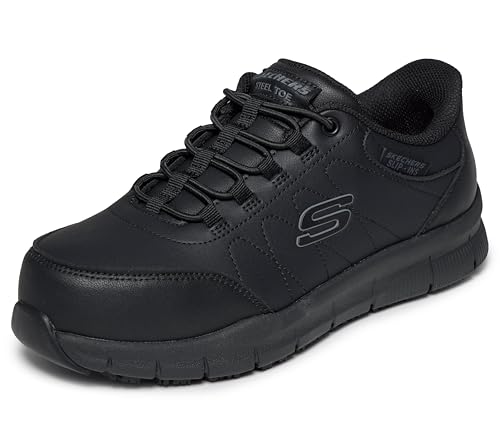
Skechers Slip-ins Work: Nampa - Enelo
Skechers says the steel toe 'meets ASTM F2413 impact and compression standards' and labels the shoe 'ASTM-F2413 Electrical Hazard rated'. The outsole is described as 'Slip-resistant (SRO) rated … for traction on wet, dry, and oily surfaces', without naming the standard. It uses Hands Free Slip-ins with an Air-Cooled Memory Foam insole, at around $85.
Buy it if: Women who want to step in and out fast at breaks and between zones. Skip it if: Your site bans slip-ons or needs a named F3445 slip rating.
- Safety toe
- Steel toe
- Rating line
- Steel safety toe meets ASTM F2413 impact and compression standards. ... ASTM-F2413 Electrical Hazard rated footwear
- Widths
- Medium, Wide
- Maker also claims
- slip-resistant outsole
Specs: Skechers product page (style 108353) (2026-11-09)
6. Best women's shoe with PR and SRO
Xena Workwear Astra Athletic
Xena lists a 'Certified Composite Toe Option (F2413-24)', a 'Puncture Resistant Outsole (PR)' and 'Top Slip Resistant SRO Rated (Dry, Wet, and Oily)'. Watch the colour: Xena says White Gold and Charcoal Gray are SD (static dissipative) and Black Silver is EH. One width only.
Buy it if: Women in distribution centres with oily dock floors and scrap underfoot. Skip it if: You need wide sizes, or EH, and might pick the wrong colourway.
- Safety toe
- Composite toe
- Rating line
- Certified Composite Toe Option (F2413-24); Electrical Hazard (EH) or Static Dissipative (SD) Protection (varies by color); Puncture Resistant Outsole (PR); Top Slip Resistant SRO Rated (Dry, Wet, and Oily)
Specs: Xena Workwear product page (2026-11-09)



Product prices and availability are accurate as of 2026-11-13 and are subject to change. Amazon prices are for the size and colour linked and vary by size. Specs are the makers' published figures; we don't wear-test boots.
Pick your job or the hazards on your site. We turn them into the ASTM F2413 codes a boot must carry, then list the boots in our catalogue whose published rating line includes every one. Your employer's hazard assessment (OSHA 29 CFR 1910.132(d)) has the final word.
A starting point drawn from the hazard examples in OSHA's Appendix B; your employer's hazard assessment decides. OSHA 1910 Subpart I, App. B
Hazards where you work
Your preferences
Codes your boots need
- IThe toe cap is struck by a 50 lb weight with a nominal 75 foot-pounds of energy and must keep a minimum interior clearance. 75 ft-lbf is an energy, not a weight. F2413-18 labels show it as 'I' on line 2 (e.g. 'M/I/C'); F2413-11 labels showed 'I/75'.
- CThe toe cap is squeezed with 2,500 lbf and must keep the same minimum clearance as the impact test. Older editions (F2413-05/-11) also had a lower class 50; OSHA's 2013 interpretation letter notes F2413-05 allowed a minimum of 50.
13 boots in our catalogue match
Skechers Slip-ins Work: Nampa - Enelo
Steel toe · shoe · women's
ICEH
slip-resistant outsole (maker's claim)
Carries I · Carries C
Specs: Skechers product page (style 108353) (2026-11-09)
Skechers Work Relaxed Fit: Cankton ST
Steel toe · shoe · men's
ICEH
Carries I · Carries C
Specs: Skechers product page (style 77055) (2026-11-09)
PUMA Safety ICONIC LOW Safety shoes ASTM EH SR
Composite toe · shoe · men's
ICEHSR
heat-resistant outsole (maker's claim)
Carries I · Carries C
Specs: PUMA Safety product page (Safety class EH; spec list) (2026-11-09)
HEYDUDE Wendy Work CT
Composite toe · shoe · women's
ICEH
slip-resistant outsole (maker's claim)
Carries I · Carries C
Specs: HEYDUDE product page (style 44289) (2026-11-09)
Reebok Work Sublite Cushion Work - RB4041
Alloy toe · shoe · men's
ICEH
slip-resistant outsole (maker's claim)
Carries I · Carries C
Specs: Reebok Work product page (2026-11-09)
Timberland PRO Intercept Steel Toe
Steel toe · shoe · men's
ICEH
slip-resistant outsole (maker's claim)
Carries I · Carries C
Specs: Amazon listing (brand store) (2026-11-09)
Timberland PRO Women's Intercept Steel Toe
Steel toe · shoe · women's
ICEH
slip-resistant outsole (maker's claim)
Carries I · Carries C
Specs: Amazon listing (brand store) (2026-11-09)
Timberland PRO Powertrain Sport Alloy Toe
Alloy toe · shoe · men's
ICEH
slip-resistant outsole (maker's claim)
Carries I · Carries C
Specs: Amazon listing (brand store) (2026-11-09)
New Balance Speedware Comp Toe
Composite toe · shoe · men's
ICEHSRPR
Carries I · Carries C
Specs: Amazon listing (brand store) — New Balance Speedware, style MIDSPWRGR (2026-11-09)
New Balance Fresh Foam Cremorne Mid CT
Composite toe · shoe · men's
ICEHSR
heat-resistant outsole (maker's claim)
Carries I · Carries C
Specs: Amazon listing (brand store) — New Balance Fresh Foam Cremorne Mid CT, style MUFCMCEHCO (2026-11-09)
KEEN Utility Flint Low Steel Toe Work Shoe
Steel toe · shoe · men's
ICEH
slip-resistant outsole (maker's claim)
Carries I · Carries C
Specs: Amazon listing (brand store) (2026-11-09)
Skechers Slip-ins Work: Cankton - Faison
Steel toe · shoe · men's
ICEH
Carries I · Carries C
Specs: Skechers product page (style 200211) (2026-11-09)


Showing the 12 lowest-priced. .
Specs are makers' published figures, linked on every card. Prices as of 2026-11-13; product prices and availability are subject to change. As an Amazon Associate we earn from qualifying purchases.
Why warehouse floors are hard on feet
Concrete doesn't give, so every step on a slab is absorbed by your shoe and your joints. A picker can walk miles a shift, and a packer stands in one spot for hours. Both wear out cheap foam fast. That's why the picks below were chosen on midsole construction as well as safety codes.
The days-away figures show why it's worth getting right. In the same BLS-based analysis, the median days missed after a foot injury varied a lot by industry. Warehousing sits below mining and utilities but is still more than two weeks of lost work per case. The figures cover foot injuries of all causes, not just those a safety shoe prevents, but they show what one dropped pallet or rolled ankle costs.
When you compare makers' cushioning claims, separate the insole from the midsole. An insole is the removable layer under your foot, often memory foam, and it feels soft in the store. The midsole is the foam slab built into the sole, and it does most of the work over a shift. Among our picks, New Balance names an Acteva foam midsole on the Speedware, Reebok Work a Sublite EVA cushion midsole, and Xena an 'Ultra Cushioned Midsole (Anti-Fatigue)' on the Astra. The two Skechers models lead with Memory Foam insoles, and Timberland PRO calls its system 'Anti-Fatigue Technology'. A soft insole on a thin midsole can feel great on day one and flat by week three.
Pallet jacks, cartons and the codes that cover them
OSHA's Appendix B to 29 CFR 1910 Subpart I lists 'shipping and receiving clerks' and 'warehouse laborers' among the jobs where foot protection 'should be routinely considered'. Its examples translate directly to a distribution centre. Our finder's warehouse preset starts from the two that apply almost everywhere.
- Dropped cartons, totes and parts call for I (impact). OSHA: impact protection 'would be required for carrying or handling materials such as packages, objects, parts or heavy tools, which could be dropped'. The test is 75 ft-lbf on the toe cap.
- Pallet jacks, carts and rolls call for C (compression). OSHA names 'skid trucks', 'bulk rolls' and 'heavy pipes', 'all of which could potentially roll over an employee's feet'. The test is 2,500 lbf on the toe cap.
- Staples, banding and pallet nails call for PR if your floor has them. PR is tested at 1,200 N (270 lbf).
- Wet docks, condensation at freezer doors and spilled product call for SR or SRO slip ratings (next section).
- Static-sensitive electronics areas use SD footwear, and only where your employer specifies it. Don't buy SD by accident if you need EH.
Shoes vs boots for warehouse work
For most indoor warehouse work, a safety shoe is the better fit. You don't need ankle-high leather to protect against a carton or a pallet jack wheel: the toe cap does that, and a low-cut shoe is lighter and cooler on a ten-hour shift. New hires' questions on forums are about comfort first; one r/AmazonFC thread is simply titled 'Most comfortable boots you can get from Zappos?'
Boots make sense in a few cases. Outdoor yards and dock aprons get wet and uneven. Freezers and cold docks need insulation that shoes rarely have. Some sites require ankle coverage, for example around order pickers or where you climb on racking. In those cases an athletic-style boot such as New Balance's Calibre, or a mid-height shoe like its Cremorne Mid, sits between the two.
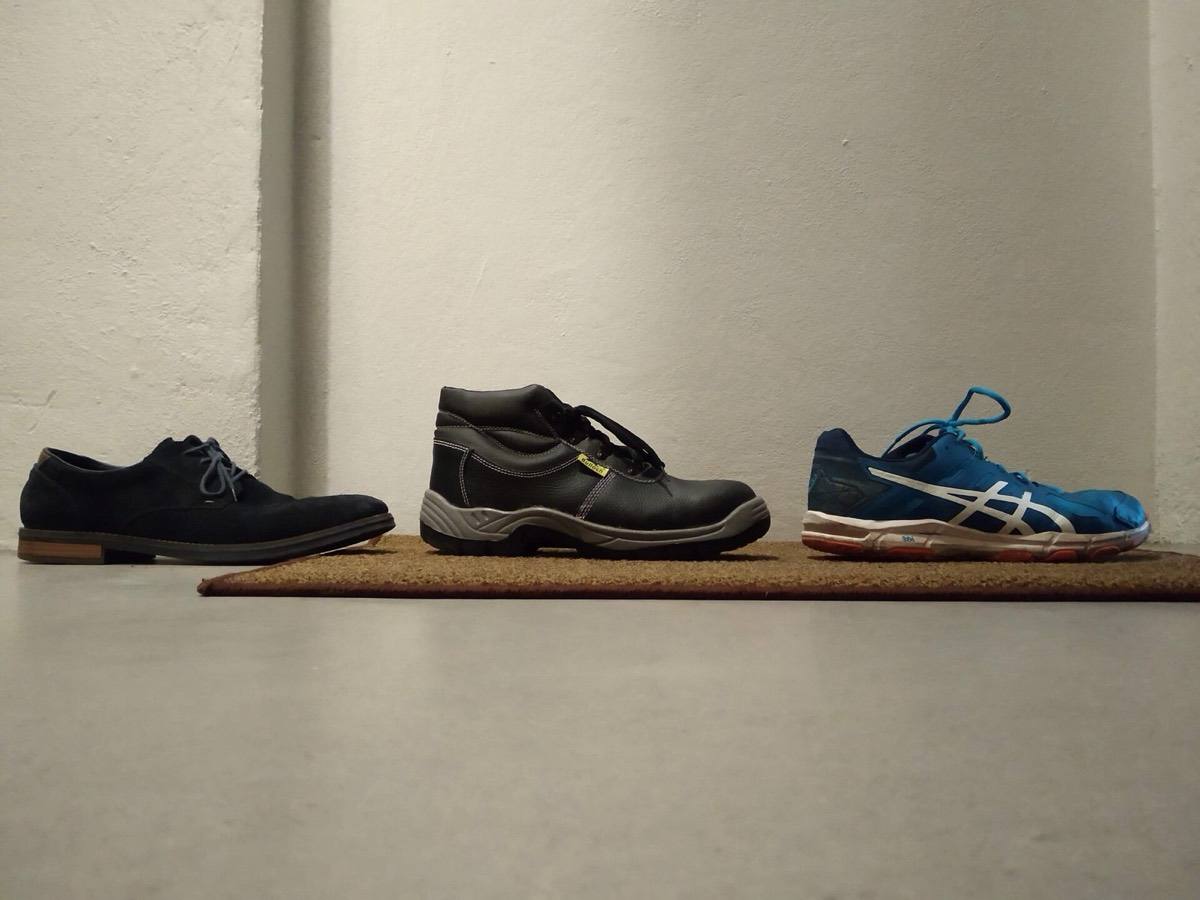
The photo below shows the silhouettes side by side: a casual shoe, a mid-cut safety shoe with a bulkier toe, and a running shoe. The safety shoe's toe box is fuller because the cap needs room. Size by the cap, not by your running shoe size.
Freezer and cold-dock work deserves its own answer. A breathable mesh sneaker that suits an ambient floor will chill your feet in a minus-twenty room. If you split shifts between ambient and cold zones, ask whether your site issues insulated boots for the freezer. Otherwise our insulated work boots guide covers safety-toe boots with published insulation.
Slip ratings: SR, SRO, and what makers actually claim
Slip resistance is optional under ASTM unless a maker claims it. When a maker does test it properly, the standard is ASTM F3445. As SATRA's summary of the 2024 edition explains, SR means a coefficient of friction of at least 0.40 on quarry tile, dry and wet. SRO adds at least 0.33 on oily-wet tile. F2413-24 now refers to SR and SRO on labels. F2913 is the test method used to measure it, not the pass mark.
Most warehouse shoe listings are vaguer than that. 'Slip resistant' with no standard named tells you the maker believes the sole grips, not that it passed a defined test. The table shows how each pick's maker words it. If your site says 'slip-resistant required', ask whether it means a named rating or any claim.
Where it matters most: the threshold of a freezer door, where condensation forms; loading docks in rain; and food or beverage DCs where product leaks onto sealed concrete. Sealed and painted floors can be slick when wet, so an SRO claim is worth paying for there. Check the outsole tread too. Worn-flat lugs lose grip no matter what the label says.
| Pick | Toe | Slip wording as published | Standard named? |
|---|---|---|---|
| New Balance Speedware | Composite | ASTM F2913-19 (SR) | Test method only |
| Reebok Work Sublite Cushion | Alloy | Slip Resistant | No |
| Skechers Cankton | Steel | No slip claim on maker page | No |
| Timberland PRO Powertrain Sport | Alloy | Slip, oil and abrasion resistance | No |
| Skechers Nampa (women's) | Steel | Slip-resistant (SRO) rated: wet, dry, oily | No |
| Xena Astra (women's) | Composite | Top Slip Resistant SRO Rated (Dry, Wet, and Oily) | No |
Five checks before you order
New hires usually have a start date and a deadline, so here's the short version. Run through these before checkout, especially if you're spending a subsidy. When you shortlist the best shoes for warehouse work, these five checks rule out most wrong orders.
- Confirm the rule. Ask HR or your trainer whether a safety toe is required, and whether composite, steel or alloy are all accepted. Some employers publish an approved list.
- Check the label code, not the look. Steel-toe sneakers and plain sneakers can look alike. You want I and C, or wording like 'meets ASTM F2413 impact and compression', on the maker's page.
- Match the width. If your feet swell over a shift, start with models sold in wide (Reebok Work goes to 4E). CCOHS advises trying shoes around midday and not expecting them to stretch.
- Pick the slip level for your floor. Dry and clean: any. Wet docks: SR. Oil or food spills: SRO.
- If you work at Amazon, use the Zappos subsidy. Zappos' Amazon FAQ says new hires get a subsidy code from Amazon, there is a '$110 credit' with any extra paid by you, unused credit 'will expire after 90 days', and the approved list covers composite toe safety shoes. Check your own onboarding paperwork for current terms.
Getting through peak season in one pair
Cushioning wears out before the toe cap does. When the midsole stops springing back, or the heel tilts as you stand, the shoe has stopped doing its concrete job even if it looks fine. Some workers rotate two pairs so each dries out and recovers between shifts. That's a choice, not a rule, but it does spread the wear.
Be careful with gel insoles and orthotics. ASTM F2413-24 says after-market footbeds or inserts could make the ASTM marking invalid, so ask the maker which replacement insoles keep the rating. Replace the shoes after a heavy drop on the toe or a puncture through the sole. CCOHS notes that damage may not be visible, and a cracked composite cap doesn't announce itself.
Small habits help too. Lace the shoe snug across the instep so your foot doesn't slide forward into the cap on ramps. Wear moisture-wicking socks rather than cotton. Retie before peak hours rather than walking on loose laces. These cost nothing and make even the best shoes for warehouse work last longer between replacements. If your site gives an annual subsidy, as the Zappos program does, plan the replacement around the date it renews.
Questions people ask
- Do you need steel toe shoes to work in a warehouse?
- It depends on the employer and the job. OSHA requires protective footwear where there's a danger of foot injury from falling or rolling objects, and its selection guide lists warehouse laborers. Amazon, for one, subsidises approved safety shoes for new hires through Zappos. Where a safety toe is required, it can be steel, composite or alloy.
- Are composite or steel toes better for warehouse work?
- Both pass the same impact and compression tests when the label shows I and C. Composite and alloy caps keep shoes lighter, which helps on long walks. Steel is common in lower-priced models. Pick by weight, fit and price.
- What are the most comfortable shoes for standing on concrete all day?
- Look for a cushioned midsole (EVA, PU or a branded foam), a width that fits you at the end of a shift, and a toe box that doesn't press on the cap. Among our picks, the Reebok Work Sublite Cushion and New Balance Speedware lead on the cushioning their makers describe. Fit counts as much as foam: a well-cushioned shoe that's half a size short will hurt by lunch.
- Can I wear sneakers in a warehouse?
- Only if your employer doesn't require protective footwear for your zone. Ordinary sneakers have no rated toe cap. Safety-toe sneakers with an ASTM F2413 rating give you a protective toe in a sneaker shape. If you're not sure, bring the shoes to orientation and ask before your first shift.
- What shoes can Amazon warehouse workers buy with the Zappos credit?
- Zappos' Amazon FAQ says new hires get a subsidy code from Amazon for an approved selection of composite toe safety shoes, with a $110 credit that expires after 90 days. You pay anything above the credit. Check the approved list on Zappos before you shop.
Sources & further reading
- OSHA 29 CFR 1910 Subpart I, Appendix B
- OSHA 29 CFR 1910.136 Foot protection
- Foot & Ankle Orthopaedics 2022: A Detailed Analysis of Workplace Foot and Ankle Injuries (PMC8795140)
- Thorogood: A Guide to ASTM Ratings and OSHA Work Boots (quotes F2413-18)
- SATRA Bulletin: Updates to US slip resistance standards (Oct 2024)
- ASTM F3445-24 abstract
- ASTM F2413-24 abstract
- CCOHS OSH Answers: Safety Footwear
- Zappos at Work: Amazon FAQ
- Xena Workwear: Astra product page
- Reebok Work: Sublite Cushion Work RB4041 product page
- r/AmazonFC thread on Zappos boots (worker question)
Read next
- Best Work Boots by Trade
Best work boots by trade: construction, electrical, welding, warehouse, food and oil field, with the ASTM codes each job needs and boots that carry them.
- Steel Toe Sneakers
Steel toe sneakers with a published ASTM F2413 rating: 6 true steel-toe shoes, 2 alloy options, the label check that separates safety shoes from look-alikes.
- Comfortable Steel Toe Shoes
Comfortable steel toe shoes start with fit: toe room, the right width and a footbed you can change safely. What makers build in, plus picks for long shifts.
- Composite Toe Shoes
Composite toe shoes compared on makers' published ASTM F2413 lines: 5 low-cut shoes and 4 low boots, what composite means, EH vs SD, and when a boot is better.
- Waterproof Work Boots
Waterproof work boots with safety toes, sorted by how each maker keeps water out: membrane, sealed seams, waterproof leather or rubber. 7 picks, 30 compared.
Part of Best Work Boots by Trade. Back to the The Boot Yard home page.
The Boot Yard editors · Editorial team
The Boot Yard's catalogue and guides are compiled by the site's editorial team from makers' published product pages, ASTM F2413 rating lines and OSHA's foot-protection rules. We do not wear-test boots, and we never claim to: every spec on the site links to the page it came from.
About this site · How pages are checked · Last updated November 8, 2026
As an Amazon Associate, The Boot Yard earns from qualifying purchases. It costs you nothing extra and never decides which boots we list.
The Boot Yard is an independent site. It is not affiliated with ASTM International, OSHA or any boot brand. Brand names and trademarks belong to their owners. Our guides explain published standards; your employer's safety program and the boot's own label decide what you must wear.