Section
Best Work Boots by Trade: The Codes Each Job Needs, Then the Boots
By The Boot Yard editors · Updated 2026-11-08 · How we research
We may earn a commission when you buy through links on this page.
Short answer
The best work boots carry every code your trade's hazards call for. Typical starting points: construction, I and C plus PR where nails lie underfoot; electricians, EH; welding and foundry work, Mt; warehouses, I and C in a lighter shoe; food plants and oil fields, a tested slip rating. Your employer's hazard assessment decides.
The best work boots look different from one job to the next. A framer on a slab steps on dropped nails. An electrician kneels beside open panels. A welder has hot plate and steel off-cuts landing near the laces. A picker walks miles of concrete beside pallet jacks. A line worker in a meat plant stands on a floor that is hosed down every shift. Each of those scenes points to different codes on the boot's label.
This page works in that order: trade first, then the ASTM F2413 codes that the trade's hazards map to, then boots from our 60-model catalogue that carry every one of those codes. The hazard-to-code mapping comes from the examples in OSHA's Appendix B selection guide. It is a starting point, not a ruling: your employer's hazard assessment decides what is required on your site.
The finder below does the same thing interactively. Pick your job, add any extra hazards, and it shows only the boots whose published rating carries all of them.
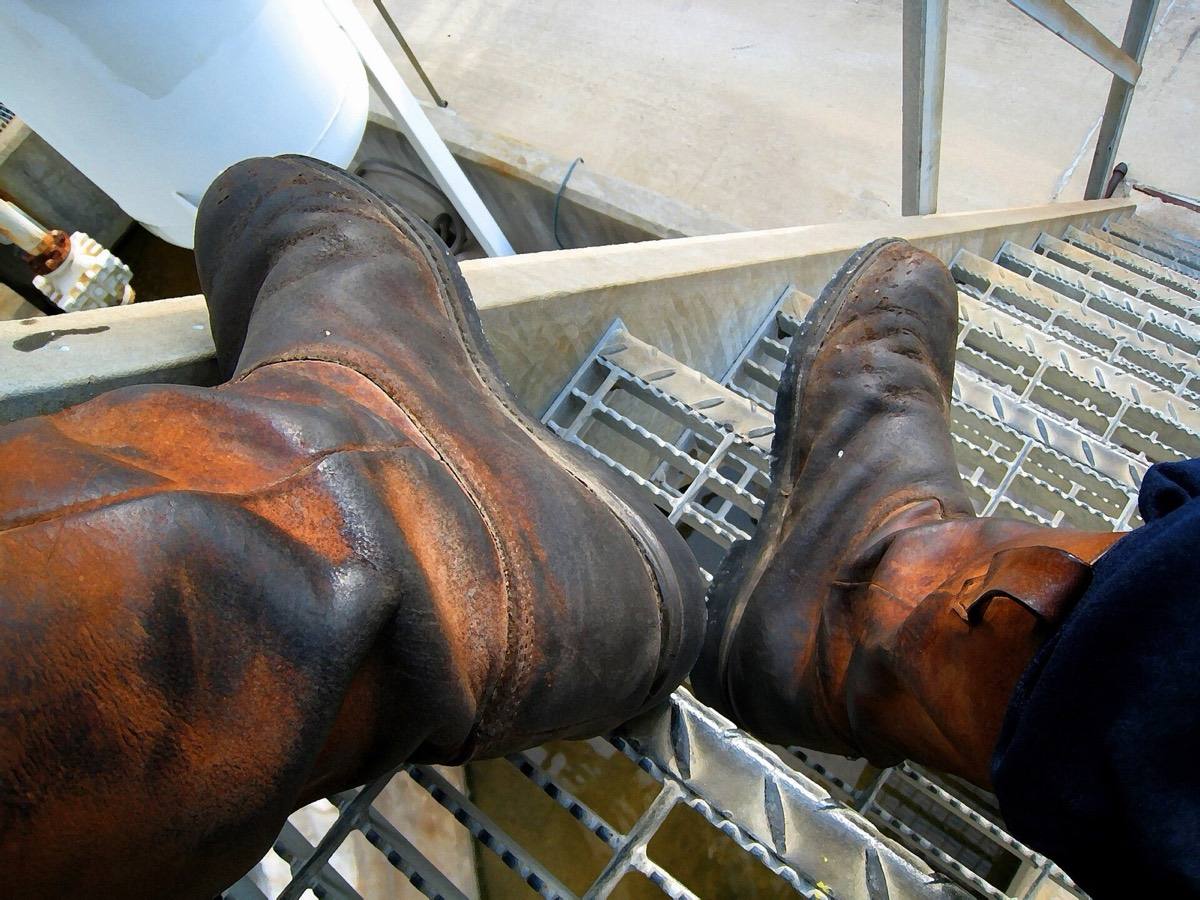
One pick per trade
1. Construction and heavy sites
Timberland PRO Endurance 6" Steel Toe Puncture Resistant External Met Guard
One of only four models in our catalogue with a puncture-resistant plate, and the only one that also has a met guard. Timberland PRO's listing says the toe meets ASTM F2413-18 I and C, the external met guard meets F2413-18 and CSA Z195-14, and the flexible steel plate meets ASTM F2892-18 PR.
Buy it if: Framing, demolition and rebar work where nails underfoot and falling material are both real. Skip it if: You need EH: the listing does not mention electrical hazard.
- Safety toe
- Steel toe
- Height
- 6 in
- Met guard
- external
- Maker also claims
- slip-resistant outsole
Specs: Amazon listing (brand store) (2026-11-09)
2. Electricians
Carolina 28 Series: 6" Waterproof Work Boot (Comp Toe)
A composite toe that Carolina says meets ASTM F2413-18 for compression and impact, an electrical hazard rating Carolina describes as tested at 18,000 volts at 60 Hz for one minute, a Scubaliner waterproof lining, and D, 2E and 4E widths, the widest run in our catalogue.
Buy it if: Building-trades electricians who want no metal cap and need width. Skip it if: Your employer wants a printed rating line; Carolina publishes the codes as separate statements.
- Safety toe
- Composite toe
- Height
- 6 in
- Waterproof
- Waterproof Scubaliner™ (Carolina's proprietary waterproof lining system)
- Construction
- welt
- Widths
- D, 2E, 4E
Specs: Carolina Shoe product page (2026-11-09)
3. Welding and fabrication
Wolverine Raider DuraShocks® Waterproof 6" Met-Guard Work Boot
Wolverine's line reads "ASTM F2413 M/I/C EH rated Mt EH rated CarbonMAX composite-toe": toe, metatarsal and EH, with a TPU met guard on the upper, a waterproof membrane and ContourWelt construction.
Buy it if: Shop welders and fitters handling plate, pipe and castings. Skip it if: You prefer an internal guard; KEEN's Evanston Int Met is the alternative.
- Safety toe
- Composite toe
- Rating line
- ASTM F2413 M/I/C EH rated Mt EH rated CarbonMAX® composite-toe
- Height
- 6 in
- Waterproof
- Breathable waterproof membrane with moisture wicking mesh lining; waterproof full-grain leather upper
- Construction
- ContourWelt
- Widths
- M, EW
Specs: Wolverine product page (2026-11-09)
4. Warehouse and manufacturing
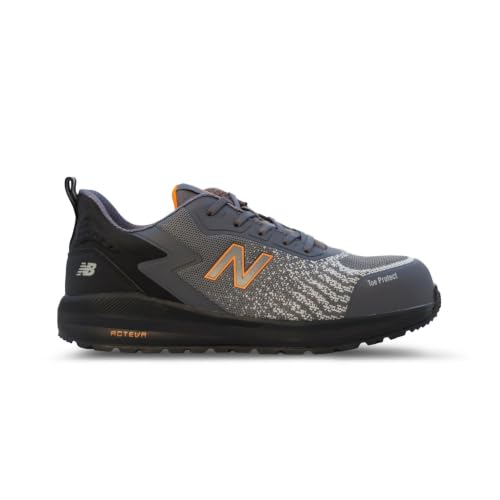
New Balance Speedware Comp Toe
A lace-up safety shoe that New Balance's brand listing says "meets or exceeds ASTM Specification F2413-18 I/75 C/75", with EH, a slip test to ASTM F2913-19 and an anti-perforation midsole (PR). Sold in standard and wide.
Buy it if: Pickers, packers and machine operators covering miles on concrete where a shoe is allowed. Skip it if: Ankle support or wet floors matter; it is a low shoe and only water resistant.
- Safety toe
- Composite toe
- Rating line
- meets or exceeds ASTM Specification F2413-18 I/75 C/75, ASTM F2412-18a (EH) ASTM F2913-19 (SR)
- Widths
- D (M), Wide
Specs: Amazon listing (brand store) — New Balance Speedware, style MIDSPWRGR (2026-11-09)
5. Food plants, dairies and wash-down
Muck Boot Company Chore Classic Men's Steel Toe Boot
A 16-inch rubber pull-on that Muck says is certified for impact and compression, ASTM certified against electrical hazard and "ASTM F3445 slip-resisting", with a 5 mm neoprene bootie and a steel shank.
Buy it if: Wet, hosed-down floors where leather never dries. Skip it if: You need a tested oily-floor rating (SRO); Muck states SR-level F3445 only.
- Safety toe
- Steel toe
- Rating line
- CERTIFIED IMPACT & COMPRESSION (ASTM OR CAN/CSA); ASTM Certified Against Electrical Hazard; ASTM F3445 slip-resisting
- Height
- 16 in
- Waterproof
- 100% Waterproof, 100% MUCKPROOF
- Widths
- Medium (D)
Specs: Muck Boot Company product page (style CHS000A) (2026-11-09); Amazon listing (brand store) — rating line only (2026-11-09)
6. Electronics assembly (SD)
Xena Workwear Astra Athletic
The only static-dissipative model in our catalogue. Xena lists a composite toe certified to F2413-24, a puncture-resistant outsole and an SRO slip rating for dry, wet and oily floors; the White Gold and Charcoal Gray colourways are SD, while Black Silver is the EH version.
Buy it if: Clean electronics work where static must bleed to ground, in a women's athletic shoe. Skip it if: You need EH: buy the Black Silver colourway instead, never SD near live conductors.
- Safety toe
- Composite toe
- Rating line
- Certified Composite Toe Option (F2413-24); Electrical Hazard (EH) or Static Dissipative (SD) Protection (varies by color); Puncture Resistant Outsole (PR); Top Slip Resistant SRO Rated (Dry, Wet, and Oily)
Specs: Xena Workwear product page (2026-11-09)




Product prices and availability are accurate as of 2026-11-13 and are subject to change. Amazon prices are for the size and colour linked and vary by size. Specs are the makers' published figures; we don't wear-test boots.
Pick your job or the hazards on your site. We turn them into the ASTM F2413 codes a boot must carry, then list the boots in our catalogue whose published rating line includes every one. Your employer's hazard assessment (OSHA 29 CFR 1910.132(d)) has the final word.
Hazards where you work
Your preferences
Codes your boots need
- IThe toe cap is struck by a 50 lb weight with a nominal 75 foot-pounds of energy and must keep a minimum interior clearance. 75 ft-lbf is an energy, not a weight. F2413-18 labels show it as 'I' on line 2 (e.g. 'M/I/C'); F2413-11 labels showed 'I/75'.
- CThe toe cap is squeezed with 2,500 lbf and must keep the same minimum clearance as the impact test. Older editions (F2413-05/-11) also had a lower class 50; OSHA's 2013 interpretation letter notes F2413-05 allowed a minimum of 50.
All 60 boots below meet the basic impact and compression tests. Pick your job or hazards to narrow them.
Nortiv 8 [Paladin-Steel] Men's Non-Slip Steel-Toe Work Boots
Steel toe · boot · men's
IC
slip-resistant outsole (maker's claim)
Carries I · Carries C
Specs: nortiv8.com product page (JS19004M-STEEL) (2026-11-09)
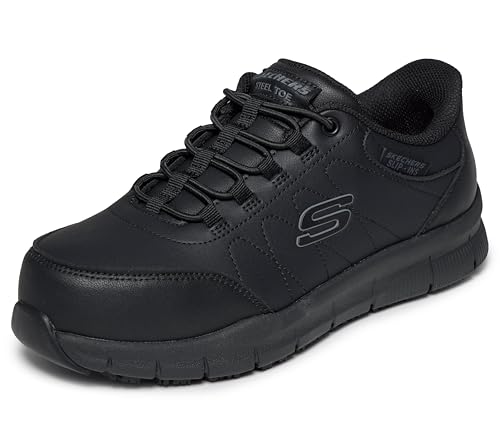
Skechers Slip-ins Work: Nampa - Enelo
Steel toe · shoe · women's
ICEH
slip-resistant outsole (maker's claim)
Carries I · Carries C
Specs: Skechers product page (style 108353) (2026-11-09)
Skechers Work Relaxed Fit: Cankton ST
Steel toe · shoe · men's
ICEH
Carries I · Carries C
Specs: Skechers product page (style 77055) (2026-11-09)
PUMA Safety ICONIC LOW Safety shoes ASTM EH SR
Composite toe · shoe · men's
ICEHSR
heat-resistant outsole (maker's claim)
Carries I · Carries C
Specs: PUMA Safety product page (Safety class EH; spec list) (2026-11-09)
Skechers Work: Rotund - Darragh ST
Steel toe · boot · 4 in · women's
ICEH
slip-resistant outsole (maker's claim)
Carries I · Carries C
Specs: Skechers product page (style 108055) (2026-11-09)
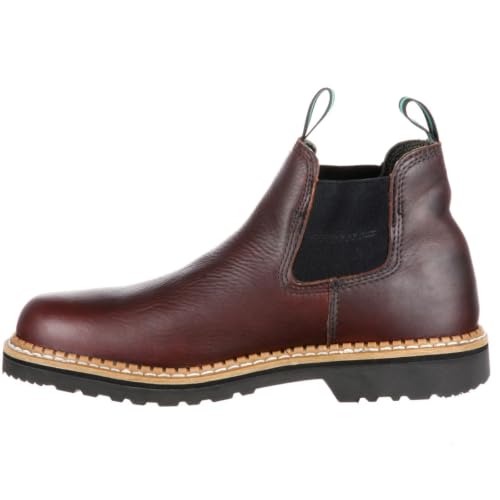
Georgia Boot Georgia Giant Waterproof Steel Toe Chelsea
Steel toe · chelsea · 5 in · men's · waterproof
ICEH
slip-resistant outsole (maker's claim)
Carries I · Carries C
Specs: Georgia Boot product page (2026-11-09)
CAT Footwear Striver Steel Toe Work Boot
Steel toe · boot · men's
ICEH
slip-resistant outsole (maker's claim)
Carries I · Carries C
Specs: Cat Footwear product page (2026-11-09)
CAT Footwear Echo Waterproof Steel Toe Work Boot
Steel toe · boot · 8 in · women's · waterproof
ICEH
slip-resistant outsole (maker's claim)
Carries I · Carries C
Specs: Cat Footwear product page (2026-11-09)
HEYDUDE Wendy Work CT
Composite toe · shoe · women's
ICEH
slip-resistant outsole (maker's claim)
Carries I · Carries C
Specs: HEYDUDE product page (style 44289) (2026-11-09)
Reebok Work Sublite Cushion Work - RB4041
Alloy toe · shoe · men's
ICEH
slip-resistant outsole (maker's claim)
Carries I · Carries C
Specs: Reebok Work product page (2026-11-09)
Georgia Boot Georgia Boot Steel Toe Waterproof Logger Boot
Steel toe · logger · 8 in · men's · waterproof
ICEH
Carries I · Carries C
Specs: Georgia Boot product page (2026-11-09)
Timberland PRO Intercept Steel Toe
Steel toe · shoe · men's
ICEH
slip-resistant outsole (maker's claim)
Carries I · Carries C
Specs: Amazon listing (brand store) (2026-11-09)





Showing the 12 lowest-priced. .
Specs are makers' published figures, linked on every card. Prices as of 2026-11-13; product prices and availability are subject to change. As an Amazon Associate we earn from qualifying purchases.
Ten trades and the codes they point to
The right-hand column is the useful one. It counts the boots in our catalogue whose maker lists every code in that row. Toe protection (I and C) is universal, so the narrowing comes from the extras. Slip counts include makers' own slip claims; only 11 of the 60 models name the test standard behind the claim (ASTM F3445 or F2913).
Two rows stand out. Welding and foundry work narrow the field to three boots, because so few makers build a metatarsal guard in. Construction and machine-shop work narrow it to four once puncture protection is added. If your site needs one of those codes, the shortlist is short, and the deciding factor becomes fit: whether the maker publishes a width for your foot.
The opposite happens for electricians and warehouse staff. With EH on 54 models and I and C on all 60, the codes no longer narrow anything. That is when build questions take over: boot or shoe, waterproof or not, steel or non-metal cap, lace-up or pull-on. The trade sections below suggest which of those matter for each job.
| Trade | Main hazards | Codes | Catalogue boots with all codes |
|---|---|---|---|
| Construction, framing, concrete | Dropped objects, rolling loads, nails underfoot | I, C, PR | 4 |
| Electrician (building trades) | Dropped objects, live circuits | I, C, EH | 54 |
| Welding, fabrication | Dropped objects, top-of-foot strikes | I, C, Mt | 3 |
| Foundry, steel mill | Dropped and rolling loads, top-of-foot strikes | I, C, Mt | 3 |
| Warehouse, distribution | Dropped objects, carts and pallet jacks | I, C | 60 |
| Manufacturing, machine shop | Dropped and rolling loads, scrap underfoot | I, C, PR | 4 |
| Electronics assembly | Dropped objects, static discharge | I, C, SD | 1 |
| Explosives, volatile chemicals | Dropped objects, static ignition | I, C, Cd | 0 |
| Food processing | Dropped objects, wet or oily floors | I, C, SR | 49 |
| Oil field, refinery | Dropped and rolling loads, oily floors | I, C, SR | 49 |
Construction: puncture protection is the gap
OSHA's Appendix B says puncture protection would be required "where sharp objects such as nails, wire, tacks, screws, large staples, scrap metal etc., could be stepped on", and CCOHS points construction workers to its green-triangle boots (puncture plate plus Grade 1 toe) where nails are present. Yet only 4 of our 60 models list PR. Most work boots, including many sold for construction, protect the toes and nothing underneath.

- Codes: I and C for dropped and rolling loads, PR for nails and screws underfoot.
- Federal rule: the construction standard, 1926.96, references only the ANSI Z41.1-1967 safety-toe standard. It says nothing about puncture or slip resistance, so PR comes from your site's hazard assessment, not from 1926.96.
- Build: a lugged outsole for mud and rubble, a welted or well-bonded sole, and a shaft tall enough for uneven ground.
- Picks with PR: Timberland PRO Endurance 6" (steel, external met, PR plate) and New Balance Calibre (composite boot, EH, PR, slip-tested to F2913-19).
Electricians: EH, kept dry and in good repair
EH is common: 54 of our 60 models list it. So the choice comes down to fit, toe material and build, not to finding the code.
- Codes: I and C, plus EH where the hazard assessment finds electrical hazards.
- What EH is: a dry-condition proof test at 18,000 V, 60 Hz, for one minute with no more than 1.0 mA of leakage (Thorogood, quoting F2413-18). It is secondary protection for an accidental step on a live conductor, not a rating for working live.
- What weakens it: CCOHS says shock resistance deteriorates with wear and in a wet environment. Worn-through soles, embedded metal and wet boots all reduce it.
- What to avoid: SD and conductive (Cd) footwear, which CCOHS says should not be used where contact with live conductors can occur.
- Who pays: OSHA's 2013 letter says that if the hazard assessment finds electrical hazards and the employer selects EH footwear rated beyond a normal safety-toe boot, the employer must provide it at no cost.
- Toe choice: steel caps can be EH-rated; composite caps are not EH-rated by default. Read the label either way.
Welding and foundry: protect the top of the foot
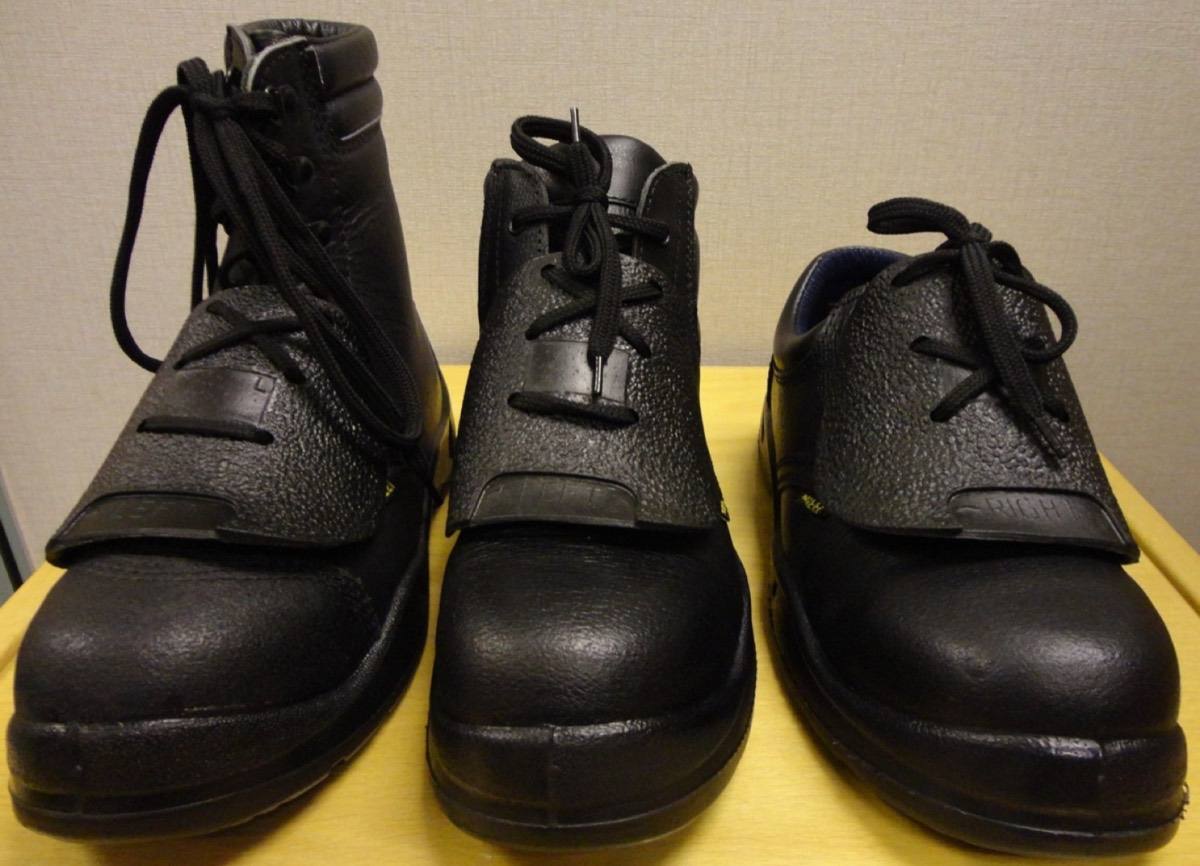
In welding and foundry work, the danger is often not the toe at all but the long bones on top of the foot. OSHA's Appendix B says that "in some work situations, metatarsal protection should be provided", and CCOHS's M marking is for environments where heavy objects can hurt the metatarsal region. The Mt test drops a 75 ft-lb impact 3.5 in back from the toe and requires 1.0 in of clearance in men's footwear (0.937 in women's).
Only three catalogue models carry Mt: the Timberland PRO Endurance (external guard), the KEEN Evanston Int Met (internal guard, carbon toe) and the Wolverine Raider DuraShocks (composite toe, TPU met guard). External guards are visible and easy to inspect; internal guards sit under the upper and snag less.
Heat matters too. Several makers claim heat-resistant outsoles (KEEN and Carhartt quote 572°F/300°C on some models, Irish Setter 475°F), but those are makers' claims, not ASTM F2413 codes. If your employer provides clip-on met guards and you ask for boots with built-in guards instead, 1910.132(h)(3) says the employer does not have to pay for the boots.
Warehouse and machine shops: light, wide, compression-rated
Appendix B names skid trucks, bulk rolls and heavy pipe as reasons for compression protection, which covers most warehouse work: pallet jacks and carts rolling over feet, cartons and parts dropped on toes. Every safety toe carries C, so the decision is about the walk, not the code.
Shoes beat boots here when the employer allows them. Our catalogue has athletic-style safety shoes from New Balance, Timberland PRO, Reebok Work, Skechers Work and PUMA Safety, with alloy, composite or steel caps. If your shop floor has metal shavings or scrap, add PR, which narrows the field to four models, two of them New Balance.
Walking distance is the hidden hazard in warehouse work. Nothing in ASTM F2413 measures cushioning or weight, so read what the maker publishes about midsole and footbed, and remember that swapping in an after-market insole can void the ASTM marking unless the maker approves it.
- New Balance Speedware (composite, EH, PR, F2913-19 slip test): low lace-up, standard and wide.
- Timberland PRO Powertrain Sport (alloy, EH): athletic shoe with a polyurethane outsole.
- Reebok Work Sublite Cushion (alloy, EH): M, W and 4E, with what Reebok calls an extra-wide toe.
- Skechers Work Cankton (steel, EH): Relaxed Fit last; Skechers makes no slip claim on this model.
- PUMA Safety Iconic Low (composite-fiberglass, EH): suede upper, 572° heat-resistant outsole per PUMA.
Food plants and oil fields: check the slip line
Wet and oily floors call for slip resistance, and this is where labels mislead most often. A maker can describe an outsole as slip-resistant without testing it to any standard. The ASTM test is F3445: SR means a coefficient of friction of at least 0.40 on dry and water-wet quarry tile, and SRO, added in 2024, also requires at least 0.33 on oily-wet tile (SATRA). Slip resistance is not part of the compulsory toe tests.
For food plants with hosed floors, tall rubber safety boots such as the Muck Chore Classic make more sense than leather. For oil fields and refineries, look for a line that names F3445, or the older F2913 test method, rather than an adjective. Among our models, KEEN, Carhartt, New Balance, PUMA Safety, Muck and Brunt name a slip standard; Xena states an SRO rating for dry, wet and oily surfaces.
Leather and wash-down floors do not mix for long. Water and cleaning chemicals work into stitching and the upper, and waterproofing claims on leather boots are about rain and puddles, not daily hosing. Plants that run wet all shift usually standardise on rubber; plants that are only damp near the line often accept a leather boot with a tested slip rating.
Trade guides in this section
Each trade above has a page of its own with more picks and the details that only matter to that job. The electrician boots page compares EH-rated boots by toe material and width. Welding boots covers spatter, heat-resistant outsoles and lace protection. Met guard boots puts internal and external guards side by side. Construction boots explains puncture plates in depth. The warehouse page focuses on shoes built for long walks on concrete.
If you would rather choose by build than by trade, the best steel toe boots hub sorts picks by waterproofing, toe material, slip-on and western styles. And if the codes are new to you, the safety toe boots hub explains each one with its test value. Whichever route you take, the best work boots for you are the ones whose label your supervisor can read and approve.
Every page in this section
- Best Shoes for Warehouse Work
Best shoes for warehouse work, chosen by label: safety toe for pallet jacks and dropped cartons, SR vs SRO slip codes, shoes vs boots, and six cushioned picks.
- Construction Boots
Construction boots for new and working tradespeople: which ASTM codes a site calls for, what PR puncture resistance means, mud and ladder features, and 7 picks.
- Electrician Boots
Electrician boots need an EH line on the label, not just a composite toe. What the 18,000 V test covers, EH vs SD vs Cd, lineman boots and six EH-rated picks.
- Met Guard Boots
Met guard boots explained: what the ASTM Mt test measures, internal vs external guards, when OSHA expects one, who pays for built-in guards, and three picks.
- Welding Boots
Welding boots compared by hazard: safety toe, no exposed laces, met guards and heat-resistant soles, with each maker's own heat rating and six picks.
Questions people ask
- What are the top 5 best work boots?
- There is no single top five, because a boot that suits a framer can be wrong for an electrician or a welder. Start from your trade's codes in the table above. For a general safety-toe boot, our best steel toe boots page has eight picks with their rating lines.
- Do construction workers need puncture-resistant boots?
- The federal construction rule, 1926.96, only references safety toes. Puncture resistance is required where your employer's hazard assessment finds nails, screws or scrap that could be stepped on, as OSHA's Appendix B describes. Many sites require it, so ask.
- Are EH boots safe for working on live circuits?
- No. EH is secondary protection against an accidental step on a live conductor, proof-tested on dry boots. It is not a substitute for de-energizing, insulated tools or dielectric equipment, and it weakens with wear and wetness.
- Can I wear safety shoes instead of boots at work?
- Usually, if your employer allows it. OSHA's rule is about protection, not height: a low shoe that meets ASTM F2413 protects the toes the same way. Some sites require boots for ankle support or because of mud, chemicals or met hazards.
Sources & further reading
- OSHA 1910 Subpart I, Appendix B (selection guidelines)
- OSHA 29 CFR 1910.136 Foot protection
- OSHA 29 CFR 1926.96 (construction)
- OSHA 29 CFR 1910.132 (h) payment for PPE
- OSHA interpretation letter, 2013-12-09 (EH footwear payment)
- Thorogood: A Guide to ASTM Ratings and OSHA Work Boots
- CCOHS OSH Answers: Safety Footwear
- SATRA: Updates to US slip resistance standards (2024)
- Carolina 28 Series 6" Composite Toe
- Wolverine Raider DuraShocks Met Guard
- r/electricians thread on work boots (worker opinion)
Read next
- Electrician Boots
Electrician boots need an EH line on the label, not just a composite toe. What the 18,000 V test covers, EH vs SD vs Cd, lineman boots and six EH-rated picks.
- Welding Boots
Welding boots compared by hazard: safety toe, no exposed laces, met guards and heat-resistant soles, with each maker's own heat rating and six picks.
- Met Guard Boots
Met guard boots explained: what the ASTM Mt test measures, internal vs external guards, when OSHA expects one, who pays for built-in guards, and three picks.
- Construction Boots
Construction boots for new and working tradespeople: which ASTM codes a site calls for, what PR puncture resistance means, mud and ladder features, and 7 picks.
- Best Shoes for Warehouse Work
Best shoes for warehouse work, chosen by label: safety toe for pallet jacks and dropped cartons, SR vs SRO slip codes, shoes vs boots, and six cushioned picks.
- Best Steel Toe Boots
Best steel toe boots for 2026: 8 picks across budget, waterproof, metal-free, EH, met guard, women's, slip-on and western, each with its published ASTM line.
Back to the The Boot Yard home page.

The Boot Yard editors · Editorial team
The Boot Yard's catalogue and guides are compiled by the site's editorial team from makers' published product pages, ASTM F2413 rating lines and OSHA's foot-protection rules. We do not wear-test boots, and we never claim to: every spec on the site links to the page it came from.
About this site · How pages are checked · Last updated November 8, 2026
As an Amazon Associate, The Boot Yard earns from qualifying purchases. It costs you nothing extra and never decides which boots we list.
The Boot Yard is an independent site. It is not affiliated with ASTM International, OSHA or any boot brand. Brand names and trademarks belong to their owners. Our guides explain published standards; your employer's safety program and the boot's own label decide what you must wear.